

A commercial roof rarely fails without warning. What costs owners and asset managers real money is not the defect itself – it is missing the early signs, accepting vague advice, or waiting until water ingress turns a manageable issue into an operational problem. The top commercial roof risk indicators are usually visible well before a major leak, compliance issue or capital shock lands on your desk.
For portfolios, schools, hospitals, industrial facilities and large-format commercial assets, roof risk is not a maintenance side issue. It affects business continuity, procurement leverage, insurance exposure, tenant satisfaction and capital planning. If the roof is carrying hidden defects, the building is carrying hidden liability.
Why top commercial roof risk indicators matter
Most roofing problems are expensive because they sit unresolved for too long. Water can travel, concealment is common, and contractor opinions often vary depending on what they want to sell. That is exactly why risk indicators matter. They create an evidence base before decisions are locked in.
A stain on an internal ceiling is not the risk indicator that matters most. By that point, the roof has usually been underperforming for some time. The stronger indicators are often found on the roof surface, at penetrations, in drainage design, around plant, and in the pattern of recurring defects across the asset.
1. Persistent ponding and slow drainage
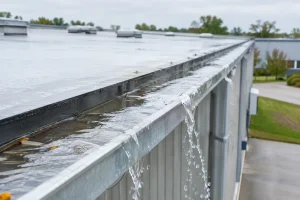
If water is sitting on a commercial roof well after rainfall, treat it as a structural and waterproofing warning, not a cosmetic issue. Persistent ponding accelerates membrane deterioration, increases contamination build-up, raises the chance of overflow events and can expose design or construction shortfalls in falls, outlets or overflow provision.
Not every instance of residual water means imminent failure. Some roof systems tolerate minor short-term ponding better than others. But where ponding is frequent, widespread or linked to blocked outlets, crushed insulation, sagging substrate or poor detailing, the risk profile changes quickly. On occupied assets, drainage failure is one of the fastest ways to turn a manageable defect into a disruption event.
2. Repeated patch repairs in the same locations
A roof that has been patched multiple times around the same lap, penetration, box gutter or flashing detail is telling you something. Repetition usually means the root cause has not been addressed. It may be movement, poor substrate preparation, incompatible materials, inadequate termination, or a broader failure pattern in the roof assembly.
This is where commercial judgment matters. A single repair is normal. A repair history concentrated in the same zone is a risk indicator because it points to systemic weakness, not bad luck. It also makes budgeting harder, because reactive spend can continue without improving actual performance.
3. Membrane stress, shrinkage or open laps
Membranes do not need to be visibly torn apart to create major risk. Early warning signs often include shrinkage at terminations, fishmouths at laps, ridging, blisters, lifting edges and stress at internal corners. These details matter because roofs usually fail at interfaces and transitions before they fail in the middle of a field area.
In Australian conditions, heat load and UV exposure can accelerate this process, particularly where specification, installation quality or maintenance access has been poor. The commercial issue is not simply whether a leak exists today. It is whether the roof assembly is losing resilience and moving towards broader failure.
4. Flashing defects around penetrations and rooftop plant
Penetrations are predictable failure points. Mechanical services, conduits, pipework, solar supports and platform fixings all interrupt waterproofing continuity. When flashings are poorly detailed, retrofitted badly, or disturbed by later trades, the risk extends beyond isolated leakage. It can affect warranties, contractor accountability and future remedial scope.
This is one of the most common blind spots on large assets. The roof may appear serviceable from ground level, while the actual defects sit under plant, behind upturns or around cluttered service zones. If multiple trades have accessed the roof over time, expect risk to be concentrated where nobody has owned the waterproofing outcome.
5. Corrosion in sheeting, gutters and fixings
Corrosion is not just a material issue. It is a signal that moisture, contamination, dissimilar metals, coating breakdown or drainage defects are already in play. On metal roofs, corrosion around laps, fasteners, penetrations and gutter lines often points to a combination of age, poor maintenance and environmental exposure.
The severity depends on location and extent. Surface corrosion may be manageable within a maintenance program. Advanced corrosion at structural supports, concealed gutters, box gutters or fixings can carry a much sharper risk, especially where water discharge is compromised. Once corrosion begins to affect holding strength or waterproofing continuity, the conversation moves from upkeep to asset exposure.
6. Internal signs that do not match the reported roof condition
When tenants, facility teams or maintenance staff report recurring leaks but inspection notes continue to describe the roof as broadly sound, that mismatch is itself a risk indicator. Either the symptoms are being misdiagnosed, or the inspection process is not identifying the real failure mechanism.
This matters in dispute settings, handovers and budget reviews. If the narrative around roof condition is too optimistic, capital decisions can be delayed until the evidence becomes impossible to ignore. Independent assessment is critical here because it separates observable fact from commercial positioning.
Top commercial roof risk indicators in ageing assets
Age alone does not condemn a roof. Plenty of systems perform well beyond their nominal design life if detailing, drainage and maintenance have been managed properly. But ageing assets do have a higher probability of concealed defects, material fatigue and cumulative workmanship issues from successive interventions.
The strongest indicators in older roofs are usually patterns rather than single defects. Recurring leaks after rain events, membrane repairs across multiple areas, ponding linked to settlement, brittle sealants, cracked cappings and ad hoc modifications by different trades all suggest the roof may be approaching a tipping point. That does not always mean immediate replacement. It often means the asset needs a clear condition baseline before more money is spent blindly.
7. Uncontrolled roof traffic and maintenance damage
A roof with no visible access strategy usually ends up paying for it. Uncontrolled traffic causes punctures, crushed insulation, dislodged flashings and damage around service routes. The risk rises sharply on buildings with frequent HVAC maintenance, communications equipment, or multiple service contractors attending site.
This is often underestimated because the damage appears minor at first. But repeated foot traffic changes how roofs drain, how membranes sit, and how details perform under movement. If there are no defined walkways, no protection around plant and no clear access controls, the roof is being used harder than it was designed to be.
8. Poor detailing at roof-to-wall and edge conditions
Perimeters and junctions carry disproportionate risk. Upturn terminations, parapet interfaces, cappings, edge restraints and façade connections all need to cope with weather, movement and water management at once. When these details are weak, even a decent field membrane or roof sheet profile can be undermined.
The commercial problem is that edge condition failures often lead to disputed responsibility between trades. Roofing, cladding, hydraulic and services scopes can overlap badly. If the detail was wrong at design stage or diluted during construction, the defect may persist through multiple repair attempts unless someone assesses the whole interface properly.
9. Reporting that describes defects without ranking risk
One of the clearest top commercial roof risk indicators is not on the roof at all. It sits in the reporting. If inspection reports list defects but do not prioritise them by consequence, urgency and likely failure pathway, decision-makers are left with technical noise instead of control.
A useful roof report should tell you what matters now, what can wait, what needs monitoring and what is likely to drive future capital expenditure. Without that structure, even competent observations can produce poor decisions. The issue is not information scarcity. It is lack of commercial clarity.
What these indicators mean for budgeting and procurement
Roof risk is not linear. A defect that looks small can carry a high consequence if it threatens a critical tenancy, hospital operation, compliance obligation or warranty position. On the other hand, some visible defects are better handled through planned maintenance than rushed replacement. That is why blanket rules are dangerous.
The right response depends on context – asset age, occupancy profile, building use, rainfall exposure, access limitations, maintenance history and the cost of failure. For owners and managers, the real value lies in knowing which risks deserve immediate action and which ones require monitoring, design review or staged capital planning.
This is where an independent consultant changes the quality of decision-making. Roof Inspection Australia does not sell repairs or replacement systems. That matters because the findings are not shaped around winning follow-on works. They are shaped around evidence, accountability and protecting the client’s position.
If a roof is showing these indicators, the smartest move is not to wait for a bigger leak or a louder contractor opinion. It is to get the facts early, while you still have options, leverage and budget control.