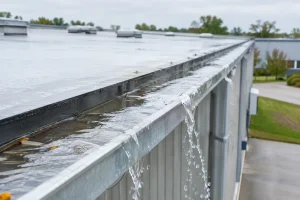




A box gutter rarely fails without warning. The warning signs are usually there first – ponding after rain, staining to internal walls, rust at joints, membrane splits, blocked sumps, overflow marks and water tracking where it should never be. The problem is that many of those signs are either missed, downplayed or bundled into a generic roof report that does not properly test the risk. A proper box gutter inspection is not a housekeeping exercise. It is a risk assessment for one of the most failure-prone drainage elements on a commercial roof.
For owners, asset managers and facility teams, that distinction matters. Box gutters sit at the point where rainfall concentration, movement joints, thermal stress, sheet interfaces, membrane details and drainage capacity all collide. When they fail, the result is rarely isolated. Water moves into insulation, ceilings, services, wall cavities and occupied areas. The repair bill is one issue. Business interruption, tenant claims, compliance exposure and premature capital works are usually the bigger one.
Why box gutter inspection matters more on commercial assets
On a commercial building, a box gutter is often expected to carry significant water volumes across long runs and toward limited discharge points. That creates a narrow tolerance for defects. Minor falls issues, localised deformation, debris loading or undersized outlets can turn into overflow during a heavy rain event. On paper, the system may look adequate. In service, many are not.
This is where contractor-led opinions often fall short. If the same party inspecting the gutter also wants to sell the repair, the diagnosis can be shaped by scope opportunity rather than evidence. Sometimes the issue is exaggerated to justify replacement. Just as often, the root cause is glossed over and a surface patch is sold instead. Neither outcome gives the client control.
An independent inspection changes the conversation. It separates defect identification from repair revenue. That means the focus stays where it should – actual condition, probable failure modes, consequence of inaction and the most commercially sensible response.
What a box gutter inspection should actually assess
A useful inspection goes well beyond spotting leaf litter and obvious rust. It needs to examine whether the gutter can perform under realistic conditions, not just whether it looks acceptable on a dry day.
Drainage performance and fall
Water should move efficiently to outlets without prolonged ponding. In reality, many box gutters have inadequate fall, settlement-related backfall, distorted trays or local sagging around supports. Persistent ponding accelerates corrosion, increases debris accumulation and places more pressure on laps, seams and membrane terminations.
A competent inspection looks at the overall drainage path, not just the outlet itself. If water has to fight its way to the sump, the system is already compromised.
Material condition and joint integrity
Metal box gutters commonly deteriorate at laps, welds, brackets, corners and discharge points. Membrane-lined box gutters often fail at terminations, penetrations and changes in direction. Surface coatings can conceal early-stage deterioration, so visual review needs to be informed by experience rather than assumption.
The question is not simply whether corrosion exists. It is whether the corrosion is cosmetic, progressive or structurally significant. That difference affects both urgency and budget.
Capacity, overflow and discharge design
Some gutters are defective because they are damaged. Others were never well designed in the first place. Undersized gutters, poor outlet spacing, inadequate overflow provisions and awkward transitions can all create systemic risk even when the materials are relatively new.
This matters during storms, when a gutter may need to cope with high-intensity rainfall and partial blockage at the same time. If there is no safe overflow path, water will find another route – usually into the building.
Interfaces with the roof system
Box gutters do not fail in isolation. Edge details, roof sheeting laps, flashings, parapets, rainheads, penetrations and adjacent waterproofing all influence performance. A leak blamed on the gutter may originate from a flashing junction. A gutter that repeatedly blocks may be receiving debris from poorly managed roof access or adjacent plant.
Inspection needs to read the whole drainage zone, not just the channel itself. Otherwise the report becomes technically neat and practically useless.
Common defects found during box gutter inspection
Across commercial and industrial assets, the same patterns come up repeatedly. Debris and organic growth are common, but they are usually the symptom, not the full story. The more serious findings include failed joints, corrosion beneath accumulated sediment, insufficient fall, blocked or poorly located outlets, damaged membrane lining, ineffective overflow measures, movement-related splitting and prior patch repairs that have simply pushed the problem downstream.
Another frequent issue is mismatch between maintenance records and actual condition. A site may show regular cleaning attendance, yet the gutter still presents active overflow risk because the underlying design or structural geometry was never corrected. Cleaning has a role, but it is not a substitute for diagnosis.
This is why box gutter inspection should never be reduced to a maintenance checkbox. If the purpose is to protect budgets and avoid failure, the inspection needs to distinguish serviceable condition from recurring liability.
When to inspect and when to escalate
Not every asset needs the same inspection frequency. It depends on building use, roof complexity, gutter design, surrounding vegetation, rainfall exposure, access conditions and consequence of failure. A logistics warehouse with critical stock, a hospital plant area and a school building with ageing roof drainage do not carry the same tolerance for risk.
As a general rule, box gutters should be inspected before and after peak wet weather periods, after major storm events, at handover of new works, before warranty expiry and whenever leak patterns suggest drainage failure rather than isolated waterproofing defects. Older assets, buildings with known ponding history and sites with repeated internal water ingress should be prioritised.
Escalation is warranted when defects suggest systemic failure rather than local deterioration. That includes chronic ponding, active corrosion at multiple points, overflow evidence, substrate movement, repeated patching history or any condition likely to affect occupied areas or critical operations.
Why reporting quality matters
A vague inspection note such as “gutter requires maintenance” is not enough for commercial decision-making. It does not tell an asset manager whether the issue is cosmetic, operational or a precursor to major capital spend. It does not help a facilities team challenge a contractor quote. It does not support procurement, budgeting or stakeholder communication.
Good reporting is specific. It records the defect location, extent, probable cause, consequence, urgency and recommended next step. It should distinguish maintenance items from repair items and repair items from replacement triggers. It should also identify where further investigation is needed because visible symptoms may not reveal the full extent of damage.
That level of clarity creates leverage. It gives owners and managers a factual basis for action rather than a sales script dressed up as advice.
Independent inspection protects more than the roof
The commercial value of an independent box gutter inspection is not limited to leak prevention. It protects procurement decisions, maintenance planning and capital allocation. It also reduces the chance of being pushed into reactive works that treat symptoms while leaving the core defect untouched.
For new builds and recent refurbishments, independent review can be even more valuable. Box gutters are often assumed to be compliant because they are new. That assumption is expensive. Design shortcuts, buildability compromises, poor falls, incomplete terminations and weak quality control can all be present from day one. If these issues are not identified early, they become the owner’s problem as soon as the defect liability window narrows.
This is where a specialist consultant adds real value. Roof Inspection Australia does not sell repairs, replacements or products. That matters because the advice is not trying to lead the client toward a preselected outcome. It is there to expose the truth, document the risk and help the asset owner make a commercially defensible decision.
What clients should expect from the process
A proper inspection should start with context – building use, known leak history, previous repairs, original construction type, drainage layout and any constraints around access or operations. Site observations should then test visible condition against likely performance risk. Where necessary, the findings should challenge assumptions about whether the issue is maintenance-related, workmanship-related or design-related.
The final output should not bury the key point under technical filler. Commercial clients need to know three things clearly: what is wrong, how serious it is, and what should happen next. If an inspection cannot answer those questions, it has not done its job.
Box gutters are easy to ignore when the weather is fine and expensive to ignore when it is not. The smartest time to inspect them is before they prove the point for you.