
A roof starts costing serious money well before it fails. The real issue for commercial owners and asset managers is not whether defects exist. It is whether those defects justify roof repair or replacement, and whether the recommendation in front of you is technically sound or commercially convenient for the party giving it.
That distinction matters. In the commercial market, roofing advice is often bundled with a sales objective. A contractor may lean towards replacement because that is where margin sits. Another may patch the problem because it wins a quick job, even when the roof system is already at the end of its useful life. Neither position is automatically wrong. But neither should be accepted without evidence.
Roof repair or replacement is a risk decision first
Too many roofing decisions are framed as a simple cost comparison. Repair is cheaper now. Replacement is dearer now. That is not analysis. That is arithmetic without context.
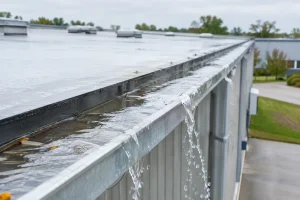
For commercial assets, the better question is this: what option gives you the strongest control over risk, cost, compliance and building performance over the next one, three and ten years? A low-cost repair can be the most expensive decision on the page if it leaves active water entry, concealed corrosion, membrane failure, drainage defects or repeat access costs unresolved.
On the other hand, full replacement can be a poor capital decision if the roof has substantial remaining service life and the real problem is localised failure, poor detailing, isolated storm damage or neglected maintenance. The point is simple – the right answer depends on condition, not sales pressure.
What actually determines whether repair is still viable
Repair remains viable when the roof system is fundamentally serviceable and the defects are specific, accessible and technically fixable. That usually means the substrate is stable, corrosion is not widespread, moisture intrusion is limited, drainage paths can be corrected, and previous repairs have not created a patchwork of incompatible materials or workmanship risks.
In these cases, targeted repair can protect budget without gambling on performance. But viable repair still requires discipline. Commercial roofs fail repeatedly when people treat symptoms instead of causes. A leak showing internally at one penetration may trace back to ponding, failed laps, blocked drainage, thermal movement, deteriorated sealants or unsafe detailing elsewhere. If the diagnostic work is weak, the repair scope will be weak too.
This is where a proper condition assessment earns its keep. Decision-makers need to know not just where water is appearing, but why the roof is behaving that way, how far the issue extends, and what residual life remains after repair.
Signs repair may be the right commercial move
A repair-led strategy is often justified when defects are localised, the roof age is consistent with remaining life expectancy, moisture damage is not systemic, and the repair methodology can be clearly documented and quality-controlled.
It also makes sense when the asset is heading for redevelopment, when budget timing matters, or when staged capital planning is preferable to immediate replacement. There is nothing wrong with deferring replacement if the decision is informed, documented and tied to a realistic risk profile. What matters is knowing the cost of deferral, not pretending there is none.
When replacement stops being optional
There is a point where repair becomes theatre. The roof gets patched, the invoices keep coming, and the risk never really leaves the building. For large assets, that pattern is more than frustrating. It undermines capital planning, disrupts operations and makes stakeholder reporting harder than it needs to be.
Replacement is usually the defensible option when failure is widespread, the roof system is beyond expected service life, defects are recurring across multiple zones, drainage design is fundamentally poor, or deterioration has reached the substrate, insulation or structural support elements. It is also often necessary when compliance, warranty, access safety or tenant risk cannot be properly managed under a repair-only approach.
A roof does not need to be collapsing to justify replacement. If maintaining it requires repeated emergency attendance, reactive patching and ongoing internal damage control, the asset is already paying the price of delay.
Signs replacement is likely the stronger decision
Repeated leaks in different locations, chronic ponding, extensive corrosion, membrane embrittlement, failed flashings across the roofscape, widespread fastener fatigue, and evidence of long-term water tracking are all indicators that spot repair may no longer be commercially credible.
The same applies when previous repair history shows no stable outcome. If you have years of call-outs and no durable performance improvement, the roof is telling you something. Listen to the evidence, not the optimism.
The hidden cost problem in roof decisions
The repair quote and the replacement quote are rarely the full financial picture. Commercial clients know this, but roofing scopes still get assessed too narrowly.
The true cost of a failing roof includes internal damage, business interruption, tenant complaints, mould risk, access equipment, traffic management, contractor mobilisation, make-safe works, consultant time, dispute management and the internal labour spent dealing with repeat incidents. For healthcare, education, logistics and government assets, the operational consequences can dwarf the roofing line item.
That is why cheap repairs can become expensive fast. If each patch buys only a short period of reduced risk, you are not preserving capital. You are spreading failure across multiple budgets.
Equally, replacement without proper scoping can destroy value. Poor design detailing, unrealistic staging, bad assumptions about existing conditions, and weak QA during delivery can leave clients paying premium dollars for a roof that inherits the same defects in a different form. New does not automatically mean right.
Why contractor advice needs testing
This is the uncomfortable part. The party recommending the work often stands to profit from the recommendation. That does not make every contractor untrustworthy. It means their advice should be verified before major decisions are made.
Commercial roofing is full of grey zones. Two people can inspect the same roof and propose very different paths. One sees salvageable life. Another sees replacement. The difference may come down to experience, methodology, product familiarity or commercial motive.
Independent review changes the leverage. It gives asset owners and facility teams evidence to challenge vague claims, test the necessity of full replacement, and identify when a repair scope is little more than a holding pattern. It also helps procurement teams compare bids on technical merit, not just price.
Roof Inspection Australia operates in that exact space. We do not sell roofing. We just tell clients what the roof is doing, what it is likely to do next, and what decision is easiest to defend when budgets, risk and accountability are on the table.
How to assess roof repair or replacement properly
A sound decision starts with condition, not quotes. The roof needs to be inspected as a system, not as a collection of visible defects. That means looking at coverings, laps, penetrations, flashings, drainage, falls, waterproofing interfaces, corrosion patterns, moisture pathways, maintenance history and any signs of movement or design weakness.
From there, the assessment should separate urgent defects from strategic issues. Some items need immediate action because they present active leakage or safety risk. Others shape lifecycle planning because they indicate declining performance over time. Mixing those together creates poor decisions. A roof can need urgent repair now and still be a replacement candidate within a planned future window.
The next step is scenario testing. What is the likely outcome if you repair only the active failures? What if you undertake broader remedial works? What if you stage replacement by zone? Good advice should show the trade-offs clearly – capital outlay, operational impact, likely service life, residual risk and procurement implications.
That level of clarity matters for boards, asset committees, government stakeholders and facilities teams who need more than a verbal recommendation. They need a position they can defend.
The best answer is often staged, not absolute
Some roofs clearly warrant repair. Some clearly warrant replacement. Many sit in the middle.
For portfolio owners and large facilities, the smartest option is often staged intervention. That may involve immediate defect rectification to control leakage, short-term maintenance to stabilise performance, and scheduled replacement of the worst zones based on condition priority. It may also involve design review before any capital works proceed, especially where drainage or detailing failures are embedded in the original build.
This approach is not about avoiding the hard call. It is about matching expenditure to evidence. If replacement is required, do it with clear scope, proper oversight and quality control. If repair is sufficient, make sure the repair is solving the real problem and not simply buying another wet season of uncertainty.
The roof does not care about internal budget politics, optimistic contractor language or delayed decision-making. It responds to condition, weather and physics. The more honestly you assess those factors, the easier it becomes to choose a path that protects both the asset and the people responsible for it.