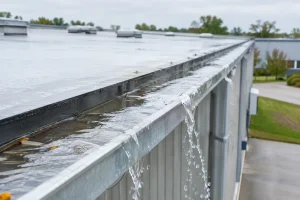




A commercial roof rarely fails all at once. It leaks in one zone, ponds in another, blisters near penetrations, and starts a budget problem long before it becomes a replacement project. That is why roof lifecycle planning matters. For asset managers, facility teams, and property owners, the real issue is not just roof condition. It is timing, evidence, and control.
Too many roofing decisions are still made in reaction to the loudest problem or the most confident contractor. That is a weak position to manage from. If you are responsible for a hospital, logistics facility, school, retail centre, or government asset, you need a clearer view than that. You need to know what the roof is doing now, what it is likely to do next, and what that means for maintenance budgets, operational risk, and capital planning.
What roof lifecycle planning actually means
Roof lifecycle planning is the process of assessing a roof as an asset, not a one-off defect. It looks at age, construction type, drainage behaviour, waterproofing performance, defect history, environmental exposure, maintenance quality, and replacement timing. The objective is straightforward – reduce surprise, extend useful life where sensible, and avoid spending capital too early or too late.
That sounds simple, but the commercial consequences are significant. Spend too late and the asset starts dictating your budget through leaks, damaged interiors, disrupted operations, mould risk, and emergency call-outs. Spend too early and you may replace a roof that still had years of serviceable life left in it. Both outcomes are expensive. Neither is good asset management.
A proper lifecycle plan does not rely on broad assumptions like “20-year roof” or “end of warranty means end of life”. Roofing systems do not age neatly. Two buildings completed in the same year can perform very differently depending on detailing, installation quality, foot traffic, maintenance history, plant integration, and drainage design. One roof might justify targeted remediation and another might already be carrying hidden failure risk behind a clean-looking surface.
Why contractor-led advice often distorts lifecycle decisions
This is where many portfolios lose money. If the person assessing the roof also sells the repair scope, the replacement system, or the maintenance contract, the advice is never truly neutral. That does not mean every contractor is wrong. It means the commercial incentive is obvious.
Lifecycle planning needs independence because the decision is rarely binary. A roof may need immediate defect rectification in one section, monitoring in another, and no intervention at all elsewhere. It may have recoverable service life if drainage is corrected and flashings are rebuilt. It may also be beyond economical repair, even if local patching still appears possible. These are judgement calls that should be made against evidence, not sales targets.
Independent assessment gives decision-makers leverage. It allows you to challenge inflated scopes, separate urgent risks from routine ageing, and stage works based on actual condition. That is how capital planning becomes defensible.
The inputs that make roof lifecycle planning useful
A lifecycle plan is only as good as the inspection and analysis behind it. Age alone is not enough. Neither is a quick walkover with a few photos. Useful planning comes from understanding how the roof was built, how it has been altered, where moisture and movement are occurring, and which defects are cosmetic versus structurally or operationally significant.
For most commercial assets, the core inputs include membrane or sheet condition, laps and joints, flashings, penetrations, drainage capacity, falls, ponding behaviour, edge details, plant supports, previous repairs, coating performance, signs of moisture ingress, and any safety or access limitations affecting maintenance. The building use also matters. A leak over a warehouse aisle is one thing. A leak over a switch room, theatre, ward, data room, or food production line is another.
Climate exposure has to be considered as well. Australian roofs deal with high UV, thermal movement, heavy rainfall events, wind uplift risk, and in some locations salt exposure. A plan that ignores local conditions is not a plan. It is paperwork.
Roof lifecycle planning is about timing, not just condition
One of the biggest mistakes in roofing is assuming that condition rating alone tells you what to do next. It does not. A roof in fair condition might still justify immediate action if the defects are concentrated around critical areas, if water is entering concealed cavities, or if a tenant fitout is about to increase consequence of failure. On the other hand, a roof with visible ageing may still be stable enough for staged maintenance if the deterioration is predictable and drainage is functioning properly.
This is why lifecycle planning needs a forward view. Not just what is wrong today, but what is likely within 12, 24, and 60 months if no action is taken. That is the difference between maintenance planning and crisis management.
For portfolio owners, the timing question is even more important. You are not planning one roof in isolation. You are balancing competing capex demands across multiple assets. A useful lifecycle plan helps rank interventions by risk, consequence, and remaining service life so the budget goes where it protects the most value.
What a good lifecycle plan should tell you
A credible plan should give you more than a defect list. It should tell you the likely remaining service life range, the major failure drivers, the immediate defects that need attention, and the difference between maintenance, remediation, and replacement pathways.
It should also identify uncertainty. If access constraints, concealed construction, water testing results, or historical records limit confidence, that needs to be stated plainly. False certainty is dangerous. Good advice is clear about what is known, what is probable, and what still needs verification.
Commercially, the plan should support procurement and budget conversations. That means staged recommendations, rough timing windows, and enough technical reasoning to justify action to executives, finance teams, insurers, or government stakeholders. If the report cannot support a decision, it is not doing its job.
The trade-offs asset owners need to face
There is no universal rule for whether to maintain, remediate, restore, or replace. It depends on consequence of failure, roof complexity, occupancy sensitivity, budget cycles, and how many times the system has already been patched.
For example, extending life through targeted remediation can be the right move when defects are localised, substrate condition is still sound, and drainage improvements can materially reduce stress on the system. It can be the wrong move when the roof has chronic detailing issues, widespread wet insulation, repeated leak history, or so many incompatible repairs that future performance becomes difficult to predict.
Likewise, full replacement is not always the conservative option. It may solve one set of problems while creating others through operational disruption, access constraints, weather exposure during works, and contractor interface risk. Sometimes the better commercial decision is staged replacement aligned with lease events, shutdown periods, or broader redevelopment plans.
That is why blunt advice fails. The right answer comes from balancing technical condition with business consequence.
Why annual reviews matter even with a long-term plan
A lifecycle plan is not a document you produce once and file away. Roofs change. New plant gets installed. Trade traffic damages flashings. Drainage points block. Temporary fixes become permanent. Storm events expose weaknesses that were not visible in dry conditions.
Annual or periodic review keeps the plan honest. It allows you to test whether deterioration is tracking as expected, whether maintenance works were effective, and whether replacement timing needs to move forward or back. That review cycle is where cost control happens. It stops minor defects from compounding into major claims and stops old assumptions from driving new expenditure.
For high-value assets, this kind of independent oversight is not overkill. It is basic risk management.
Where roof lifecycle planning creates leverage
The real value of roof lifecycle planning is not technical for its own sake. It is commercial leverage. It gives you evidence before tendering, clarity before approving capital, and a stronger position when a contractor recommends major works. It helps reduce waste, improve scope accuracy, and explain decisions internally with confidence.
That matters at handover, during disputes, before acquisitions, and across live portfolios where every unplanned roof failure can trigger wider cost. Roof Inspection Australia works in that space because owners and asset teams do not need another sales pitch. They need facts that stand up under pressure.
If your roofing strategy starts with who wants the work, you are already on the back foot. Start with the condition, the risks, and the decision path instead. A roof does not care about budget cycles, but good planning does.