

A roof does not need to collapse to become a major asset problem. More often, it fails slowly – through ponding, saturated insulation, membrane fatigue, blocked drainage, poor penetrations, and handover defects that sit unnoticed until the cost lands in your budget. That is why an asset manager roof risk guide matters. Roof risk is rarely just a maintenance issue. It is a capital planning issue, a compliance issue, a tenant risk issue, and in many portfolios, a governance issue.
For asset managers, the real problem is not simply water ingress. It is poor visibility. If your understanding of roof condition comes from reactive callouts, contractor opinions, or ageing reports with no clear action pathway, you are managing spend after the damage has already started. That is not control. That is drift.
What roof risk actually looks like in a portfolio
Roof risk is often misunderstood because the visible leak is treated as the event. In reality, the leak is usually the lagging indicator. The earlier indicators are more useful – deteriorating sheet laps, movement at joints, failed sealants, corrosion at fixings, membrane stress around plant, chronic drainage issues, non-compliant details, and maintenance practices that solve symptoms while leaving the cause in place.
Across commercial and institutional assets, roof risk also behaves differently depending on the building type. A logistics facility may tolerate cosmetic deterioration for years, then suffer a major operational impact when a storm exposes drainage failures over stock or automation systems. A healthcare or education asset may face a lower threshold for disruption because moisture ingress affects hygiene, safety, service continuity, and stakeholder scrutiny. A CBD commercial office may carry greater reputational and leasing consequences than the physical defect alone would suggest.
That is the first principle of any asset manager roof risk guide – the same defect does not carry the same consequence on every asset. Condition matters, but consequence matters just as much.
The asset manager roof risk guide starts with evidence
If you want defensible decisions, start with independent evidence. Contractor-led roof opinions can be useful, but they are not neutral. If the same party diagnosing the issue also stands to win repair or replacement work, you do not have a clean advisory process. You have a commercial incentive sitting inside the recommendation.
Independent inspection changes the quality of the decision. It separates fact from sales. It gives asset managers a documented basis to challenge inflated scopes, question premature replacement, and identify where a cheaper repair is false economy.
A sound inspection process should do more than name defects. It should establish extent, likely cause, urgency, consequence, and practical treatment pathways. It should also distinguish between isolated defects and system-level failure. That distinction protects budgets. If a roof has localised issues that can be managed through targeted remediation, a blanket replacement recommendation may be commercially lazy. On the other hand, if defects are repeated across the roof build-up, patching can become a costly delay tactic.
Where portfolios lose money
Most overspend is not caused by one dramatic event. It comes from three quieter failures.
The first is deferred diagnosis. The issue is known, but no one has established root cause. Maintenance funds keep getting spent on attendance, sealants, and minor works while moisture continues to track through the assembly.
The second is poor scope definition. A contractor is engaged to fix a leak, but the actual problem sits in drainage design, incompatible materials, movement, or a broader installation defect. The wrong scope creates repeat expenditure and contractor disputes.
The third is capital planning without condition certainty. Roof replacement is often treated as a timing decision based on age, not evidence. Age matters, but roofs do not fail on schedule. Exposure, traffic, detailing, prior workmanship, maintenance quality, and plant penetrations can move one roof well ahead of another built in the same year.
For asset managers carrying multiple sites, this is where the numbers get distorted. Capex forecasts become rough allowances rather than risk-based plans. High-risk assets do not get prioritised early enough, while lower-risk assets attract unnecessary spend because nobody has tested the assumptions.
How to assess roof risk properly
An effective roof risk review should answer a commercial question, not just a technical one. You are not asking whether the roof is perfect. You are asking what defects exist, what they mean, how likely they are to worsen, and what action best protects the asset.
Condition is only one part of the picture
Physical condition is the starting point, but not the whole story. A roof with moderate wear over a low-consequence storage area may be a lower priority than a roof with isolated but critical defects above a data room, theatre, operating space, or public interface. Asset managers need triage logic, not just defect lists.
Drainage deserves more attention than it gets
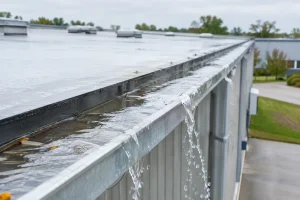
Drainage failures are a repeat offender across Australian assets. Blocked outlets, insufficient falls, undersized overflows, poor discharge detailing, and localised ponding do not always create immediate leaks, but they accelerate deterioration and increase storm vulnerability. They also turn a manageable roof into a claims problem after heavy rainfall.
If drainage has not been properly reviewed, the roof has not been properly assessed.
Handover and warranty assumptions can be dangerous
Newer roofs are not automatically low risk. In fact, some of the most expensive disputes start with recent works. Handover defects, incomplete commissioning, undocumented variations, and warranty language that looks reassuring but proves narrow in practice can all leave asset owners exposed. A new roof without independent review may simply be a new defect profile waiting to emerge.
Using the asset manager roof risk guide to control contractors
Good roof reporting gives you leverage. That matters when competing contractor opinions start to diverge or when a large replacement proposal arrives with very little supporting detail.
Independent technical evidence changes the conversation from opinion to proof. It allows you to ask better questions. Is the failure local or widespread? What test evidence supports moisture spread? Are the recommended works addressing cause or only symptoms? Is staging possible? What is the consequence of deferral for six, twelve, or twenty-four months?
This is where commercially sharp reporting matters. The best advice is not the most technical. It is the clearest. Asset managers need findings they can use with procurement teams, executives, owners, and boards. If a report cannot support funding decisions or contractor challenge, it has limited value no matter how many photos it contains.
What a practical risk framework looks like
The strongest roof strategies usually group assets by a mix of condition, consequence, and intervention timing. Some roofs need immediate action because failure is active and impact is high. Some need planned remediation within the current budget cycle. Others need monitoring, maintenance tightening, and a defined trigger for future capex.
That approach avoids two common mistakes. One is panic spending after a leak event. The other is false comfort based on age or the absence of reported internal water ingress. Neither gives you a reliable picture.
For most portfolios, the sensible framework includes current condition evidence, defect severity, consequence by building use, maintenance history, known drainage or waterproofing weaknesses, likely remaining service life, and an intervention pathway linked to cost and urgency. That is how roof risk becomes manageable rather than reactive.
Why independence matters more when budgets tighten
When budgets are under pressure, roof decisions become harder, not simpler. Every recommendation needs to stand up to scrutiny. If you are being asked to approve major remediation or replacement, you need confidence that the scope is necessary, proportionate, and timed correctly.
That is exactly where an independent consultant earns their place. Roof Inspection Australia operates on that basis – no repair agenda, no product agenda, no interest in selling the outcome. That model matters because it protects the decision itself. When the advice is clean, your budget strategy is stronger and your contractor management gets sharper.
There is also a less obvious benefit. Independent inspection helps asset managers communicate risk without exaggeration. Not every defect is a crisis. Some can be managed safely with monitoring and targeted works. Others need urgent action because delay increases both cost and exposure. Clear third-party advice makes that distinction easier to explain internally.
The real objective is not a perfect roof
The real objective is control. You want enough truth, early enough, to make the right call before a minor defect becomes an operational problem or a budget shock. That means seeing beyond leak reports, beyond age assumptions, and beyond contractor sales language.
A good roof strategy does not start when water hits the floor. It starts when someone asks for evidence before approving spend. That question alone can save a portfolio a significant amount of money – and a great deal of avoidable grief.