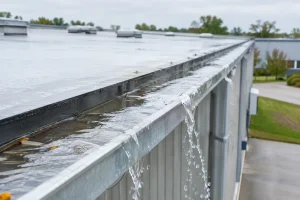




A roof handover inspection is where risk either gets contained or quietly transferred to the owner. By the time a commercial roof reaches practical completion, everyone wants the job closed out, the paperwork signed, and the retention released. That is exactly why defects get missed. Not because they are invisible, but because pressure, assumptions and incomplete verification let them slide.
For asset managers, developers and facilities teams, handover is not an admin step. It is the last real point of leverage before roofing defects become your maintenance problem, your tenant issue and your capital spend. Once the contract is closed and the contractor has moved on, the cost of proving responsibility goes up fast.
What a roof handover inspection is actually for
A proper roof handover inspection is not a courtesy walkover and it is not a box-ticking exercise against a glossy defects list. Its job is to test whether the installed roof system matches the design intent, complies with relevant requirements, drains as it should, and is fit for service under real operating conditions.
That means looking beyond obvious workmanship issues. The most expensive failures are often not dramatic on day one. They sit in details – incomplete terminations, poor laps, unsupported penetrations, blocked or underperforming drainage, membrane damage, missing sealant, incorrect fixings, inadequate flashings, ponding risk and unfinished interfaces with plant or facade elements. A roof can look complete from ground level and still be carrying latent defects that will show up in the first summer storm or after the first maintenance contractor walks across it.
The commercial value of the inspection is simple. It gives the owner independent evidence before final acceptance. That evidence matters when you need the builder or roofing contractor to rectify defects, complete omitted work or clarify warranty obligations.
Why contractor sign-off is not enough
Builders and roofing contractors have a role in quality control. They do not have independence. That is not a moral judgement. It is a commercial fact.
When the same party that installed the roof is also telling you it is ready for handover, there is an obvious conflict. Their objective is to close the project. Yours is to inherit an asset that will perform. Those goals overlap, but not perfectly.
This is where independent review changes the balance. An external consultant who does not sell repairs, products or replacement work has no reason to soften findings. That matters most on large commercial assets where a small defect at handover can become a large dispute later. We do not sell roofing. We just tell you the truth.
What should be checked during a roof handover inspection?
The answer depends on roof type, access, use of the building, exposure conditions and the contract scope. A newly completed membrane roof on a healthcare facility should not be assessed in exactly the same way as a metal roof replacement on a logistics shed. Still, there are common areas that should always be reviewed.
Workmanship and system integrity
The inspection should assess whether the installed system reflects the approved scope and whether workmanship is consistent across field areas, edges, penetrations, upturns and transitions. This includes checking laps, fixings, flashings, sealant application, terminations and protection of vulnerable areas.
It also means testing the logic of the build. Roof failures often begin where trades intersect. Mechanical plant, solar framing, cable trays, access systems and facade details can compromise an otherwise sound roof if interfaces have been handled poorly.
Drainage and falls
Drainage is where many handovers fall short. A roof may be technically complete yet still hold water, surcharge outlets or direct flow toward vulnerable details. On commercial buildings, poor drainage does not stay a roofing issue for long. It becomes a safety issue, a maintenance issue and eventually a structural or internal damage issue.
A roof handover inspection should assess falls, outlet placement, overflow provision, evidence of ponding risk, debris management and whether the drainage design is likely to perform under actual site conditions rather than theoretical drawings.
Penetrations, plant and traffic impacts
Penetrations are predictable weak points. If they are not detailed properly, they become repeat leak locations. The same applies to roof-mounted plant and service access routes. If people are going to walk the roof, the handover should verify whether the system is protected for that use.
This is where many defects are not defects in the narrow sense, but design or coordination failures that create future defects. That distinction is irrelevant to the owner. If the roof leaks around new plant six months after handover, the commercial impact is the same.
Documentation and warranty alignment
A completed roof is not properly handed over without proper records. That includes as-built information, warranty documents, maintenance requirements, product data where relevant and evidence that the installed scope aligns with what is being warranted.
This point gets overlooked. Warranty language can be broad, conditional or full of exclusions that are not obvious during close-out. If access provisions, maintenance regimes or third-party penetrations affect warranty validity, that needs to be clear before handover, not after a claim is rejected.
The hidden cost of getting handover wrong
Most handover failures are not immediate catastrophes. They are slow-burn commercial problems.
A missed drainage defect may lead to ponding, accelerated deterioration and tenant complaints. A poorly sealed penetration may leak intermittently, making fault diagnosis difficult and expensive. Incomplete documentation may weaken your ability to enforce a warranty. A roof accepted without proper evidence may leave the asset team carrying the burden of proof when defects emerge later.
That is why the cheapest handover is often the most expensive one. If sign-off happens on trust rather than evidence, the owner loses leverage at the exact point leverage matters most.
When to commission the inspection
Too early and the roof may still be incomplete. Too late and the pressure to sign off may already be dictating the outcome. The best time is typically when the works are substantively complete but before final acceptance, final payment or release of key contract securities.
On more complex projects, one inspection may not be enough. A pre-handover review can identify defects while the contractor is still fully mobilised, followed by a final verification inspection after rectification. That sequence gives the owner a clearer path to closure and reduces arguments about whether defects were actually addressed.
For large portfolios or critical facilities, this staged approach is usually more commercially sensible than a single end-point review.
What good reporting looks like
A report should do more than describe defects. It should support decision-making.
That means clear photos, precise location references, plain-English defect descriptions, likely implications, and practical recommendations on what needs rectification, confirmation or further investigation. It should distinguish between cosmetic issues, workmanship defects, compliance concerns and performance risks. Not every issue carries the same weight, and decision-makers need priority, not noise.
A useful handover report also creates accountability. When findings are specific and evidenced, contractors have less room to deflect, reinterpret or minimise. That improves the quality of defect close-out and gives project teams a stronger basis for commercial discussions.
Why this matters more on high-value assets
On a small building, a roofing defect may be inconvenient. On a hospital, school, shopping centre, warehouse or government facility, it can disrupt operations, damage stock, compromise compliance and trigger internal scrutiny well beyond the maintenance team.
That is why roof handover inspection work needs to be commercially literate, not just technically competent. The issue is not only whether a flashing is wrong. It is whether that defect creates exposure for the owner in warranty, operations, tenant relations, capital planning or dispute management.
Independent oversight matters most where the stakes are high. It gives decision-makers a defensible position. It protects budgets from avoidable claims and repeat works. And it stops vague reassurances from replacing facts.
A roof does not become acceptable because the programme is tight or the contractor says it is finished. It becomes acceptable when evidence shows it is ready to perform. If handover is your last chance to test that properly, use it like it matters.