


A drone can show you a roof. It cannot necessarily tell you whether that roof is failing, why it is failing, or what the failure will cost if left alone. That is the commercial distinction behind roof survey versus drone inspection. One produces useful visual information. The other should produce evidence you can use to control risk, challenge contractors and defend a capital decision.
For large commercial assets, this is not a choice between old methods and new technology. It is a question of scope, competence and accountability. A drone is a valuable inspection tool. It is not a substitute for a properly scoped roof condition survey led by someone who understands roofing systems, defects, drainage, waterproofing interfaces and lifecycle risk.
Roof survey versus drone inspection: the real difference
A drone inspection captures aerial photographs, video and sometimes thermal imagery. It can document broad roof areas quickly, reduce the need for immediate access and give stakeholders a clear visual record of obvious defects. On a large warehouse, distribution centre or multi-building education campus, that speed has genuine value.
A roof survey is a technical assessment. It considers the roof as a functioning system, not just a surface to be photographed. That includes membrane or sheet condition, laps and seams, flashings, penetrations, drainage paths, ponding, fall, roof-mounted plant, safety issues, previous repairs, substrate concerns and the interaction between roof elements.
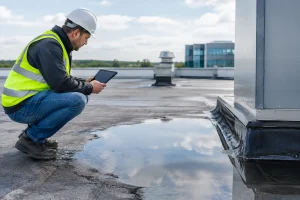
The difference matters because visible damage is only part of the picture. A drone may identify a split in a membrane or a deteriorated gutter line. It cannot reliably determine whether the defect is superficial, whether moisture has migrated beneath the waterproofing, whether the roof falls are contributing to repeated failure, or whether an apparently isolated issue points to wider system deterioration.
Good decisions require diagnosis, not just imagery.
What a drone inspection does well
Drone technology earns its place when access is difficult, the roof area is extensive or a quick initial view is required. It can efficiently document roofs with restricted access, steep geometry, fragile materials or immediate safety constraints. It can also capture consistent high-resolution images for comparison over time.
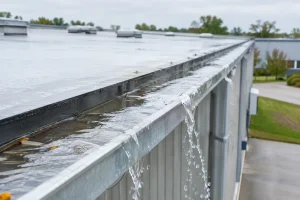
For asset managers with geographically dispersed portfolios, aerial imagery can be particularly useful for triage. It may reveal blocked outlets, obvious ponding, displaced sheets, damaged cappings, accumulated debris, storm damage or plant-related issues that justify a priority site visit. After a severe weather event, it can help establish where resources should be directed first.
It also improves communication. Board members, tenants, project teams and contractors can see the same roof conditions without relying on vague descriptions. A marked-up aerial image is often more effective than a page of unsupported commentary.
But a clear image is not the same as a clear conclusion. Drone footage is evidence. It needs to be interpreted by a competent and independent roofing professional.
Where drone-only inspections fall short
The limitation is physical. A drone operates above the roof and records what its camera can see. Many of the defects that create the greatest cost sit beneath surfaces, inside laps, around concealed terminations or at interfaces that require close examination.
Water entry is a good example. The visible point where water appears inside a building is often not the point of failure. Moisture can travel along roof sheets, insulation, structural members, service penetrations or internal linings. Finding the source may require a close inspection of flashings, fasteners, sealants, joints and drainage details. In some cases, it requires moisture investigation or targeted testing.
Drone imagery can also distort scale and condition. A stain, open lap or corrosion area may look severe from the air but prove localised on inspection. The opposite is more dangerous: a roof can appear orderly from above while widespread seam fatigue, failed sealant, deteriorated concealed gutters or poor detailing is developing below the visual threshold.
Thermal drone surveys add another layer of information, but they are not a shortcut to certainty. Thermal results depend on weather, roof construction, moisture conditions, timing and interpretation. A temperature difference may indicate trapped moisture, but it can also reflect solar loading, material variation or building services below. Thermal imagery should guide further investigation, not be presented as a final diagnosis without supporting evidence.
A roof survey answers the questions that affect money
Commercial roof decisions are rarely about whether a defect exists. They are about extent, consequence, urgency and the correct response. Do you maintain, repair, recover, replace or monitor? Is the defect within warranty responsibility? Is the contractor’s proposal proportionate to the actual condition? Can planned works be staged to protect cash flow without accepting unacceptable risk?
A proper roof survey is designed to answer these questions. It records the roof system and its condition, identifies defects by type and location, assesses likely causes, prioritises remedial action and provides a basis for budget planning. Where necessary, it separates urgent risk controls from routine maintenance and longer-term capital works.
That distinction protects clients from a common problem: receiving a contractor quote before receiving an independent diagnosis. A contractor may be competent and acting in good faith, but their commercial model is to sell and deliver work. Their inspection can be influenced by the solution they are equipped to provide.
Independent advice changes the balance. It gives the asset owner evidence before the scope is written, leverage before a contractor is appointed and a record against which completed work can be checked. Roof Inspection Australia does not sell repairs or replacement systems. The point is simple: the recommendation is not shaped by a repair target.
The best approach is often both
For many commercial properties, the strongest process is not roof survey versus drone inspection as an either-or decision. It is drone imagery integrated into a wider independent survey methodology.
Aerial capture can be used before a site visit to understand roof layout, identify access constraints and flag obvious areas of concern. During the survey, images can support defect mapping and make the final report easier for non-technical stakeholders to follow. After storm events or remedial works, repeat drone imagery can provide a useful visual comparison.
The technical survey remains the decision-making framework. It determines what needs close inspection, what the images actually mean and whether the recommended response is commercially justified.
This combined approach is particularly effective on large industrial roofs, multi-storey facilities, schools, hospitals and portfolio assets. It makes field time more targeted without pretending that a camera can inspect every failure point.
Choose the method based on the decision required
If the immediate requirement is a rapid visual overview, storm triage or safe documentation of difficult-to-access areas, a drone inspection may be appropriate as a first step. The brief should still be clear about what it can and cannot establish.
If you are facing recurring leaks, a major repair proposal, end-of-warranty concerns, a handover dispute, acquisition due diligence or a capital replacement decision, drone footage alone is not enough. You need a detailed roof condition survey with defensible findings and practical recommendations.
The same applies where safety, compliance or operational continuity is at stake. A roof failure can interrupt manufacturing, damage stock, close classrooms, compromise clinical spaces or trigger difficult conversations with tenants and insurers. The cost is not limited to the repair invoice.
Before engaging any provider, ask what inspection is actually being offered. Will the report identify roof types and areas? Will defects be mapped and supported by photographs? Does it explain probable cause rather than simply list symptoms? Are priorities tied to consequence and timeframe? Most importantly, is the assessor financially independent of the remedial works they may recommend?
Those questions expose the difference between a marketing exercise and a professional assessment.
Don’t buy pictures when you need proof
Drone inspection has changed how roofs can be viewed, documented and monitored. Used properly, it improves efficiency and visibility. Used as a substitute for technical assessment, it can create false confidence and defer the very investigation needed to prevent a larger failure.
The right level of inspection should match the financial and operational consequence of getting the decision wrong. When the roof protects a high-value commercial asset, the useful question is not whether you can see it from the air. It is whether you have enough independent evidence to act with confidence.