



A roof handover is often treated as an administrative milestone: practical completion is called, documents are exchanged, and the asset team inherits the building. That is precisely when expensive defects get buried. Knowing how to verify roof handover means separating what has been claimed from what has actually been installed, tested and documented.
For a commercial asset, a signed handover is not proof of a sound roof. It is merely the point at which responsibility starts moving. If drainage falls are wrong, membrane details are incomplete, penetrations are poorly sealed or access provisions are unsafe, the cost will not wait for the paperwork to catch up.
Start with the handover standard, not the contractor’s checklist
The first question is not, “Has the contractor finished?” It is, “Finished against what?” A proper handover review begins with the contract requirements, approved drawings, specifications, variations, manufacturer installation requirements and relevant compliance obligations.
This baseline matters because roof defects are frequently defended as subjective or cosmetic. They are neither when the contract specifies a required outcome. A ponding area, unsupported pipework, missing overflow provision or poorly terminated membrane can be assessed against documented requirements, not contractor opinion.
Review the agreed scope before attending site. Identify roof zones, system types, interfaces with other trades, drainage layouts, plant areas, parapets, skylights and any high-risk details. On a large industrial facility, the roof may contain thousands of square metres of membrane or sheeting. A generic completion statement is not enough. The evidence needs to match each relevant area.
Be particularly alert where the final installation differs from the design. Substituted products, revised plant locations, late service penetrations and changed drainage routes can create defects even where each trade has technically completed its own work. Roofs fail at interfaces. Handover needs to test those interfaces.
How to verify roof handover on site
A roof handover inspection should be systematic, evidence-led and conducted before final sign-off removes your leverage. It should not be a quick walkover with a contractor pointing out the best-looking areas.
Start by confirming safe access. Permanent ladders, hatches, walkways, guardrails, anchor points and exclusion controls should be installed, compliant and practical to use. If facility staff cannot safely access the roof for routine maintenance, the building has not been handed over in an operationally complete condition.
Then inspect the roof in zones. Record photographs, location references and clear descriptions of each issue. Broad statements such as “workmanship concerns observed” are weak in a dispute. Specific findings create accountability: identify the roof area, detail, defect type, likely consequence and required action.
The inspection should focus on the details that determine whether water stays out and drains away. That includes:
- membrane laps, seams, welds, terminations and upstands
- flashings at parapets, walls, doors, skylights and rooflights
- penetrations for pipework, ducts, conduits, supports and plant
- roof drains, sumps, gutters, overflows, rainheads and discharge paths
- roof sheet laps, fasteners, closures and sealant work
- plant plinths, walk pads and areas exposed to concentrated maintenance traffic
Do not allow a visually tidy roof to substitute for close inspection. Many failures are hidden beneath cappings, behind flashings, below service supports or within drainage components. A roof may look complete from ten metres away and still contain defects that will trigger leaks during the first major storm.
Check drainage as a performance issue
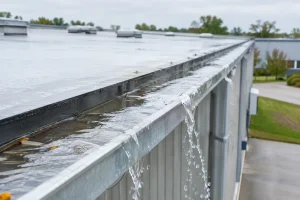
Drainage is one of the most commonly underestimated handover risks. Water does not need a dramatic defect to cause damage. Inadequate falls, blocked outlets, poorly formed sumps and ineffective overflows can leave standing water that accelerates membrane ageing, increases loading and exposes weak details.
Verify that drainage points are clear, accessible and installed at the intended low points. Check for debris from construction, temporary protection materials and sealant waste. Confirm that overflows are present where required and visibly discharge to a location that will reveal a blockage rather than conceal it.
For box gutters and complex drainage zones, visual review alone may not be enough. Controlled water testing can be appropriate, provided it is planned carefully and does not create an avoidable overflow event. The point is not to create a theatrical test. It is to establish whether the system drains as designed under realistic conditions.
Test interfaces with services and structure
Roofing contractors do not control every element that penetrates or sits on a roof, but the asset owner inherits the combined result. Mechanical, electrical, hydraulic, fire and communications works commonly create handover defects through late penetrations and poorly coordinated supports.
Check whether every penetration has an appropriate weatherproofing detail and whether cables, pipes and conduits are supported without damaging the roof surface. Temporary blocks, loose pavers, makeshift sealant patches and unprotected sharp edges are not acceptable permanent solutions.
Also examine connections between roof systems and adjacent building elements. Facade flashings, parapet cappings, expansion joints, fire-rated interfaces and roof-to-wall transitions need coordinated detailing. These are often the first places water enters, then travels before becoming visible internally. By the time a ceiling stain appears, the defect may be well beyond the apparent leak location.
Demand proof, not assurances
A defensible handover file contains more than warranties and a generic maintenance manual. It should provide enough evidence for the owner or facility manager to understand what was installed, how it should be maintained and who remains responsible for unresolved work.
At minimum, verify that the handover package includes approved-for-construction and final marked-up drawings, product data, manufacturer warranties, installer warranties, maintenance requirements, test records where applicable, photographs of concealed or critical details, certificates, defect registers and confirmation that defects have been closed out.
The distinction between proposed and final documentation matters. An operations and maintenance manual copied from a tender submission may describe products that were never installed. A warranty may be conditional on inspections, cleaning intervals or approved maintenance practices that no one has communicated to the facilities team. Those gaps can undermine warranty protection when it is needed most.
Check warranty commencement dates, duration, exclusions, transfer conditions and the party legally standing behind the warranty. A document with an impressive logo is not automatically meaningful. It must relate to the installed system, the specific project and the required registration process.
Manage defects before they become your defects
Not every defect needs to prevent handover. The commercial question is whether the issue creates an unacceptable risk to weatherproofing, safety, compliance, operations or future cost. Minor finishing items may be managed through a time-bound defects list. A failed drainage arrangement or unsealed penetration should not be normalised as a post-handover inconvenience.
Classify issues by consequence and require a clear rectification path. Each item should identify the responsible party, required action, evidence needed to verify completion and a due date. Avoid vague directions such as “repair as necessary”. They give the contractor room to apply a cosmetic fix while leaving the underlying cause untouched.
Reinspection is critical. A closed defect register is only useful if someone independent has verified that the work is actually complete. Photographs supplied by the contractor can support closure, but they should not automatically replace physical inspection for high-risk defects.
Where there is disagreement, preserve the evidence early. Record moisture damage, ponding, incomplete details and construction debris before it is altered. This protects the owner’s position during defects negotiations, warranty claims or later disputes.
Use independent oversight where the risk justifies it
A contractor has a role in demonstrating that its work meets the contract. It should not be the sole judge of whether that standard has been achieved. That is a conflict built into the process, particularly when final payment, retention release or warranty exposure is involved.
Independent oversight gives asset managers a factual basis for sign-off. It turns assumptions into evidence, identifies issues while the contractor is still accountable and creates a report that can be used with project teams, boards, insurers and future maintenance providers. Roof Inspection Australia does not sell repairs or replacement works. The value is a clear view of the roof’s actual condition and the leverage to act before responsibility shifts.
A handover review is especially prudent for complex roofs, large footprints, occupied facilities, critical buildings, new developments and projects with late design changes. It is also valuable where previous trades have created programme pressure or where the roof has been exposed to weather before completion.
The useful closing question is simple: if this roof leaks six months from now, will your handover records show what was installed, what was inspected and who accepted the risk? If the answer is no, the handover is not ready to sign.