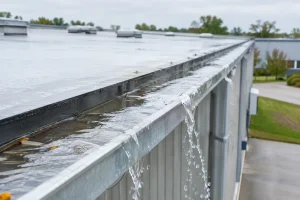



A roof does not need to leak to be failing.
On commercial assets, drainage problems often show up first as ponding, stained soffits, saturated insulation, overloaded gutters, membrane stress or internal moisture where it should not exist. By the time water is entering occupied space, the problem is usually older, broader and more expensive than anyone wants to admit. That is why knowing how to assess roof drainage matters. It is not a maintenance box-tick. It is a risk control exercise tied directly to asset protection, compliance, operating continuity and capital planning.
For owners, facility managers and asset teams, the mistake is usually the same – relying on a quick visual check or a contractor opinion without asking whether water is actually being collected, conveyed and discharged as the roof was intended to perform.
How to assess roof drainage on a commercial roof
If you want a useful answer, start with function, not appearances. A roof can look serviceable and still drain badly. Clean gutters do not prove adequate falls. New membranes do not fix undersized outlets. A recent repair does not mean overflow risk has been addressed.
To assess roof drainage properly, you need to examine how the whole system behaves as a network. That includes roof falls, surface geometry, sumps, outlets, box gutters, downpipes, overflow provisions, membrane detailing and any obstructions that interrupt flow paths. On larger assets, you also need to consider staging of roof levels, plant installations, later modifications and whether the drainage design still matches actual rainfall exposure and current building use.
The first question is simple: where is the water supposed to go? If that cannot be answered clearly from drawings, site conditions and discharge points, there is already a control gap.
Start with evidence of water behaviour
The fastest way to cut through assumptions is to look for physical evidence. Ponding marks, dirt rings, silt deposits and localised membrane ageing tell you where water sits and how long it sits there. Corrosion at sheet laps, staining beneath overflow points, biological growth around gutters and repeated patch repairs near outlets all point to chronic drainage issues rather than isolated defects.
Inside the building, ceiling stains and moisture damage help, but they are lag indicators. The more useful evidence is often on the roof itself – crushed insulation beneath membranes, deflection around gutters, outlet strainers blocked by debris, or mechanical plant installed directly in drainage paths.
This is where many inspections fail. They record what is visible without interpreting what it means. Water marks are not cosmetic. They are a record of system performance.
Check falls, not just outlets
Outlets are where the water leaves, but falls determine whether it gets there. On commercial roofs, especially older low-slope systems, inadequate falls are one of the most common reasons drainage underperforms.
Assessing falls means more than standing back and eyeballing the surface. You need to identify high points, low points and any areas where settlement, structural movement or poor refurbishment work has interrupted the intended drainage path. Tapered insulation, screeds and structural decks can all create hidden inconsistencies. A roof may technically fall toward an outlet on paper while trapping water in reality.
Some ponding after rain does not always mean immediate failure. The question is scale, duration and consequence. Minor residual water in a localised area may be tolerable in some systems. Broad or persistent ponding is not. It increases membrane degradation, raises dirt loading, stresses laps and flashings, and can add dead load over time. On occupied or sensitive facilities, that risk profile changes again.
The components that usually get missed
Drainage failures are rarely caused by one obvious issue. More often, they sit in the gaps between trades, design assumptions and maintenance scope.
Box gutters are a frequent example. They may be accessible enough for cleaning, yet still be too flat, too narrow, poorly supported or reliant on outlets that cannot handle peak flow. Overflow provisions also deserve far more scrutiny than they usually get. If primary drainage blocks, where does the water go next? If the answer is into the building, across a doorway, into a wall cavity or toward a live operational area, the system is not adequately controlled.
Penetrations matter as well. Every conduit support, mechanical plinth, cable tray and retrofit platform can interrupt sheet flow if it has been dropped into the wrong location. Plant upgrades often create drainage defects years after the original roof was installed. Nobody redesigns the water path, but everyone assumes someone else checked it.
Gutters, downpipes and overflow paths
When assessing gutters and downpipes, capacity and condition both matter. A gutter that is clear on inspection day may still surcharge during heavy rainfall if it is undersized, poorly graded or fed by a large catchment area. Likewise, a downpipe can appear intact while discharging poorly due to blockages, poor connection detailing or inadequate number and spacing.
Overflow paths should never be treated as secondary details. They are part of the roof drainage system, not a nice extra. If overflow weirs, sumps or relief openings are missing, blocked, set too high or discharged into vulnerable areas, the building is exposed to preventable water entry during storm events.
That exposure is not theoretical. It affects procurement decisions, insurance conversations, handover disputes and future capital works.
How to assess roof drainage when design and site conditions conflict
Many commercial roofs are no longer operating under their original conditions. Roof-mounted services have increased. Adjacent developments have changed wind exposure. Maintenance access routes have altered traffic patterns and caused localised deflection. Refurbishments have tied new sections into old drainage infrastructure with very mixed results.
This is why drainage assessment needs to compare intent against reality. Review available drawings, hydraulic layouts and previous defect records, then test those assumptions against what is actually built. If the roof has been modified repeatedly, site evidence should carry more weight than outdated documentation.
There is also a practical commercial point here. A roof can be technically compliant at handover and still perform poorly in service if workmanship, tolerances or maintenance access were badly handled. That is exactly why independent review matters. The party who designed or installed the system has a built-in incentive to explain away marginal performance.
What a serious assessment should include
A credible drainage review should document outlet locations, catchment relationships, visible falls, low points, blockages, overflow provisions, gutter condition, discharge points and any defects influencing water movement. It should also comment on likely consequence, not just defect presence.
For higher-value or more complex assets, that often extends to moisture tracing, level checks, review of roof plans, rainfall event correlation and staged recommendations based on risk. Not every issue needs immediate replacement. Some need cleaning, some need local redesign and some indicate a broader failure of the drainage concept. Lumping them together is how budgets get wasted.
The trade-off is straightforward. A quick inspection is cheaper upfront, but it tends to produce generic maintenance advice. A proper assessment gives you evidence you can act on, challenge with, and defend internally.
What good reporting looks like
If the final report simply says gutters should be cleaned and outlets monitored, it has not gone far enough.
Decision-makers need to know where drainage is failing, why it is failing, what the consequence is if nothing changes, and whether the issue is maintenance-related, workmanship-related, design-related or the result of later modifications. That distinction matters because it changes who should respond, how urgent the issue is, and whether the cost sits in maintenance, defect liability or future capital works.
Clear reporting should also prioritise defects. Not every ponding area carries the same risk. Water sitting near a plant plinth above a critical operations room is not equivalent to shallow residual ponding on a non-sensitive warehouse section. Commercially sharp advice does not just list problems. It ranks them by consequence.
That is the value of independent roof consultants such as Roof Inspection Australia. We do not sell drainage upgrades, repairs or replacement systems. We just tell you the truth about performance, risk and what needs to happen next.
A well-assessed roof drainage system gives you leverage. It helps you push back on vague contractor claims, support maintenance budgets with evidence, and avoid spending capital on the wrong scope. More to the point, it lets you act before water starts making decisions for you.