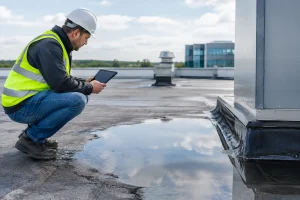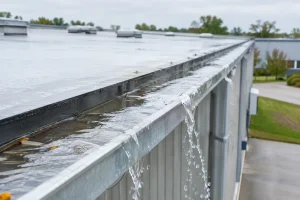



A roof rarely fails without warning. What usually fails first is visibility. By the time water reaches occupied space, corrodes structure, damages stock or disrupts operations, the defect has often been active for months. That is why knowing when to inspect commercial roofs is not a maintenance detail. It is a risk control decision.
For asset managers, facility teams, developers and government or institutional property owners, timing matters as much as scope. Inspect too late and you inherit avoidable damage, contractor disputes and rushed capital spending. Inspect too casually and you get vague commentary instead of evidence. The right inspection at the right point in the asset cycle gives you leverage, not just information.
When to inspect commercial roofs as a baseline
Every commercial roof should be inspected on a planned basis, even when there are no visible issues. For most assets, that means at least annually. For higher-risk buildings, older roofs, coastal sites, buildings with heavy rooftop plant, or facilities where water ingress carries major operational consequences, six-monthly inspections are often the more defensible standard.
This is not about over-servicing. It is about catching small failures while they are still cheap to deal with. Blocked drainage, membrane laps under stress, failing sealants, corrosion around penetrations and mechanical damage from contractors are all common findings that sit quietly until the next storm exposes them.
A calendar-based inspection program also creates a record. That record matters when budgets are being set, warranties are being tested, and stakeholders want to know whether a roof is deteriorating normally or declining because something has been missed.
The critical moments when an inspection is non-negotiable
Routine inspections are the floor, not the ceiling. Some triggers should move a roof inspection from advisable to immediate.
After major rain, wind or hail events
Extreme weather does not need to tear a roof open to create problems. Wind can lift flashings, stress fixings and open laps. Hail can bruise membrane systems, crack skylights and damage coatings in ways that are not obvious from the ground. Heavy rain often reveals drainage limitations that were already there but had not yet been pushed hard enough to fail.
A post-event inspection gives you evidence while conditions are current. That matters for insurance, warranty positions and contractor accountability. It also helps separate cosmetic damage from defects that will accelerate deterioration if ignored.
Before buying, leasing or taking over an asset
Commercial roofs are expensive to replace and easy to misread. A surface can appear serviceable while hiding widespread moisture ingress, defective falls, poor detailing or a history of patch repairs that have reached the end of their usefulness.
If you are acquiring a property, negotiating a lease, or assuming management responsibility for a building, a roof inspection should happen before the decision is locked in, not after settlement or handover. Otherwise, the first real roof report becomes an unpleasant budget surprise.
At practical completion and handover
New does not mean defect-free. Some of the most consequential roof problems start at installation: poor terminations, incomplete sealing, non-compliant detailing, ponding, unfinished penetrations and workmanship that looks acceptable until weather tests it properly.
An independent inspection at completion gives principals, developers and building owners a factual basis to challenge defects before final positions harden. It also helps confirm whether the roof aligns with documentation, expected service life and maintainability. That is a stronger position than relying on contractor assurances.
Before warranty expiry
This is one of the most missed inspection points in commercial property. Roof warranties often create false comfort. They are only useful if defects are identified and documented in time, and if the actual installed condition supports a valid claim.
Inspecting before warranty expiry gives you a chance to identify workmanship issues, product failures and unresolved defects while there is still commercial leverage to pursue rectification. Leave it too late and the cost usually shifts back to the owner.
After rooftop works or service trades
Roofs are frequently damaged by people who were not engaged to work on the roof itself. Mechanical contractors, solar installers, communications trades and other service providers often create punctures, loose flashings, broken sheeting, blocked sumps or unsupported cabling without recognising the consequence.
Any major rooftop access or works package should be followed by an inspection, particularly on membrane roofs and complex plant-heavy sites. If no one checks the roof afterwards, responsibility becomes harder to prove and defects become harder to trace.
When to inspect commercial roofs on older assets
Older roofs need a different level of scrutiny. Once a system starts approaching the latter part of its expected service life, annual inspections may not be enough. Materials become less forgiving. Small defects spread faster. Patch repair strategies start delivering shorter returns.
This is where inspection timing should support capital planning, not just maintenance response. If a roof is showing increasing defect frequency, repeated leaks, widespread corrosion, movement at laps or chronic drainage issues, inspections should be scheduled to track condition and define whether targeted remediation is still commercially sensible.
The point is not to replace early for the sake of caution. The point is to stop spending maintenance dollars on a roof that has already moved into capital failure territory. That line is not always obvious without independent technical review.
Inspection timing depends on asset risk, not just roof age
Not every commercial roof needs the same cadence. A distribution centre with minimal internal sensitivity may tolerate more operational risk than a hospital, school, data environment or public facility where leaks create immediate disruption, safety concerns or reputational damage.
The right answer depends on consequence. Buildings with critical operations, public exposure, compliance obligations or sensitive plant should be inspected more often because the cost of being wrong is higher. The same applies to assets in exposed regional locations, cyclone-prone areas, marine environments or sites with known drainage constraints.
That is why a generic maintenance checklist is often not enough. Inspection timing should reflect how the building is used, what failure would cost, and whether the roof has a history of defects, disputes or access-related damage.
What a decision-maker should actually look for
If you are asking when to inspect commercial roofs, you are really asking when objective evidence is needed to make a defensible decision. That could be a maintenance budget, a capex forecast, a contractor dispute response, a handover position or a risk report to internal stakeholders.
A useful inspection does more than say the roof is in good or poor condition. It should identify active defects, likely failure points, drainage performance issues, maintenance backlog, safety concerns, workmanship problems and probable remaining service life. It should also distinguish between items that need immediate action and items that can be planned.
That distinction matters commercially. Without it, urgent defects get buried in general commentary and non-urgent items get inflated into unnecessary works. Both outcomes cost money.
Why independence matters when timing is critical
The moment an inspection influences spend, procurement or liability, bias becomes a problem. If the person inspecting the roof also wants to sell the repair, replacement or product solution, timing can be manipulated. A contractor-led inspection may lean towards urgent scopes, broad replacement recommendations or selective framing of defects.
Independent advice changes that dynamic. It gives owners and managers a cleaner view of condition, risk and priority without the sales agenda. That is particularly important before major expenditure, at handover, in dispute situations and when deciding whether a roof still warrants repair or has moved into replacement planning.
This is where Roof Inspection Australia’s model makes commercial sense. We do not sell roofing works. We inspect, diagnose and report so clients can act from evidence rather than pressure.
A simple rule for timing
If the roof is exposed to age, weather, access, transaction risk, warranty deadlines or stakeholder scrutiny, inspection should happen before the problem becomes visible from inside the building. That is the real threshold.
Waiting for a leak report is not a strategy. It is an admission that no one had control of the asset condition in the first place. Better timing gives you options. And in commercial property, options are what protect budgets, operations and accountability.
The best time to inspect a commercial roof is usually earlier than people think and well before anyone starts arguing about whose fault the damage is.