

A roof does not need to collapse to become a serious commercial problem. More often, the cost arrives earlier – in water ingress that disrupts a tenancy, drainage defects that keep returning, handover failures that become owner liabilities, or maintenance decisions made off bad advice. That is why commercial roofing risk trends matter now. The risk profile across Australian assets is changing, and many property owners are still relying on inspection methods, contractor feedback, and budget assumptions that no longer match reality.
Why commercial roofing risk trends are getting sharper
The core issue is not that roofs have suddenly become more complex. It is that the consequences of getting them wrong are now harder to absorb. Insurance pressure, tighter compliance expectations, ageing asset portfolios, more aggressive weather patterns, and rising construction costs have all increased the commercial impact of what used to be treated as a maintenance issue.
For asset managers and facility teams, that changes the question. It is no longer just, “Does this roof need repairs?” The better question is, “What is the actual exposure here, what is driving it, and how defensible is our current plan?”
That distinction matters because many roofing risks are still hidden behind a neat surface appearance. A membrane can look serviceable while termination details are failing. A roof can be under warranty while drainage design is already creating ponding and deterioration. A contractor can call a defect minor while the owner carries the downstream cost.
The biggest commercial roofing risk trends affecting portfolios
Deferred maintenance is turning into capital shock
This is one of the clearest shifts across commercial and institutional property. Roofs that should have had structured condition reviews and staged remediation have instead been left to reactive maintenance. That worked for a while when budgets were easier to stretch and replacement costs were lower. It works badly now.
When defects are left unresolved, they rarely stay isolated. Moisture gets into insulation, fixings corrode, internal finishes are affected, and patch repairs multiply. The result is not just a bigger repair bill. It is a compressed decision window where owners are forced into major expenditure without time to test options properly.
The risk is higher in large portfolios because small recurring issues are often treated as local site problems rather than a systemic pattern. By the time the trend is visible at portfolio level, the cost has usually escalated.
Drainage failures are attracting more attention for good reason
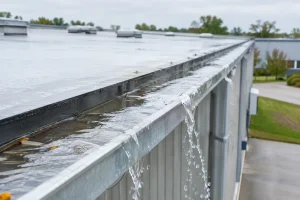
Drainage defects remain one of the most persistent sources of roof failure, yet they are still underestimated during inspections and handovers. Blocked sumps, inadequate falls, poorly set overflows, undersized outlets, and ponding water are often treated as maintenance irritants. In reality, they are risk multipliers.
Poor drainage shortens roof life, increases leak likelihood, and can create structural loading concerns in the wrong conditions. It also complicates warranty discussions because contractors and manufacturers may point to maintenance, design, or installation depending on what suits their position.
For owners, that argument is usually a dead end unless there is independent technical evidence. This is where many avoidable costs begin – not with the defect itself, but with the lack of clear, defensible diagnosis.
Handover quality is still too inconsistent
New roofs are not automatically low risk. In many cases, they are where risk is quietly introduced. Commercial projects continue to face programme pressure, trade coordination issues, substitution of materials, variable workmanship, and incomplete close-out documentation. Roofing systems are particularly vulnerable because defects at terminations, penetrations, flashings, laps, and drainage interfaces can be concealed or minimised at practical completion.
Owners and developers who assume a new roof is a solved problem often inherit defects that only become visible after the builder has moved on and the defect liability conversation becomes more contested.
This is one of the more expensive commercial roofing risk trends because it creates a false sense of security. If the initial inspection is superficial or performed by a party with a repair or contractual agenda, the owner loses leverage early.
Contractor-led advice is becoming a risk category of its own
Not all contractor advice is poor. The problem is structural. If the same party inspecting the roof also sells the repair, replacement, coating, or upgrade, the advice is never fully neutral. That does not mean the recommendation is always wrong. It means the client does not have proper control over the diagnosis.
In a high-cost environment, that matters more than ever. Scope inflation, premature replacement recommendations, patch-repair cycles, and selective reporting all become harder to detect when there is no independent benchmark.
For commercial decision-makers, the real risk is not just overspending. It is making a decision that cannot be justified later to internal stakeholders, insurers, tenants, or procurement teams. A roof report should increase your leverage. If it narrows your choices to the seller’s preferred outcome, it is not protecting the asset.
Compliance and documentation risk is rising with scrutiny
Evidence now matters as much as the defect
Across government, healthcare, education, industrial, and institutional assets, documentation standards are getting more important. Whether the issue is handover, maintenance planning, waterproofing performance, or dispute resolution, the ability to show what was found, where it was found, how serious it is, and what should happen next has real commercial value.
Too many roof inspections still produce vague findings, poor photo evidence, generic risk language, or maintenance recommendations with no prioritisation. That may satisfy a box-ticking exercise, but it does not help when a leak reappears, a contractor pushes back, or a budget request needs approval.
A useful report should do three things at once. It should identify the technical issue, explain the business risk, and create a defensible action path. Anything less leaves the owner exposed.
Warranties are not a substitute for verification
Another trend worth calling out is misplaced confidence in warranties. A warranty can be valuable, but only if the installed system complies with its conditions, the defects are identified early, and the claim pathway is clear. In practice, many owners rely on warranty language without verifying whether the roof was installed, maintained, or documented in a way that supports future claims.
That is not caution. That is gamble disguised as comfort.
Weather volatility is exposing weak roofs faster
Australian conditions have always been hard on roofing, but the operational impact of weather events is increasing. More intense rainfall, heat cycling, storm activity, and localised wind events are accelerating failure in roofs that already have design weaknesses, ageing components, or unresolved defects.
The key issue is not simply climate. It is preparedness. Assets with current condition data, drainage review, and staged maintenance planning are far better positioned than assets managed through reactive call-outs. The weather event may be the trigger, but the real damage often comes from pre-existing weaknesses nobody had properly measured.
This is especially relevant for logistics, industrial, healthcare, and education sites where roof failure affects continuity, safety, and stakeholder confidence as much as repair cost.
What smarter clients are doing differently
The better operators are shifting from roofing as a trade issue to roofing as a risk-control function. That means they are not waiting for leaks to define urgency, and they are not outsourcing judgment to the party quoting the works.
Instead, they are using independent inspections to establish baseline condition, test contractor claims, prioritise defects by consequence rather than noise, and align roof decisions with capital planning. They want evidence before they commit funds. They want scope clarity before they go to market. And they want reports that help them challenge poor workmanship or weak recommendations with confidence.
That is where an independent consultant changes the outcome. Roof Inspection Australia works in that space because the value is not in selling a fix. It is in giving clients the truth early enough to stay in control.
The real trend is a higher cost of being wrong
When people talk about commercial roofing risk trends, they often focus on products, storms, or maintenance backlog. Those are real issues, but the larger shift is commercial. The cost of misdiagnosis, delay, weak documentation, and conflicted advice has gone up.
A roof problem that once sat inside maintenance now spills into compliance, procurement, capital forecasting, tenant impact, and reputational risk. That means the standard for decision-making has to lift with it.
If the roof protects a high-value asset, the inspection process should protect the decision. That starts with independent evidence, clear defect diagnosis, and advice that is not trying to sell you the answer.
The useful question is not whether roofing risk is rising. It is whether your current information is strong enough to see it before the budget gets hit.