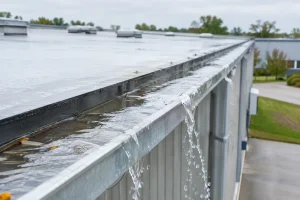




A leak after practical completion is expensive. A non-compliant roof buried under certificates and contractor assurances is worse. That is why a roof compliance inspection matters for commercial assets – not as a paperwork exercise, but as a risk control process that tests whether the roof actually meets the required standard.
For asset managers, developers, facility teams and public-sector property owners, the issue is rarely just water ingress. It is exposure. Exposure to defects that were signed off too early. Exposure to drainage failures that only become obvious after the first major storm. Exposure to workmanship that does not align with specifications, standards, warranty conditions or the realities of the building’s use. A roof can look finished and still fail the compliance test that matters most: is it fit for purpose, defensible on paper, and likely to perform in service?
What a roof compliance inspection is really checking
A proper roof compliance inspection is not a quick walkover with a camera and a generic checklist. It is a technical review of whether the installed roof system aligns with the documented requirements and whether the completed work introduces operational, safety or financial risk.
That means checking more than obvious defects. Compliance can involve falls, drainage design, waterproofing continuity, penetrations, membrane terminations, sheet fixing, lap detailing, insulation installation, trafficable areas, edge treatments and the interface between trades. It can also involve whether the roof has been constructed in line with approved drawings, manufacturer requirements, relevant codes, project specifications and handover obligations.
This is where weak inspections fail. They focus on visible blemishes and miss the bigger question: does the roof system, as installed, support a defensible sign-off? For high-value assets, that distinction is not academic. It affects warranties, liability, future maintenance costs and contractor accountability.
Why roof compliance inspection gets mishandled
The most common problem is conflict. If the party inspecting the roof also wants the repair work, the advice is rarely clean. If the party certifying completion is under pressure to keep the programme moving, defects can be minimised, deferred or reframed as maintenance items.
The second problem is false confidence in documents. Test certificates, product data sheets and installation declarations all have their place. None of them prove that the roof on your building was installed correctly in every critical area. Compliance is not established by paperwork alone. It has to be verified on the asset.
The third problem is timing. Many issues are easiest to identify before access is restricted, before services are added, or before handover closes leverage. Leave the inspection too late and rectification becomes slower, more disputed and more expensive.
Commercial clients do not need comforting language here. They need the truth. If a roof is non-compliant in key respects, that risk should be documented clearly enough to support action.
What should be included in a roof compliance inspection
The scope depends on the building, procurement pathway and project stage, but the essentials are consistent. The inspection should examine whether the roof has been built in accordance with the specified system, whether details have been executed correctly, and whether any departures create measurable risk.
In practice, that often means reviewing the roof covering, substrate condition, falls and drainage behaviour, flashings, joints, parapet interfaces, box gutters, rainwater sumps, overflow provisions, membrane transitions, sealant quality, penetrations, plant support detailing and signs of premature distress. On complex sites, it may also require checking the coordination between roofing, hydraulic, mechanical and facade elements, because non-compliance often sits in the gaps between packages.
A strong report should do more than state that defects exist. It should classify them, explain the likely consequence, identify the probable cause and set out what needs to be clarified, monitored or rectified. Decision-makers need evidence they can use in contractor discussions, defect claims, procurement reviews and budget planning.
Compliance is not the same as condition
This is where many portfolios lose money. A roof can be in fair condition and still be non-compliant. It can also be compliant at handover and perform poorly later because maintenance, access control or rooftop modifications were mishandled.
Condition reporting asks, what state is the roof in now? Compliance reporting asks, does the roof meet the required standard and obligations? Both matter, but they answer different commercial questions.
For a newly completed asset, the compliance question usually takes priority because the owner still has leverage. For an existing building, condition and compliance often overlap, particularly where alterations, ageing waterproofing, drainage modifications or undocumented repair history have blurred the original design intent.
That is why experienced clients do not rely on a single label. They define the purpose of the inspection first. Are you validating handover? Testing a contractor claim? Supporting capital planning? Responding to a failure? The right scope follows the decision you need to make.
Handover, disputes and latent risk
Roofing disputes are rarely about one visible defect. They are about whether a pattern of detailing, omission or poor workmanship points to systemic failure. A roof compliance inspection is often the first point where that pattern becomes visible.
At handover, the inspection can confirm whether defects are minor finishing issues or signs of a broader installation problem. During a dispute, it can separate allegation from evidence. For existing assets, it can expose latent risk that was inherited years earlier and never properly interrogated.
This matters because roofing failures are rarely self-contained. Water does not respect trade boundaries or budget lines. Once moisture tracks into insulation, ceilings, services, wall systems or occupied areas, the cost is no longer a roofing line item. It becomes an operational issue, a tenant issue, a safety issue and sometimes a reputational issue.
An inspection that stops at surface commentary does not protect the client. It just delays the argument.
What commercial clients should demand from the inspection report
If the report is vague, it has limited value. Commercial stakeholders need enough technical detail to understand the issue and enough commercial clarity to act on it.
A useful roof compliance inspection report should set out the inspection basis, site limitations, documents reviewed, observed defects or non-conformances, photographic evidence, risk implications and recommended next steps. It should also distinguish between items requiring urgent rectification, items needing further investigation and items that should be monitored.
Just as important, the language should be plain. Senior stakeholders should not need to decode jargon to understand whether there is a compliance problem, what it means for asset risk, and where responsibility is likely to sit.
This is one reason independent consultants add value. They are not trying to preserve a variation stream or soften findings to protect a relationship on site. They are there to tell the truth, with enough evidence behind it to give the client leverage.
When a roof compliance inspection should happen
Earlier is better, but there is no single perfect moment. On new projects, hold points during installation are often more valuable than waiting until completion, because critical details are still visible and defects are easier to rectify properly.
At practical completion, a roof compliance inspection can test whether handover is genuinely ready. During the defects liability period, it can verify whether reported issues are isolated or symptomatic. For existing portfolios, inspections are often triggered by acquisition due diligence, recurring leak history, warranty concerns, capital planning or disputes over responsibility.
It depends on the asset and the decision at stake. A logistics facility with extensive roof penetrations and services exposure presents a different risk profile to a healthcare site, a school campus or a multi-building government portfolio. The inspection should reflect that context rather than force every roof into the same template.
The commercial value is control
The point of a roof compliance inspection is not to produce another PDF that sits in a project folder. It is to give the client control. Control over contractor claims. Control over defect rectification. Control over maintenance priorities and capital timing. Control over what gets accepted, challenged or escalated.
That is especially important where budgets are tight and every recommendation competes for approval. If you are responsible for a high-value asset, you need more than opinion. You need independent technical findings that stand up in meetings, on site and, if necessary, in dispute.
Roof Inspection Australia works in that space for a reason. We do not sell roofing. We assess it. That independence changes the quality of the advice and the usefulness of the report.
If a roof is compliant, you want confidence backed by evidence. If it is not, you want the issue identified before it becomes somebody else’s excuse and your cost.