



A roof that leaks once is a defect. A roof that leaks again after repairs is a warning sign. If you are asking what causes recurring roof leaks, the real issue is usually not bad luck or unusually heavy rain. It is misdiagnosis, incomplete scope, poor detailing, or a defect pathway that was never properly isolated in the first place.
For commercial assets, recurring leaks are not just maintenance annoyances. They create avoidable call-outs, tenant disruption, mould risk, damaged finishes, compliance exposure and wasted capital. The longer the cycle continues, the more likely it is that the site is treating symptoms while the actual failure mechanism remains active.
What causes recurring roof leaks on commercial buildings?
In most cases, recurring leaks come from one of three problems. The source was identified incorrectly, the repair addressed only part of the defect, or the roof has multiple interacting failures rather than a single entry point. That last point matters. On larger roofs, water rarely behaves in a neat, linear way. It can enter at one point, track across insulation, purlins or slab interfaces, and present well away from the true source.
This is where contractor-led assumptions often create cost. If the inspection starts with the repair product they want to sell, the diagnosis can get shaped around the remedy. That is not technical clarity. That is scope bias.
The leak location is not the entry point
Internal water staining tells you where water finished, not where it began. On metal roofs, water can travel along laps, fasteners and supports before dropping internally. On membrane roofs, moisture can migrate beneath the system and emerge at joints, upturns or service penetrations some distance away.
This is one of the most common reasons a leak returns after a seemingly logical repair. The team patched the visible suspect area, but the water entry path sat elsewhere. Without a methodical inspection of falls, laps, penetrations, terminations, drainage behaviour and substrate condition, the building ends up paying for educated guesses.
Drainage failure keeps reactivating the problem
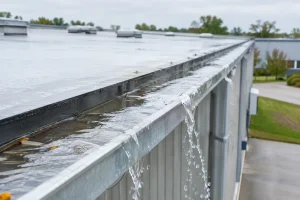
A sound roof system can still leak if water is not draining as intended. Blocked sumps, undersized outlets, back-falling gutters, ponding behind plant, and debris accumulation around rainwater heads all increase dwell time. The longer water sits on a roof, the more likely it is to exploit minor weaknesses that would otherwise stay dormant.
Drainage-related leaks are often treated as isolated waterproofing defects when they are really hydraulic failures. That distinction matters because patching the membrane without correcting the falls or outlet performance simply resets the clock. The leak may disappear for a short period, then return with the next major weather event.
Penetrations and terminations are weak points
Most recurring leaks are not in the open field of the roof. They occur at transitions and interruptions – service penetrations, skylights, parapet junctions, expansion joints, roof hatches and plant supports. These are high-risk details because they rely on workmanship, sequencing and compatible materials rather than broad-sheet coverage alone.
On operational commercial sites, penetrations are often added years after completion by mechanical, electrical or communications trades. If those works are poorly detailed, not properly flashed, or installed without regard to the existing roof system, the leak path can remain hidden until weather conditions align. Then the call-out starts, followed by another call-out, and another.
Why repairs often fail to stop the leak
Many repairs fail because they were never designed as true defect rectification. They were urgency responses. There is a difference.
An emergency sealant application may reduce ingress temporarily, but sealants are not a strategy. On aged roofs, they are frequently applied over movement joints, corroded substrates, contaminated surfaces or incompatible materials. That can buy days or months, but rarely delivers a durable outcome.
Short-term patching over long-term movement
Commercial roofs move. Thermal expansion, structural deflection, wind loading and building settlement all place stress on laps, flashings and membrane details. If the leak is driven by recurring movement, a static patch over the top will often crack, separate or lose adhesion.
This is common around parapets, sheet end laps, box gutters and plant curbs. The repair looks neat on day one, then fails because the underlying movement mechanism was never accounted for. Good diagnosis is not just about where water gets in. It is about why that pathway opens repeatedly.
Corrosion and substrate deterioration are missed
Where metal roofing or flashings are involved, corrosion can sit beneath coatings, laps or fixings long before it becomes visually obvious from ground level. Once the substrate has lost integrity, surface treatments may conceal the issue without restoring performance.
The same applies to wet insulation, deteriorated backing materials, failed bond lines and delaminated membrane substrates. If the base is compromised, the top-layer repair may have nothing stable to adhere to. That is why repeat leaks often occur in roofs that have already had multiple rounds of patchwork.
Workmanship and sequencing defects remain in place
Some recurring leaks are the legacy of how the roof was built or altered. Incomplete laps, poorly dressed flashings, missing closures, incorrect fastener placement, inadequate membrane terminations and badly integrated services all create ongoing vulnerability. If a repair team addresses only the wettest area and ignores the surrounding workmanship pattern, the asset remains exposed.
This is particularly relevant at handover stage, after refurbishments, or following rooftop service upgrades. One visible leak can be the first sign of a broader quality problem.
What causes recurring roof leaks after heavy rain?
Heavy rain does not create defects from nowhere. It exposes defects that already existed and tests drainage capacity harder than usual. If leaks appear only during high-intensity events, that usually points to one of two issues: the roof system has limited tolerance for water build-up, or the detailing fails when water is driven sideways, backed up, or retained for longer than normal.
Wind-driven rain can force water under flashings and sheet laps that seem watertight in mild conditions. Overflowing gutters can push water into wall interfaces and internal box gutter terminations. Ponding can submerge low upstands and dormant laps. In each case, the weather event reveals a threshold problem rather than acting as the sole cause.
That distinction is commercially useful. It stops teams from dismissing failures as rare weather anomalies when the roof is simply underperforming.
The commercial cost of getting the diagnosis wrong
A recurring leak is not only a maintenance line item. It affects operations, insurance posture, contractor management, lifecycle planning and budget credibility. When the same issue keeps returning, decision-makers are forced into reactive spending without confidence that the latest invoice solved anything.
It also muddies accountability. Contractors may blame weather, age, access limitations or unrelated defects. Internal teams may struggle to challenge that position without independent evidence. Meanwhile, the building keeps wearing the consequences.
This is why independent inspection matters. Roof Inspection Australia does not sell repairs, replacements or roofing products. That changes the quality of the diagnosis. The job is not to justify a scope. The job is to identify the actual failure mechanism, document the evidence and give the client leverage to act with control.
What a proper investigation should examine
If leaks are recurring, the inspection needs to move beyond the obvious wet spot. It should assess roof geometry, drainage performance, historical repair locations, penetrations, detailing quality, material compatibility, movement stress points and internal signs of water tracking. On some assets, that also means reviewing whether rooftop service trades have introduced defects after completion.
It depends on the building type and roof system. A distribution centre with long-run metal sheeting presents different risks to a hospital with complex plant zones and membrane interfaces. A school building with repeated service additions has a different defect profile again. The principle is the same, though: diagnose the whole failure environment, not just the latest symptom.
That often leads to a less dramatic answer than clients expect. There is not always one catastrophic flaw. Sometimes recurring leaks come from several moderate issues interacting – marginal falls, ageing sealants, poor penetration detailing and debris-driven drainage inefficiency. Fixing only one of those may reduce the problem, but not eliminate it.
The useful question is not whether a leak can be patched today. It is whether the cause has been proven, the scope matches the evidence, and the asset now has a defensible path forward.
Recurring roof leaks are expensive mainly because they waste time before they waste money. Once the diagnosis is right, the repair strategy usually becomes clearer, narrower and easier to defend. That is how you stop chasing water across a roof and start making decisions that hold up under scrutiny.