


A commercial roof rarely fails all at once. What usually happens is slower, more expensive, and far less convenient. Drainage starts underperforming, flashings open up, laps deteriorate, patch repairs multiply, and the building keeps operating under a layer of growing risk. That is why knowing when to replace commercial roof systems is not a maintenance question alone. It is a capital planning, risk control and asset protection decision.
Too many replacement calls are made either too late or too early. Too late means leaks, internal damage, tenant disruption, compliance exposure and reactive spend. Too early means throwing capital at a roof that could have delivered more service life with targeted works and proper oversight. Neither outcome is acceptable if you are responsible for budgets, business continuity or stakeholder reporting.
When to replace commercial roof assets is not about age alone
Age matters, but it is not the decision-maker. A 20-year-old roof can still be serviceable if the system was well designed, installed correctly, maintained consistently and exposed to manageable conditions. A much newer roof can be a replacement candidate if it has chronic defects, poor falls, recurring ponding, failed detailing or widespread workmanship issues.
That is the first trap in this space. Many contractor-led recommendations reduce the question to a rough age range because that is easy to sell. Serious asset decisions need more than a rule of thumb. They need evidence.
The real test is whether the roof can still perform its job without disproportionate cost, operational risk or repeated intervention. If the answer is no, replacement starts to become commercially rational, even if the roof is not technically at the end of a theoretical lifespan.
The signs that replacement is becoming the right call
Some signs point clearly to localised repair. Others show the roof system is losing reliability at a broader level. The distinction matters.
If defects are isolated, accessible and not tied to systemic design or installation problems, repair may remain the right move. But when the same issues keep returning across multiple areas, you are no longer dealing with a one-off fault. You are dealing with a roof that is consuming budget without restoring confidence.
Widespread membrane deterioration is one of the clearest signals. That includes embrittlement, cracking, shrinkage, splitting at laps, surface erosion and loss of waterproofing integrity across large sections. Once deterioration becomes general rather than local, patching usually becomes a holding pattern rather than a solution.
Persistent water ingress is another major indicator, especially when leak sources are difficult to isolate or appear unrelated to rainfall intensity. If the roof leaks in multiple zones, leaks after previous repairs, or presents concealed moisture migration, the system may be too compromised for piecemeal works to make sense.
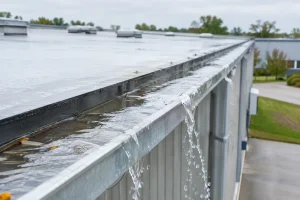
Drainage failure often tips the balance. Chronic ponding, blocked overflow logic, inadequate falls and water retention around penetrations accelerate roof failure and increase structural and waterproofing risk. You can repair around ponding for a while, but if the roof geometry itself is wrong, the underlying problem remains.
There is also the issue of repair history. A roof covered in patches, sealants, local replacements and short-term fixes tells a financial story. Once annual spend keeps climbing but defect recurrence stays high, the argument for replacement becomes stronger. Not because replacement is always cheaper upfront, but because the repair cycle has stopped delivering control.
When repair is still the better option
Not every ageing roof should be replaced. That needs to be said plainly, because many portfolios have lost money on premature replacement programs driven by worst-case assumptions or sales pressure.
Repair remains viable where the substrate is sound, moisture intrusion is limited, defects are localised, drainage is largely functional and the roof still has service life worth protecting. In those cases, targeted remediation paired with a realistic maintenance plan can buy meaningful time.
This is especially relevant for owners managing staged capital works, short hold periods, redevelopment horizons or competing asset priorities. A roof does not need to be perfect to remain fit for purpose. It needs to be reliable enough for the building, the occupancy profile and the risk tolerance attached to the asset.
That said, repair only works if the scope addresses the actual failure mechanism. Cosmetic patching over systemic problems is not maintenance. It is deferred expenditure dressed up as prudence.
The commercial factors behind when to replace commercial roof systems
Roof decisions are often framed as technical calls, but for asset owners and facility teams they are commercial decisions first. The roof is part of a larger risk environment that includes tenancy obligations, insurance exposure, compliance, procurement timing and capital allocation.
For example, a roof with moderate visible deterioration may still be a replacement priority if the building houses healthcare operations, critical plant, data infrastructure or sensitive educational environments. The consequence of failure changes the threshold.
Likewise, an industrial roof with asbestos-related constraints, complicated access, ageing penetrations and recurring leak claims may justify earlier replacement because the cost of unmanaged failure extends well beyond the roof surface itself. Production interruptions, safety controls, contamination risks and contractor callouts all carry a price.
Timing also matters. Replacing a roof under controlled procurement conditions is different from replacing one after a major weather event or an internal damage incident. Planned replacement gives you leverage. Reactive replacement rarely does.
Why independent evidence matters before spending capital
If the same party inspecting the roof also wants to sell the replacement, you do not have independent advice. You have a sales process.
That does not mean every replacement recommendation from a contractor is wrong. Some are entirely justified. The issue is incentive. When major capital is on the table, decision-makers need evidence that stands up to scrutiny from boards, procurement teams, insurers and other stakeholders.
An independent condition assessment changes the quality of the decision. It tests whether defects are isolated or systemic, whether moisture is widespread, whether drainage defects are driving failure, whether previous repairs were appropriate, and whether the roof has realistic remaining life. It also helps separate urgent action from convenient upselling.
For clients managing complex property assets, that independence creates leverage. It gives you a defensible basis to challenge inflated scopes, verify contractor claims and plan expenditure against real condition rather than opinion.
That is where a specialist advisory firm such as Roof Inspection Australia adds value. We do not sell roofing works. We just tell you what the roof is actually doing, what the risks are, and whether repair, remediation or replacement is the commercially sound path.
What a replacement decision should be based on
A sound replacement decision usually combines technical evidence with operational context. That means looking at roof condition, moisture presence, structural implications, drainage performance, defect frequency, access constraints, compliance issues and the consequences of failure for the occupied asset.
It should also consider lifecycle economics. A cheaper repair program is not automatically the lower-cost option if it keeps generating leaks, emergency response costs, internal damage, tenant complaints and repeated contractor mobilisation. Equally, a full replacement is not automatically smart if a well-scoped remediation strategy can stabilise the roof for another five to seven years.
The key is not optimism or alarmism. It is clarity.
Common mistakes that lead to bad replacement timing
One common mistake is relying on age-based assumptions without investigating actual condition. Another is approving replacement after a severe leak event without understanding whether the failure was local, systemic or caused by a detail that could have been rectified.
A third mistake is focusing only on visible membrane condition while ignoring drainage design, substrate issues, movement, edge restraint failures or defects around plant and penetrations. Roofs do not fail from one cause alone very often. The pattern matters.
There is also a procurement mistake that appears regularly in commercial portfolios: asking for quotes before defining the actual problem. That invites inconsistent scopes, pricing noise and recommendations shaped by product preference rather than asset need. If you want control, get the evidence first.
The right question is not whether the roof looks old
The right question is whether the roof can still perform with acceptable risk and sensible expenditure.
If defects are isolated, repairs may be enough. If the roof has crossed into recurring failure, systemic deterioration or poor lifecycle value, replacement may be the disciplined choice. The point is to make that call with evidence, not pressure.
A roof does not need your optimism. It needs an honest assessment before it forces the issue on its own terms.