


A roof rarely fails without warning. What catches asset teams out is not the absence of evidence, but the habit of treating early symptoms as minor maintenance noise. The top roof failure warning signs usually show up well before a major leak, membrane blow-off, corrosion event or internal shutdown. If you manage commercial, industrial or institutional assets, those signals are not technical trivia. They are budget warnings.
The problem is that roof defects are often misread. A contractor may call a recurring leak isolated. A site team may assume ponding is normal after heavy rain. An owner may delay action because the roof is still technically serviceable. That is how manageable deterioration turns into capital shock, tenant complaints, business interruption and disputes about who knew what, and when.
The top roof failure warning signs are rarely isolated
On commercial roofs, failure tends to build through connected issues rather than one dramatic event. Poor falls create ponding. Ponding accelerates membrane fatigue. Blocked drainage lifts moisture loads. Wet insulation reduces thermal performance and can hide deterioration below the surface. By the time water is visible inside, the defect path may have been active for months.
That matters because isolated repairs often miss the real risk. A patched penetration might stop one leak point while leaving movement, corrosion, substrate decay or sheet lapping issues unresolved. If the root cause remains, the spend repeats and confidence drops.
The smartest approach is to read defects as a pattern. One symptom can be maintenance. Several appearing together usually point to a system in decline.
Internal leaks are late-stage evidence, not early warning
Many portfolios still treat internal water ingress as the trigger for investigation. That is backwards. By the time ceilings stain, insulation saturates or internal finishes are affected, the roof has already failed in service.
Leaks also travel. Water entering at one point can appear metres away, especially on large commercial buildings with complex services, purlin lines and ceiling cavities. That creates false assumptions about source locations and leads to wasted repair attempts.
If leaks are recurring, seasonal, or difficult to trace, do not frame the issue as a simple patching problem. Frame it as a diagnostic problem. Repeated ingress is one of the clearest top roof failure warning signs because it indicates the roof system is no longer providing reliable weatherproofing under normal conditions.
Ponding water is not harmless
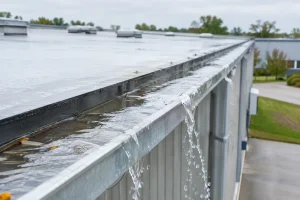
After major rain, some standing water may remain briefly on low-slope roofs. The issue is persistence, frequency and depth. Water that sits for extended periods places ongoing stress on membranes, laps, seams, fixings and drainage points. It also increases slip risk for maintenance crews and can accelerate biological growth and debris build-up.
More importantly, ponding usually tells you something structural or hydraulic is wrong. Falls may be inadequate. Drainage design may be undersized. Outlets may be blocked. The roof may have deflected over time. None of those issues improve on their own.
A roof does not need to be leaking today for ponding to be a genuine warning sign. It is enough that the roof is holding water where it should be shedding it. That is a performance failure in waiting.
When ponding points to a bigger problem
If ponding occurs near sumps, box gutters, plant zones or lap transitions, the risk profile increases. Those are already high-stress locations. Add standing water and the likelihood of accelerated failure rises fast.
Rust, corrosion and coating breakdown mean time is being lost
On metal roofing, corrosion is not just cosmetic. Surface rust can become section loss. Protective coating breakdown can expose broader areas to deterioration. Fasteners may loosen, back out or corrode at different rates to surrounding sheets. Flashings often fail before the main roof area and then open pathways for water entry.
The commercial mistake is waiting until corrosion looks severe from ground level. By then, replacement scope may be wider than expected. Early corrosion can often be managed strategically. Advanced corrosion narrows your options and pushes decisions into a more expensive corner.
The same principle applies to membrane roofs. UV degradation, blistering, cracking, splitting and seam fatigue all indicate the roof surface is losing resilience. Once the waterproofing layer is compromised, every storm becomes a test the asset may not pass.
Movement at laps, joints and penetrations is a major warning
Roofs move. Thermal expansion, wind load, building settlement and service penetrations all introduce stress. Good roofing systems account for that movement. Failing systems start to show where they cannot.
Look closely at sheet laps, membrane seams, cappings, termination points, skylight upstands, pipe penetrations and service mounts. Separation, lifting, distortion, failed sealants and loose fixings are not minor visual defects. They are indicators that detailing is breaking down under real operating conditions.
This is where independent assessment matters. Too many defect reports stop at describing the visible symptom without testing whether the original design, installation method or subsequent service works created the stress point. If movement is the cause, replacing sealant alone is not a fix. It is delay.
Drainage distress is one of the clearest top roof failure warning signs
Drainage failures are common because they are easy to dismiss until they become disruptive. Overflowing gutters, stained façades, blocked sumps, debris-loaded valleys, undersized downpipes and water backing up at outlets all point to a roof that is struggling to clear stormwater reliably.
On schools, hospitals, logistics facilities and government assets, that can quickly become more than a maintenance problem. It can affect safety, compliance, operations and stakeholder confidence. Overflow at entry points creates slip risk. Backflow can drive water into wall cavities. Chronic gutter surcharge can damage adjacent elements and create a false impression that the roof membrane itself is the only issue.
In large assets, drainage defects also distort lifecycle planning. Owners may budget for local roof repairs while the real capital need sits in drainage redesign, falls correction or broader rectification of hydraulic bottlenecks.
Soft spots, deflection and trapped moisture should not be guessed at
A roof that feels soft underfoot, shows unexplained deflection, or displays localised deformation deserves immediate technical review. These symptoms can indicate substrate deterioration, saturated insulation, concealed corrosion, failed decking or long-term moisture entrapment.
The key point is this: not all structural warning signs are dramatic. Some are subtle and progressive. A roof may remain trafficable and look passable from a distance while capacity and durability are being eroded below the surface.
This is where many portfolios lose control of the narrative. If no one has tested moisture migration, uplift risk, or the extent of concealed deterioration, planning becomes guesswork. Guesswork is how maintenance budgets get burned without materially reducing risk.
Why visible condition can be misleading
A roof can present reasonably well and still be nearing the end of practical service life. Surface appearance, especially after isolated repairs, is not enough. What matters is whether the system still performs consistently, drains correctly, withstands movement and protects the asset without repeated intervention.
Recurring repairs are themselves a warning sign
If the same area has been repaired multiple times, that history matters as much as the defect itself. Repeat attendance usually means one of three things: the diagnosis was wrong, the repair methodology was inadequate, or the underlying failure mechanism was never addressed.
For asset managers, this is where commercial discipline matters. Track the frequency, location and type of repair. Compare that against disruption, internal damage and contractor variation in diagnosis. A roof that needs constant reactive spend is giving you evidence. It is telling you the current approach is not controlling risk.
An independent inspection can reset the conversation. Roof Inspection Australia works in that gap between contractor opinion and owner accountability. We do not sell roofing. We just tell you what is failing, why it is failing, and what that means for cost, timing and risk.
What decision-makers should do when warning signs appear
Do not wait for consensus built around convenience. If several warning signs are present, act on evidence. Commission a condition assessment that looks at defect causation, extent, service life, drainage performance, compliance exposures and whether repairs are still commercially rational.
That last point matters. A roof can often be repaired technically long after it stops making sense financially. The job is not to keep a failing system alive at any cost. The job is to protect the asset, defend the budget and make a decision you can justify to owners, boards, tenants or procurement teams.
The earlier that happens, the more options you keep. Once failure becomes visible to occupants, operations and finance, the roof is no longer just an engineering issue. It is a management issue. Better to deal with it while you still have leverage.