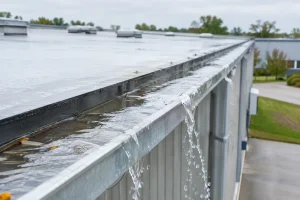




A roof leak rarely starts as a leak. It starts as a missed detail, a drainage fault, a failed lap, a cracked penetration seal, or a membrane system that was signed off long before it should have been. That is why a roof waterproofing assessment matters. For commercial property owners and asset managers, it is not a box-ticking exercise. It is a risk control tool.
If you are responsible for a hospital, logistics facility, school, office tower or government asset, the question is not whether water will test the roof. It will. The real question is whether you have clear, independent evidence of how the waterproofing system is performing now, what is likely to fail next, and what that means for budget, operations and liability.
What a roof waterproofing assessment actually tells you
A proper roof waterproofing assessment goes well beyond spotting obvious leaks or surface wear. It examines whether the roof is managing water as designed, whether detailing is fit for purpose, and whether the current condition supports the asset’s remaining service life.
That includes membrane condition, terminations, upstands, flashings, penetrations, joints, drainage paths, ponding behaviour, substrate movement, previous repair quality and signs of moisture entry. On larger or more complex sites, the assessment also needs to account for traffic exposure, plant interfaces, staging of prior works and whether multiple roofing systems have been poorly joined over time.
For decision-makers, the value is not in the defect list alone. It is in what that evidence allows you to do. You can separate minor maintenance from systemic failure, distinguish workmanship issues from age-related deterioration, and make decisions based on actual condition rather than contractor sales pressure.
That independence matters. A contractor inspecting a roof may be technically capable, but if they also sell repairs or replacement, their advice is never commercially neutral. The conflict is obvious. An independent consultant has one job – tell you what is there, what it means, and what needs to happen next.
Why waterproofing failures are often misread
Waterproofing problems are easy to oversimplify. A ceiling stain gets blamed on a single defect. A few blisters get written off as cosmetic. A persistent leak near a rooftop plant gets patched three times with no one asking why the area keeps failing.
Commercial roofs do not fail neatly. Water can travel. Symptoms appear far from the point of entry. Drainage defects can overload details that would otherwise perform adequately. Mechanical services trades can damage membranes during later works. A new coating can hide a poor substrate or trap existing moisture.
This is where many owners lose money. They pay for reactive work aimed at the visible symptom, not the failure mechanism. Six months later, the problem returns, often with more internal damage, more disruption and less confidence in everyone involved.
A competent assessment does not just identify where water is getting in. It explains why the assembly is vulnerable. That distinction is what turns inspection data into commercial leverage.
When a roof waterproofing assessment should be commissioned
Waiting for active leaks is poor asset strategy. By the time internal water ingress is obvious, the cost profile has usually worsened. Ceiling finishes, insulation, electrical systems, stock, equipment and tenant operations may already be affected.
The right time for a roof waterproofing assessment depends on the trigger. It is particularly valuable before end-of-defects inspections, before acquiring an asset, before a major lease commitment, after severe weather, when repeated repairs are not resolving the issue, or when capital planning decisions need to be made over the next one to five years.
It is also critical where contractor claims do not align with site reality. If one party says the roof needs full replacement and another says it only needs patching, you do not need more opinions from interested parties. You need evidence.
For portfolios, periodic waterproofing reviews are even more useful. They help compare risk across multiple sites, prioritise limited capital and stop the loudest leak from automatically getting the largest budget.
What a good assessment looks like in practice
Not all inspections are equal. A superficial walkover might identify obvious defects, but it will not support a defensible maintenance plan, procurement strategy or dispute position.
A strong roof waterproofing assessment should be methodical. It should record the roof type and waterproofing system, document defects with location-specific evidence, identify likely causes, assess severity, and explain the consequence of inaction. It should also comment on repairability. Some roofs are suitable for localised remediation. Others have reached the point where patchwork spending is simply disguised waste.
Just as importantly, the reporting should be readable by commercial stakeholders. Asset managers do not need vague technical jargon. They need clear findings, risk-based priorities and practical next steps.
That may include immediate safety or water-ingress risks, short-term maintenance actions, further diagnostic testing, scope recommendations for remedial works, or advice that a proposed replacement is premature. Good reporting gives you control. Poor reporting gives you paperwork.
The trade-off between repair, remediation and replacement
This is where many roof decisions go off track. Owners are often pushed towards the most expensive option before anyone has properly tested whether the existing waterproofing system can be stabilised.
Sometimes replacement is the right call. If the membrane is broadly deteriorated, detailing is fundamentally flawed, moisture is trapped across large areas, or repeated piecemeal work has created an unreliable patchwork, continuing to repair may not be defensible.
But the opposite is also true. Some roofs are condemned too early. Local failures, isolated drainage issues, damaged penetrations or poor previous repairs do not always justify full replacement. A disciplined assessment helps draw that line.
This is not just a technical judgement. It is a commercial one. Spending less now is not smart if it creates more operational risk, repeated access costs and accelerated capex later. Spending more now is not smart if the roof still has useful life and targeted remediation can extend it with confidence.
It depends on the asset, the risk tolerance, the occupancy profile and the planned holding period. That is exactly why independent advice matters.
What clients should demand from waterproofing advice
If you are commissioning a roof waterproofing assessment, demand clarity on three points. First, what is failing? Second, what is causing it? Third, what is the most commercially rational response?
If the report cannot clearly answer those questions, it is not doing enough.
You should also expect the assessor to challenge assumptions. If a recent refurbishment has already failed, that should be said plainly. If workmanship appears substandard, it should be documented. If a contractor recommendation is excessive, that should be tested against evidence. Protecting the client does not mean producing a polite report. It means producing a truthful one.
This is where an independent consultancy model is powerful. Roof Inspection Australia does not sell roofing works, products or replacement programmes. That changes the conversation. The advice is not designed to win the next package of works. It is designed to give the client leverage, control and a basis for defensible decisions.
Why this matters at portfolio and board level
Waterproofing defects are often treated as maintenance noise until they trigger something larger – a tenant dispute, a compliance issue, a shutdown risk, an insurance event or an emergency capex request. By then, the roof is no longer just a building element. It is a governance problem.
A credible roof waterproofing assessment helps prevent that escalation. It gives facility teams a basis for action, asset managers a stronger case for budget allocation, and executives a clearer view of risk exposure across the portfolio.
It also improves contractor accountability. When defects, causes and priorities are documented independently, it becomes much harder for underperforming parties to blur responsibility, oversell scope or hide behind vague language.
That is the bigger value. A roof assessment is not only about finding defects. It is about controlling the decisions that follow.
The smartest time to get clarity is before the next storm, before the next dispute and before another dollar is spent on the wrong fix.