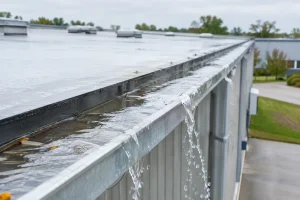




A roof replacement or major remediation can be one of the largest capital works items in a property portfolio. Yet many projects are effectively handed to the contractor who priced the work, with the client receiving progress updates rather than independent verification. Roof project oversight changes that equation. It gives asset owners evidence, technical leverage and a clear record of whether the work delivered matches the scope, specification and commercial promise.
For commercial property teams, the issue is not whether a contractor has attended site. The issue is whether the roof will perform through heat, wind, ponding water, building movement and years of maintenance traffic. Defects concealed beneath membranes, flashings or finishes are expensive to correct once practical completion has passed. Early intervention is not administrative overhead. It is capital protection.
Why contractor-led quality control is not enough
Competent roofing contractors carry out valuable work, but their quality systems do not remove the commercial conflict. They are responsible for delivering the works, managing labour, responding to programme pressure and protecting their own margin. Their inspection records may be useful, but they are not a substitute for an independent review on behalf of the asset owner.
This is particularly relevant where a project includes complicated interfaces: new roof areas tying into existing construction, penetrations for services, solar installations, drainage upgrades, parapet works, plant platforms or waterproofing transitions. Most serious failures occur at these details, not in the open field of a roof membrane. A roof can look finished from ground level and still contain conditions that will lead to water ingress, corrosion or premature failure.
Independent oversight creates a different reporting line. The consultant is not there to sell a variation, defend an installation method or create future repair work. Their role is to test the evidence against the agreed requirements and identify material risk while it can still be corrected.
What effective roof project oversight looks like
Oversight is not simply a final inspection with a defect list. By that point, critical work may be covered and access to the underlying cause is lost. Effective roof project oversight is planned around project milestones, with inspection points selected for the elements most likely to affect long-term performance.
Before work starts: remove ambiguity
The first control point is the scope. Many disputes that emerge during construction started with vague documentation, assumptions about substrate condition or a specification that did not properly address site constraints. Before mobilisation, an independent reviewer can assess the proposed system, details, sequencing and interfaces against the existing roof condition and the building’s intended use.
This does not mean redesigning every contractor proposal. It means asking the questions that protect the client later. Is the proposed membrane suitable for the environment? Are falls and outlets adequate? How will the contractor manage junctions to existing waterproofing? Are materials, thicknesses and fixings clearly nominated? Is there a documented approach for wet-weather protection, substrate preparation and testing?
These checks are especially valuable for occupied buildings. A logistics facility, school, hospital or government asset cannot absorb casual programme decisions that expose internal operations to rain damage. Buildability and staging need to reflect the operational risk, not merely the installation crew’s preferred sequence.
During construction: inspect what will soon be hidden
The strongest value of oversight occurs while work remains visible. This includes substrate preparation, removal of failed materials, moisture conditions, insulation placement, membrane laps, terminations, penetrations, outlets, flashings and expansion joints. Each is a potential failure point, and each becomes harder to verify after the next layer is installed.
Site inspections should be purposeful rather than theatrical. The question is not whether every square metre can be watched. It is whether high-risk details, representative areas and non-conforming work are identified in time. A clear inspection report should record observations, photographs, location references, the relevant requirement, risk level and the action needed. Vague language helps nobody. If a termination is incomplete or a drainage detail is likely to pond, the report should say so plainly.
The right frequency depends on project scale, system complexity, weather exposure and the contractor’s programme. A straightforward overlay on a small, accessible roof may need fewer hold points than a staged replacement across an active industrial site. The principle remains the same: inspect before concealment, not after the defect has become a warranty argument.
At completion: verify performance, not presentation
A neat-looking roof is not necessarily a compliant or durable roof. At practical completion, oversight should focus on whether the completed works align with the approved scope, accepted details and manufacturer requirements. It should also test whether the documentation is complete enough to support warranty, maintenance and future asset decisions.
That typically includes confirmation of completed areas, unresolved defects, drainage performance, penetrations and terminations, as-built records, test results where relevant, warranties and maintenance requirements. The aim is to distinguish minor finish items from defects that could compromise waterproofing, safety or service life.
A final report also gives project teams a defensible basis for managing retention, practical completion and post-completion rectification. This matters when multiple stakeholders are involved. Asset managers need a capital record. Facility managers need practical maintenance information. Owners and boards need confidence that the project risk has been properly controlled.
The commercial value is in the evidence
Roofing failures are often described as maintenance issues until the costs become too large to ignore. Water damage can interrupt tenants, damage stock, affect sensitive equipment, trigger mould concerns and force emergency works at the worst possible time. The original defect may be small. The downstream cost rarely is.
Independent reporting helps contain that exposure because it creates evidence at the point decisions are made. If a contractor disputes an issue, the client has dated photographs, observations and a technical explanation. If a variation is proposed, the client can assess whether it reflects a genuine concealed condition, an incomplete scope or an attempt to transfer avoidable cost. If a warranty claim arises later, there is a record of what was observed during the works and what was required to be rectified.
This evidence also improves internal governance. Capital works approvals are easier to defend when project decisions are supported by an independent technical record rather than informal site conversations. For public-sector, healthcare and education portfolios, that accountability is not optional. It is part of responsible asset management.
Common gaps that create avoidable exposure
The most costly oversight failures are usually ordinary rather than dramatic. A roof outlet may be poorly detailed. A membrane may be terminated incorrectly at a wall. Existing moisture may be trapped beneath a new system. Falls may be insufficient around plant or penetrations. New work may not integrate properly with older roof sections that remain in service.
Another common gap is treating the handover package as paperwork to chase at the end. If maintenance obligations, warranties, material records and as-built information are incomplete, the client loses control quickly. Six years later, when a leak emerges, no one can establish exactly what was installed, where the system changes occurred or whether maintenance conditions were met.
Programme pressure makes these issues more likely. When wet weather, tenant access restrictions or supply delays compress the construction schedule, quality can become a negotiation. It should not. A clear hold-point regime gives the principal a practical means of saying that critical work must be inspected and accepted before the project moves on.
Choosing an independent oversight partner
The right adviser should understand roofing systems, waterproofing behaviour, drainage, construction sequencing and the commercial realities of capital works. Just as importantly, they should be independent of repair and replacement sales. Advice is more useful when there is no product quota, installation target or future works pipeline influencing the finding.
Look for reporting that is specific enough to act on. Photographs without technical interpretation are not oversight. Neither are broad statements that a roof appears satisfactory. Decision-makers need to know what was observed, why it matters, what should happen next and the likely consequence of doing nothing.
Roof Inspection Australia approaches project oversight from that position: no roofing products, no repair agenda, and no reason to soften a finding. The purpose is to give clients the truth early enough to use it.
A roof project should not be judged by how clean it looks on handover day. It should be judged by whether the asset owner has evidence that the roof was built correctly, the risks were addressed and the investment has a credible path to its intended service life.