


A roof rarely fails when the budget says it should. It fails when water finds a path through an overlooked detail, drainage backs up during a major storm, or an ageing membrane reaches the point where patching is no longer credible. A proper facility roof budgeting guide starts with that reality: budgets based on assumptions are exposure, not planning.
For asset managers and facility teams, roofing expenditure is often treated as a maintenance line item until a leak interrupts operations, damages stock, closes a classroom or creates a safety issue. By then, the decision is no longer strategic. It is urgent, expensive and usually made with limited leverage over the contractor.
The objective is not to predict every defect years in advance. It is to establish the actual condition of the roof asset, quantify risk, stage expenditure intelligently and retain control of the procurement process.
Budget from evidence, not age or appearance
The age of a roof is a useful reference point. It is not a budget. Two roofs installed in the same year can have entirely different remaining service lives because of design, installation quality, maintenance history, traffic, drainage performance, exposure and prior repairs.
A roof that looks acceptable from ground level may have compromised laps, failed sealants, ponding water, deteriorated flashings or concealed moisture within the system. Equally, an older roof may remain serviceable if its waterproofing integrity is sound and defects are isolated. Replacing either roof on age alone is poor capital discipline.
Budget decisions should begin with an independent condition assessment that records the roof system, defects, likely failure mechanisms, drainage condition and repair history. The report needs to distinguish between work required now, work that can be planned, and work that should be monitored. That distinction is where capital control begins.
Contractor-led recommendations can be useful, but they must be tested. A contractor who quotes replacement also has a commercial interest in replacement. That does not make the recommendation wrong. It means the asset owner needs independent evidence before committing capital.
Build a roof budget across three horizons
A credible roof plan separates immediate risk from lifecycle investment. Combining everything into one annual maintenance allowance creates false comfort and encourages reactive spending.
Immediate: make the roof safe and watertight
This is the work that addresses active leaks, safety hazards, failed penetrations, blocked outlets, loose sheeting, damaged flashings and defects likely to escalate quickly. It may also include urgent investigation where moisture ingress is affecting electrical systems, ceilings, insulation or critical operations.
These items belong in the current operating or maintenance budget. Deferring them to preserve a number on a spreadsheet is rarely a saving. A small drainage correction can prevent internal damage and business interruption that costs many times more than the repair.
Near term: remove known failure points
The next one to three years should cover defects that are not yet causing a crisis but have a clear deterioration path. Typical examples include widespread sealant failure, coating breakdown, localised membrane degradation, corroding fixings, poor detailing at plant penetrations, ageing rooflights and inadequate overflow provisions.
This is the period in which planned works deliver real value. The team can scope the work properly, package compatible repairs together, obtain comparable pricing and schedule access around tenant, school, healthcare or production requirements. The alternative is paying emergency rates after the defect turns into a failure.
Long term: fund renewal before the decision becomes forced
The five to 15-year horizon is for major renewal, replacement and upgrade decisions. It should identify the likely timing range for major expenditure, not pretend to offer a single precise date. Roof condition is dynamic. Severe weather, accumulated patch repairs, plant changes and drainage failures can materially alter the trajectory.
Use condition evidence to set a renewal window, then review it after significant events and at regular inspection intervals. This gives finance teams time to reserve capital and gives asset managers time to decide whether renewal should coincide with solar installation, HVAC replacement, tenancy works, insulation upgrades or other planned projects.
What a defensible roof budget must include
A budget line for “roof repairs” tells a decision-maker almost nothing. It does not describe the risk, the scope, the basis of the estimate or the consequence of deferral. A defensible plan links each allowance to evidence and a defined outcome.
For every significant item, record the roof area or asset affected, the defect or condition driver, recommended scope, priority, anticipated timing and estimate basis. State whether the figure includes access, design, removal of existing materials, temporary weather protection, testing, disposal, project management and contingencies. These costs are often omitted from early estimates, then reappear as variations.
The budget should also identify dependencies. A roof replacement may be delayed by operational constraints, but that delay may require interim remediation. Installing new rooftop plant may require structural review, new penetrations, drainage changes and warranty implications to be addressed first. A cheap scope that ignores these interfaces is not cheap. It is incomplete.
Allow for investigation where certainty is not yet available
Not every risk can be priced accurately from a visual inspection. Suspected trapped moisture, substrate deterioration, concealed corrosion or complex waterproofing interfaces may require targeted testing or opening-up works.
Do not force a false number into the capital plan simply because a budget cycle demands one. Allocate an investigation allowance, define the question it will answer and identify the decision it will support. Spending modestly to confirm the extent of a defect is often the difference between a controlled project and a major contingency claim.
Treat drainage as a budget driver, not a maintenance afterthought
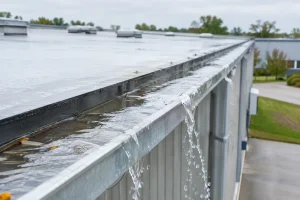
Many roof failures are water-management failures. Blocked outlets, inadequate falls, undersized drainage, poorly located overflows and ponding around penetrations can shorten the life of otherwise sound roofing materials.
Drainage work can be difficult to justify when there is no visible leak. That is precisely why it gets deferred. Yet persistent ponding increases load, accelerates deterioration and exposes building occupants and operations when storm intensity exceeds the system’s capacity.
Assess drainage alongside the roof covering. Confirm whether outlets are accessible for cleaning, whether overflows are present and functional, whether ponding is localised or systemic, and whether recent building alterations have changed water flow. If drainage defects are contributing to deterioration, repair allowances alone will not solve the problem.
Use independent scope development to protect procurement
Once a project enters the market, the quality of the scope determines the quality of the prices received. Vague scopes invite exclusions, assumptions and wildly different tender returns. They also make it almost impossible to compare contractors fairly.
An independent consultant can convert inspection findings into a clear work package, including materials, detailing requirements, drainage works, access constraints, quality controls, testing and handover documentation. The contractor then prices a defined outcome rather than selling their preferred solution.
This changes the commercial conversation. Instead of asking, “What do you recommend?”, the asset owner can ask, “Price this scope, explain any departure, and demonstrate how you will meet the required standard.” That is leverage.
Roof Inspection Australia does not sell repairs, replacement systems or roofing products. Its role is to provide the evidence and technical clarity owners need before money is committed, during procurement and while works are being delivered.
Review the plan after weather events and building changes
A roof budget is not a document to file after approval. It should be reviewed when the building changes and when the roof has been tested.
Major storms, new rooftop services, solar works, tenancy fit-outs, façade projects and recurring leaks can all change risk and expenditure timing. So can a contractor’s proposed repair method. If it introduces incompatible materials, additional penetrations or unaddressed drainage issues, the lifecycle plan should be reassessed before approval.
Annual inspections are sensible for many commercial assets, but inspection frequency depends on roof type, condition, building use, exposure and consequence of failure. Healthcare facilities, schools, logistics operations, data-sensitive spaces and public buildings may warrant closer oversight because the cost of disruption is high.
Make the budget useful in the boardroom
Technical detail matters, but decision-makers also need a clear commercial narrative. A roof budget should show what will happen if funds are approved, what is likely if works are deferred, and which risks cannot be transferred to a contractor through wording alone.
Present the plan as choices with consequences. Fund targeted repairs now to protect the current asset. Invest in drainage correction to reduce repeat failure. Start renewal design early to avoid an emergency replacement later. Each decision should be supported by photographs, defect locations, condition ratings and a transparent estimate basis.
The strongest roof budget is not the lowest figure. It is the one that gives the organisation enough evidence to spend at the right time, challenge poor advice and avoid being forced into a high-cost decision after water is already inside the building.