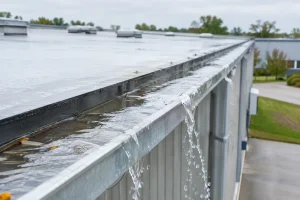




A roof starts leaking six months after handover, the contractor says it is maintenance, the owner says it is defective work, and the budget gets dragged into a fight nobody planned for. That is where a commercial roof dispute case study becomes useful – not as a war story, but as a clear example of how evidence changes leverage.
For commercial property owners and asset managers, roof disputes are rarely about one leak. They are about accountability, warranty exposure, latent defects, programme delays, tenant disruption, and whether capital works were delivered to the standard that was paid for. When the facts are vague, the loudest party usually wins. When the evidence is clear, the decision-maker gets control back.
A commercial roof dispute case study with real commercial lessons
This case involved a large-format commercial facility in Australia with a low-slope metal roof, multiple box gutters, roof-mounted plant, and several membrane transitions around penetrations and upstands. Within the first year of occupancy, the site experienced repeated water ingress during moderate to heavy rain. The leaks were not isolated to one area. They appeared at internal wall lines, around service penetrations, and beneath sections of roof drainage infrastructure.
The builder’s position was predictable. Some leaks were attributed to extreme weather. Others were blamed on poor maintenance, blocked drainage points, or alleged post-handover damage by other trades. The owner’s team had a different view. They had a relatively new roof, an operational building, and a growing list of defects that did not line up with the project brief or the contractor’s assurances.
At that point, the problem was no longer purely technical. It had become commercial. Every week without a clear diagnosis increased risk, delayed rectification, and weakened the owner’s position in conversations about responsibility.
What made this roof dispute hard to resolve
On paper, the dispute looked simple. Water was entering the building and the parties needed to identify the cause. In practice, it was messy.
The roof had been touched by multiple parties across design, construction, services installation, and post-completion access. The as-built documentation was incomplete in key areas. Some details shown on drawings did not match what was installed on site. There were also signs of reactive patching after practical completion, which confused the timeline and gave each party room to shift blame.
This is common in commercial roofing disputes. The issue is not just whether a roof leaks. The issue is whether the leak is tied to design error, workmanship failure, material incompatibility, inadequate falls, poor drainage capacity, defective flashing installation, movement, or later interference. If you cannot separate those causes, you cannot assign responsibility with confidence.
That is why contractor-led inspections often fail to settle disputes. A repair contractor may identify symptoms and propose works, but if they also stand to profit from the solution, their report can struggle under scrutiny. In a dispute, independence matters because the report needs to survive challenge, not just sound plausible on site.
The inspection approach that changed the conversation
The owner engaged an independent roofing consultant to assess the roof system, document the condition, and determine likely causes of water ingress. The brief was not to quote repairs. It was to establish facts.
The inspection combined close visual review, moisture tracing, detail assessment at penetrations and terminations, drainage review, and correlation against available design and construction documents. The exercise focused heavily on buildability and on whether installed details could reasonably be expected to perform under normal service conditions.
Several key findings emerged.
First, there were measurable drainage deficiencies. Localised ponding was evident near sumps and in transitional areas where falls had not been properly achieved. On a commercial roof, ponding is not just untidy. It increases stress on laps, sealants, and terminations, and it raises the chance of water tracking into minor defects.
Second, there were workmanship issues at critical waterproofing interfaces. Some membrane terminations lacked proper mechanical restraint. Certain penetrations had inconsistent sealing and poor detailing. In a few areas, installed flashings did not adequately manage water movement away from vulnerable junctions.
Third, several roof-mounted services had been integrated poorly. This mattered because it exposed a familiar grey zone. The builder argued those areas had been altered by services trades. The inspection evidence showed that some detailing failures were present in the original installation logic, regardless of who made the final cut or penetration. That distinction was important. It shifted part of the conversation from damage attribution to system responsibility.
Finally, the report identified maintenance issues, but not as the primary cause. Yes, there was debris in sections of guttering. Yes, routine cleaning would improve performance. But the inspection made a sharper point: normal maintenance assumptions do not excuse a roof that lacks sufficient tolerance for ordinary operating conditions. A commercial roof should not depend on perfect housekeeping to avoid failure.
Why the report mattered more than the opinion
Many people in a roof dispute have opinions. Few have evidence presented in a way that holds up commercially.
The turning point in this matter was not a dramatic discovery. It was the structure of the reporting. The findings were mapped to specific roof zones, photographed properly, described in plain commercial language, and separated into probable defect categories. The report distinguished between workmanship defects, design-related concerns, maintenance observations, and issues requiring further intrusive review.
That level of separation matters. If every problem is bundled together, the responsible party can dismiss the whole document as vague or overstated. If each issue is isolated and tied to a likely cause, it becomes much harder to avoid accountability.
For the client, the report also created internal clarity. Asset managers, legal advisers, project stakeholders, and contractors were no longer arguing from scattered emails and site comments. They were working from one evidence base. That reduced noise and improved negotiating position.
The commercial outcome
The dispute did not end because everyone suddenly agreed. It ended because the room for denial narrowed.
Armed with an independent technical report, the owner was able to challenge broad contractor defences and push for targeted rectification. Some items were accepted as builder responsibility. Others required coordinated works involving roofing and services interfaces. A smaller subset remained shared or disputed, but the scope of disagreement shrank materially.
Just as importantly, the owner avoided two expensive mistakes. The first was authorising broad replacement works without clear causation. The second was accepting a superficial patch-and-monitor approach that would have left the underlying drainage and detailing problems in place.
This is the value of independent advice in a commercial roofing dispute. It protects budget by preventing overreaction and underreaction at the same time. You do not want to replace a roof section that can be rectified properly. You also do not want to keep patching a roof that was installed with systemic defects.
What this commercial roof dispute case study shows
The core lesson from this commercial roof dispute case study is blunt: if the person diagnosing the problem also wants to sell the fix, you should assume the evidence needs testing.
That does not mean every contractor is wrong. It means commercial decisions need a higher standard than reassurance. In contested situations, independent inspection gives owners and asset teams three things they usually lack at the start of a dispute – technical clarity, commercial leverage, and a defensible record.
It also exposes the trade-offs. Sometimes the report will confirm a contractor defect and support a hard claim. Sometimes it will show the issue is mixed, with design limitations, maintenance gaps, and trade coordination failures all contributing. That answer can feel less satisfying, but it is still valuable because it stops the wrong party carrying the whole cost and prevents wasted time chasing the wrong remedy.
For complex assets, especially those with plant-heavy roofs, membrane interfaces, ageing drainage systems, or recent handover concerns, speed matters. The earlier the evidence is captured, the less chance there is for weathering, further works, or informal patching to blur the record. Once that happens, proving cause becomes harder and positions harden.
An independent consultant such as Roof Inspection Australia is not there to make the situation sound nicer than it is. The job is to tell you what is actually on the roof, what is likely causing the failure, and where responsibility appears to sit based on evidence. That is how disputes move from noise to action.
If you are dealing with recurring leaks, warranty resistance, or conflicting contractor narratives, do not start with a quote for repairs. Start with the truth. It is usually the cheapest leverage you will buy.