



A roof report that says “fair condition” is not a management tool. It is an opinion with no commercial weight. The best roof reporting templates turn site observations into evidence that can support a maintenance decision, challenge a contractor scope or defend a capital request at board level.
For commercial assets, a reporting template is not simply a neat document layout. It determines what gets inspected, what is missed, how risk is ranked and whether the person holding the budget understands the consequence of delay. A useful template must make defects visible, assign accountability and provide a clear path from finding to action.
What the Best Roof Reporting Templates Must Do
The right template depends on the property, roof type and decision required. A logistics facility with 40,000 square metres of metal deck roofing needs a different reporting structure from a hospital with complex plant penetrations, multiple waterproofing systems and no tolerance for water ingress.
That said, every credible commercial roof report should establish four things: the roof system and its current condition, the evidence supporting each finding, the risk posed by inaction and the recommended response. If one of those elements is absent, the report leaves too much room for assumption, sales pressure or dispute.
A template should also separate urgent defects from planned works. A blocked box gutter requiring immediate clearing is not the same as an ageing membrane that should be included in a five-year capital plan. Combining both under a single “repairs required” heading creates confusion and distorts budgets.
1. Roof Condition Assessment Template
This is the foundation report for an owner, asset manager or facility team that needs an independent view of the roof’s overall condition. It should record the roof construction, approximate age, accessible areas, roof coverings, flashings, penetrations, drainage components, safety systems and visible previous repairs.
The condition assessment template works best when it uses a defined condition scale rather than loose language. Terms such as good, fair and poor are often interpreted differently by different readers. A more useful approach identifies condition by element, explains the observed deterioration and states whether the issue affects weatherproofing, safety, compliance or service life.
Photographic evidence matters. Each image should be traceable to a location and defect reference, not dropped into the report as decoration. A photograph of ponding, corrosion or failed sealant is useful only when the reader can identify where it is, why it matters and what should happen next.
2. Defect Register and Rectification Template
A defect register is the report format that gives clients control over contractor discussions. It converts scattered observations into a numbered schedule of faults, locations, likely causes, risk ratings and recommended corrective actions.
For every defect, the template should identify the relevant roof area, component, severity, supporting photograph and whether further investigation is needed. It should also distinguish between an observed failure and a probable cause. For example, water staining below a penetration is evidence of ingress. The failed penetration flashing may be the cause, but that should be verified before an expensive scope is approved.
The strongest defect registers do not prescribe unnecessary replacement. They state what is known, what remains uncertain and what level of work is justified by the evidence. This is where independent reporting becomes commercially valuable. We do not sell roofing. The assessment should not be written to create a repair opportunity.
3. Leak Investigation Template
A leak report needs more discipline than a standard roof inspection. The visible internal leak point is frequently remote from the entry point, particularly on low-slope roofs, roofs with insulation layers or buildings where water tracks along structural members.
A practical leak investigation template records the reported leak history, weather conditions, internal damage location, roof area above and adjacent to the affected space, moisture indicators and the results of testing where undertaken. It should identify whether the cause is confirmed, probable or still unverified.
This distinction protects the client. A contractor who sees a ceiling stain and immediately recommends broad membrane replacement may be correct, but the evidence must support the recommendation. Targeted investigation can expose a local flashing failure, drainage overflow or services penetration issue that is cheaper and faster to rectify.
4. Drainage and Ponding Review Template
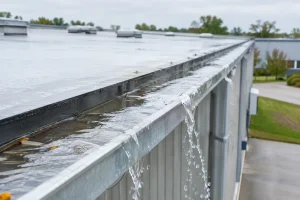
Drainage failures are rarely minor. Water that remains on a roof accelerates coating breakdown, loads gutters and penetrations, encourages corrosion and can expose design or maintenance failures. Yet drainage is often reduced to a brief line item in general inspection reports.
A dedicated drainage template should map gutters, sumps, outlets, overflows, downpipes and known low points. It should note blockages, inadequate falls, debris accumulation, corrosion, overflow evidence and ponding depth or extent where relevant. The report must assess capacity and discharge paths, not merely confirm that outlets exist.
For large commercial roofs, include rainfall performance history and maintenance records where available. A drainage system may appear acceptable during dry conditions but repeatedly overflow in a moderate storm. Those facts change the priority of works and may affect compliance, tenant risk and insurance conversations.
5. Roof Lifecycle and Capital Planning Template
Asset owners do not need a report that simply says replacement will be required “in due course”. They need a defensible forecast that helps organise capital expenditure before failure dictates the timing.
A lifecycle template separates routine maintenance, condition-based repairs, renewal works and full replacement. It should estimate remaining service life by roof zone, identify the assumptions behind that estimate and note the factors that could shorten it, such as poor drainage, incompatible repairs, heavy plant traffic or repeated water ingress.
The report should avoid false precision. No consultant can responsibly guarantee a membrane will last exactly seven years based on a visual inspection alone. But a useful assessment can provide a realistic planning range and recommend investigation or testing where the investment decision requires greater certainty.
For portfolio managers, consistency is critical. If every site uses a different condition scale and cost basis, prioritising projects becomes guesswork. A standardised lifecycle template allows assets to be compared on risk, remaining life and expected expenditure.
6. Practical Completion and Handover Template
New roofs and major refurbishment works require a different lens. At handover, the question is not whether the roof looks new. The question is whether the installed system matches the documented design, is fit for purpose and has been delivered with the evidence needed to protect the owner later.
A practical completion template should address workmanship, materials, detailing, falls, drainage, penetrations, interfaces with other trades, damage, incomplete works and site cleanliness. It should also record outstanding documentation such as warranties, test records, product data, maintenance requirements and as-built information.
This template is most effective before final payment and before a builder or contractor demobilises. Once access equipment, labour and commercial leverage have disappeared, rectification becomes slower and more expensive. Handover is the point to identify defects, not the first heavy rain event.
7. Maintenance Verification Template
Maintenance reports are often too vague to prove whether scheduled work has actually protected the roof. “Gutters cleared” does not tell an asset manager which gutters were cleared, what was removed, whether outlets were tested or whether defects were identified during the visit.
A maintenance verification template records the date, weather, roof areas accessed, tasks completed, findings, photos and limitations. It should also track recurring issues, including chronic debris sources, repeated ponding and failed repairs. This converts maintenance from a recurring invoice into a measurable risk-control activity.
The template should not be used to mask defects through repeated patching. If the same repair is appearing every six months, the report needs to say so plainly. Persistent defects are a signal to investigate root cause, review design details or prepare a renewal strategy.
Choosing a Template Without Creating More Paperwork
The best reporting format is the one matched to the decision in front of you. Use a condition assessment when you need a broad asset view. Use a defect register to obtain comparable repair pricing. Use a leak investigation when the source is disputed. Use a handover report when payment and warranty risk are still live.
Avoid asking one generic template to do every job. It usually produces a long report with little priority, weak evidence and no useful commercial direction. A short, targeted report that clearly states the risk, evidence and required action is more valuable than fifty pages of technical noise.
Before approving the next roof report, ask one practical question: could this document help you say no to an unsupported scope of works, or yes to a necessary one with confidence? If the answer is no, the template needs more than a cosmetic update.