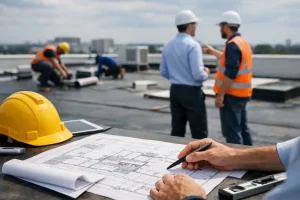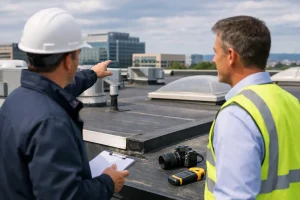




A roof specification review is not a paperwork exercise to complete between tender issue and site mobilisation. It is the point at which an owner can identify whether a proposed roofing solution will actually protect the asset, comply with the brief and be buildable in the real conditions of the site. Once materials are ordered and work begins, vague wording becomes variation claims, compromised details and a much weaker bargaining position.
For commercial property owners, asset managers and project teams, the specification is where cost, performance, warranty and accountability meet. A contractor may be capable of installing a roof correctly, yet still price and build to a specification that leaves critical interfaces unresolved. That is not necessarily misconduct. It is often what happens when the document is incomplete, generic or written without enough understanding of the existing building.
The commercial question is simple: does the specification give you control over the outcome, or does it leave the outcome open to interpretation?
What a roof specification review should test
A proper review tests more than whether the nominated membrane, sheeting profile or insulation appears suitable. It examines whether the design responds to the building, the site constraints and the risks that have already emerged through inspection.
On an occupied healthcare facility, for example, the sequence of works, weather protection and temporary waterproofing can be as significant as the selected roof system. On a logistics facility, drainage capacity, penetrations for services and access around plant may determine whether a new roof performs for its intended life. For a school or government building, compliance, safety, public access and procurement clarity can shape the specification as much as the roof covering itself.
The review should establish whether the scope is sufficiently detailed for comparable tender pricing and defensible construction. It should also expose assumptions that have been pushed into contractor exclusions, provisional sums or broad clauses such as “make good as required”. Those phrases can be appropriate where genuine unknowns exist, but they should never conceal foreseeable work.
A useful specification answers four questions clearly: what is to be built, how it is to be built, what standard it must achieve, and how compliance will be verified. If any answer relies on a site-based decision after award, the client is carrying avoidable risk.
Start with the existing roof, not the preferred product
Many weak specifications begin with a product solution and work backwards. The better approach starts with evidence from the existing roof. That evidence should include its condition, construction, moisture history, drainage performance, movement, plant interfaces, access arrangements and previous repair patterns.
A replacement specification based only on age or visible deterioration can miss the cause of failure. Blistering may point to trapped moisture, poor substrate preparation or incompatible materials. Persistent ponding may be a design and falls issue rather than a membrane issue. Replacing the roof covering without addressing the contributing condition simply resets the clock on the same problem.
This is particularly relevant to refurbishment projects. Existing drawings are often incomplete, previous alterations may not be documented, and concealed conditions can affect buildability. A specification should identify known constraints and set a controlled process for investigating unknown conditions. It must not pretend that uncertainty does not exist, but neither should it give the successful contractor a blank cheque.
Independent assessment matters here because product selection and repair recommendations can be influenced by what a contractor installs or sells. Roof Inspection Australia does not sell roofing. The value of independent review is that the proposed system can be tested against the asset’s needs rather than a sales agenda.
Detail the interfaces where roofs actually fail
Large roof areas are rarely the source of the most expensive defects. Failures commonly occur at interfaces: parapets, gutters, sumps, rooflights, penetrations, expansion joints, plant plinths, wall flashings and transitions between systems. These details need drawings, dimensions, material compatibility requirements and installation expectations that reflect the actual site.
A generic detail copied from a manufacturer manual may be technically sound in isolation and still be unbuildable on the building in question. There may be insufficient upstand height, limited clearance around mechanical plant, conflicting services or a substrate that cannot accept the proposed fixing method. The review needs to ask whether the detail can be installed, inspected and maintained after handover.
Drainage deserves the same scrutiny. Roof drainage is often treated as a secondary consideration until water remains on the surface after rain. The specification should define how falls will be checked, how outlets and overflows will be managed, how gutters will be restored or replaced, and how water will be controlled during staged works. A new membrane over an underperforming drainage arrangement is not a complete solution.
Check the scope for commercial ambiguity
Tender returns can look competitive while concealing completely different interpretations of the work. One contractor may include removal and disposal of all existing materials, another may allow only for visible layers. One may include edge restraint upgrades and temporary weatherproofing, another may exclude them. If those differences are not resolved before appointment, the cheapest price can become the most expensive procurement decision.
A roof specification review should identify omissions and force them into the open before tenders are compared. Particular attention should be paid to demolition, hazardous materials, substrate repairs, wet insulation or decking, service relocations, craneage, protection of occupied areas, after-hours work, testing, cleaning and handover documentation.
The aim is not to eliminate every contingency. Old buildings contain unknowns, and sensible procurement allows for them. The aim is to distinguish genuine latent conditions from work that was always necessary but was left out of the written scope. That distinction gives the client leverage when variations arise.
Quality requirements also need to be measurable. “Install to manufacturer recommendations” is not enough on its own. The specification should state the required system, preparation, compatibility, fixing pattern where relevant, minimum upstand heights, treatment of laps and terminations, test requirements, hold points and rectification process. It should set out what evidence the contractor must provide, including photographs, inspection records, test results, warranties and as-built information.
Make compliance and warranty requirements specific
Compliance language is often broad because every project has different statutory, insurance, fire, wind, safety and building-code considerations. Broad language is not an excuse for vague responsibility. The specification should identify the applicable performance requirements and make clear who is responsible for design confirmation, certification, product approvals and evidence of compliance.
Warranties require the same discipline. A long warranty term has limited value if the installation conditions, maintenance obligations or product limitations are not understood. Review whether the specified system is approved for the building type, exposure conditions and roof geometry. Confirm that junction details, substrates and accessory components do not void the warranty. Then ensure the handover requirements create a record the owner can rely on later.
Use the review to protect delivery, not just design
The specification is only useful if it supports control during construction. It should include practical inspection and hold points at stages when defects can still be corrected without dismantling completed work. These may include substrate preparation, moisture checks, falls, flashing installation, penetrations, drainage details and final testing.
Project oversight is more effective when the acceptance criteria were set before work commenced. Without them, site inspections can become arguments about opinion. With them, the discussion is grounded in documented requirements, observable evidence and the contract scope.
This approach also protects capable contractors. Clear requirements reduce late changes, avoidable rework and disputes caused by unclear client expectations. The point is not to make construction harder. It is to make responsibility visible.
A strong review should also consider maintainability. Can gutters be safely accessed and cleaned? Are roof-mounted services creating future waterproofing risk? Will maintenance teams be able to inspect critical details without damaging the roof? A system that is difficult to maintain may satisfy a short-term construction brief while creating a predictable lifecycle cost for the owner.
When should the review happen?
The best time is before a specification is issued for tender. At that stage, gaps can be corrected without resetting the procurement process, and all bidders can price the same work. A review can still add value after tenders are received, particularly where prices vary sharply or exclusions reveal inconsistent assumptions. However, the client’s options narrow once a contractor is appointed.
For new construction, review should occur before final design documentation is released and again when shop drawings or proposed substitutions are submitted. For refurbishment, it should follow a condition assessment and investigation of the existing roof. The quality of the specification cannot exceed the quality of the information used to prepare it.
The roof is a high-consequence building element. It protects operations, equipment, stock, occupants and the capital value of the property. Treat its specification as a control document, not a formality, and you retain the evidence and leverage needed to make the right call before the cost of being wrong is built into the roof.