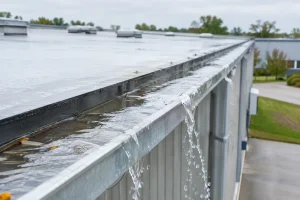




A roof that has not yet leaked into an occupied space can still be a capital risk. Failed laps, blocked outlets, deteriorated penetrations and ponding may sit out of sight until a heavy weather event turns a manageable refurbishment into an urgent operational problem. This roof refurbishment planning guide is for asset teams that need control before committing substantial capital to commercial roofing works.
Refurbishment is not simply a larger maintenance job. It is a decision about risk, remaining service life, business continuity and where capital will produce the strongest return. Get the diagnosis wrong and the project may merely cover defects, create warranty disputes or spend money on the wrong part of the roof.
Start with facts, not a contractor proposal
A contractor quote is not a roof condition assessment. It is a commercial response to a stated scope, often prepared from a limited inspection and shaped by the contractor’s preferred system, labour model and appetite for work. That does not make every contractor recommendation wrong. It does mean it should not be the sole basis for a major capital decision.
Before defining a refurbishment scope, establish what is actually happening across the roof. This requires an inspection that considers the roof covering, flashings, penetrations, drainage, joints, safety access, substrate condition and interfaces with walls, plant and adjoining structures. The visible membrane is only part of the risk.
For large portfolios, a consistent asset condition report also creates a defensible baseline. It lets management compare buildings, sequence expenditure and explain why one site needs intervention ahead of another. Without that baseline, budgets are often driven by the loudest complaint or the most persuasive quote.
An independent assessment matters because the assessor is not trying to sell a replacement, coating or repair crew. Roof Inspection Australia operates on that principle: no roofing products, no repair agenda, just evidence that gives clients leverage over the next decision.
Define the refurbishment problem precisely
The term ‘refurbishment’ can describe very different work. It may involve localised repairs and drainage corrections, a new membrane over an existing system, removal and replacement of failed roofing, replacement of deteriorated flashings, or remediation of defects caused by previous work. Each option carries different cost, risk and service-life implications.
The first planning question is not, “What system should we install?” It is, “What failure are we solving?” A roof with isolated mechanical damage and otherwise sound waterproofing may justify targeted remediation. A roof with widespread loss of adhesion, moisture-affected insulation, failing details and chronic ponding may not. Applying a new surface over compromised materials can defer disruption, but it can also conceal deterioration and complicate future investigations.
Asset teams should ask for clear answers on the cause, extent and consequence of each defect. Are leaks related to drainage capacity, overflow paths, failed penetrations, movement, poor installation, or ageing materials? Is water entering the building, trapped within the roof build-up, or simply ponding on the surface? Those distinctions determine whether the right answer is repair, renewal or a staged programme.
Build a scope that can be priced and delivered
A weak scope invites a low initial price and expensive variations. It also makes it difficult to compare tenders because each contractor is pricing a different interpretation of the problem. The objective is not to prescribe every installation method without reason. It is to define the required outcomes, known risks, quality controls and interfaces clearly enough that pricing is comparable and accountability is real.
A useful refurbishment scope should address the existing roof construction, areas to be retained or removed, treatment of wet or degraded materials, drainage modifications, flashings, penetrations, plant plinths, temporary weatherproofing, access constraints and protection of occupied areas. It should also specify how unknown conditions will be managed. Unknowns cannot be eliminated, particularly on older buildings, but they can be identified, investigated where practical and allowed for transparently.
The evidence package should be strong enough for tenderers, project managers and stakeholders to work from. It commonly includes:
- annotated roof plans identifying defects, work zones and drainage paths
- photographs tied to locations, not a gallery of unlabelled images
- a schedule of condition findings and recommended actions
- specifications for materials, detailing and quality requirements
- hold points for inspections, testing and acceptance.
Details matter disproportionately. A new membrane will not compensate for a poorly resolved penetration, ineffective overflow, incompatible sealant or flashing that cannot accommodate movement. Many repeat failures occur at transitions, not in the broad field of the roof.
Plan around water management and building operations
Drainage should be assessed as part of the refurbishment, not treated as a minor trade item. Roof outlets, sumps, overflows, box gutters and discharge paths must be capable of managing design rainfall and blockage scenarios appropriate to the building. A membrane replacement that leaves inadequate falls or undersized drainage in place can preserve the original failure mechanism.
This is especially relevant to large industrial, healthcare, education and government assets where roof geometry has been altered over time. New plant, services, solar infrastructure and ad hoc repairs may have disrupted falls or created obstructions. The effect may only be apparent in sustained rain, when the consequence is greatest.
Operational planning is equally important. Consider tenant activity, sensitive equipment, clinical areas, school calendars, manufacturing shutdowns, security, crane access, noise and the risk of temporary openings during wet weather. The cheapest construction sequence can be the most expensive option if it disrupts a critical site or leaves the building exposed.
A staged approach can be sensible where capital is constrained or the roof has distinct condition zones. But staging must be based on risk and logical waterproofing boundaries, not simply on arbitrary budget splits. Deferring work around a failed detail may force unnecessary rework when the next stage begins.
Test the commercial assumptions before approval
Refurbishment budgets should include more than the contractor’s base price. Allow for investigation, design, approvals, access, removal and disposal, temporary protection, testing, independent inspections, contingency and potential latent-condition works. A low headline number often excludes the very issues most likely to emerge once work starts.
Contingency should reflect the quality of available information. On an accessible, well-documented roof with targeted opening-up investigations, the unknowns may be limited. On an older roof with multiple overlays, concealed substrates and a history of leakage, a thin contingency is not prudent budgeting. It is optimism presented as control.
Tender evaluation should also look beyond price. Compare proposed systems, exclusions, programme, labour resources, safety approach, warranty terms, substrate assumptions and the contractor’s response to critical details. If one tender is significantly cheaper, find out what has been omitted or assumed before treating it as a saving.
Warranties require the same scrutiny. A long warranty does not repair poor detailing, inadequate maintenance or defects excluded by its terms. Confirm who provides it, what it covers, what inspections and maintenance are required, and whether the proposed scope satisfies the manufacturer’s requirements. A warranty is a contractual instrument, not proof of quality.
Use independent hold points during construction
Once works begin, the project’s risk profile changes. Existing defects are exposed, weather windows narrow and decisions are made quickly on site. If quality checks occur only at practical completion, many critical elements are already concealed.
Independent project oversight provides a clear line of sight at the moments that matter: substrate preparation, treatment of wet materials, drainage corrections, membrane installation, flashings, penetrations, testing and defect rectification. These checks are not about interfering with the contractor’s work. They are about verifying that the approved scope is being delivered and recording any departure before it becomes expensive to reverse.
Site records should capture progress, non-conformances, instructions, photographs and test results. This documentation protects the asset owner if disputes arise and gives facility teams meaningful handover information. A completion certificate without evidence of what sits beneath the finished surface offers limited comfort.
Set up the roof for its next decade
Handover is the point to establish a maintenance regime, not the end of responsibility. Facility teams need current roof plans, warranty information, maintenance requirements, drainage cleaning schedules, access rules and a record of completed works. New plant installations, solar upgrades and service penetrations should be controlled from this point forward. Unmanaged trade access is a common way to damage a newly refurbished roof.
The strongest refurbishment plans are not built around a product or a contractor’s preferred answer. They are built around verified condition, clear scope, realistic risk allowances and independent quality control. When the evidence is clear before work starts, asset teams can spend with confidence rather than hope the roof holds until the next storm.