

A commercial roof can look serviceable from the ground and still carry a seven-figure liability. Pre purchase roof due diligence gives buyers, funders and advisers evidence of what sits above the ceiling line before the transaction closes – not after the first major rain event, tenant complaint or insurance query.
For high-value assets, a roof is not a minor building element. It protects operations, stock, equipment, people and lease revenue. If its condition is unknown, the acquisition model is incomplete. The issue is not whether a roof has defects. Most roofs of any age do. The issue is whether those defects are understood, costed and assigned to the right party before the buyer loses commercial leverage.
Why roof due diligence changes the deal
General building inspections are useful, but they rarely provide the depth required to assess a large commercial roof. A brief visual review may identify obvious corrosion, damaged sheets or ponding water. It will not necessarily establish the condition of concealed waterproofing interfaces, the adequacy of drainage falls, the extent of historic patching, the quality of prior repairs or the likely timing of capital works.
That distinction matters during acquisition. A roof with isolated maintenance defects may be a manageable operating cost. A roof approaching failure, with incompatible repair materials or systemic drainage problems, is a capital expenditure event. Treating both conditions as the same thing creates bad assumptions in the purchase price, asset plan and post-settlement budget.
Independent roof due diligence turns a vague concern into a defensible position. It can support a price adjustment, a vendor rectification requirement, a retention amount, further investigation or a deliberate decision to accept the risk. Without evidence, these decisions are driven by optimism, contractor opinion or incomplete documentation.
What pre purchase roof due diligence should examine
A useful assessment is not a checklist of visible faults. It should connect physical condition to risk, cost and timing. The scope needs to reflect the roof type, age, building use, access constraints and transaction risk profile.
Roof covering, waterproofing and interfaces
The primary roof surface is only part of the system. Inspections should assess sheets, membranes, flashings, penetrations, laps, joints, parapets, gutters, rooflights and transitions between materials. These interfaces are where water commonly enters.
The question is not simply whether a repair can be applied. Almost anything can be patched. The question is whether the roof has a stable, compatible and maintainable system beneath those patches. Repeated local repairs may be reasonable on a younger roof with isolated damage. On an ageing roof, they can indicate deferred renewal and a growing failure pattern.
Drainage and ponding risk
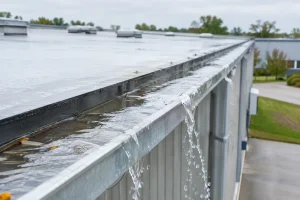
Drainage defects are routinely underestimated because they are often invisible in dry weather. Blocked outlets, undersized drainage, inadequate overflows, poor falls and local deflection can cause ponding. Standing water accelerates deterioration, adds loading and exposes weak points in waterproofing.
For industrial, logistics, education and healthcare sites, drainage failure also has an operational dimension. Water entering a warehouse can damage stock. Water above critical services can interrupt operations. Water penetrating occupied buildings can create safety, mould and reputational issues. The inspection should identify the cause of drainage risk, not just record that water has been observed on the roof.
Structure, corrosion and roof-mounted services
A roof assessment must consider what has been added to it. Solar arrays, air-conditioning plant, exhaust systems, communications equipment and access walkways can introduce concentrated loads, unsupported penetrations, drainage obstructions and maintenance access problems.
Corrosion around fasteners, flashings, gutters and support steel may be cosmetic, localised or structurally significant. It depends on the roof construction, exposure, maintenance history and extent of section loss. Due diligence should distinguish these conditions clearly. A report that labels every corrosion mark as critical is no more useful than one that ignores it.
Safety, access and compliance exposure
Safe access is part of asset condition. Missing or inadequate fall protection, unsafe roof hatches, damaged walkways and poorly located plant can expose an owner to immediate liability. They also make routine maintenance more expensive and less likely to occur.
The assessment should identify practical constraints around access, maintenance and future works. It should not make broad compliance claims without evidence. The value lies in defining what has been observed, what requires verification and what action is needed to manage the risk.
Documents matter, but they do not prove condition
Vendor records can provide useful context: warranties, maintenance logs, roof plans, past invoices, construction information and reports of leaks. They can also create false confidence.
A warranty does not repair a failed detail. A maintenance invoice does not confirm the underlying issue was resolved. A contractor report may be technically sound, but if the author is also quoting replacement work, the buyer should understand the commercial interest attached to the recommendation.
Compare documents with site evidence. If records show recurring repairs in the same area, investigate the cause. If a roof was reportedly replaced recently but displays premature defects, establish whether the work was completed as documented and whether warranties remain enforceable. If no records exist, that absence is itself relevant to lifecycle planning and risk allocation.
Turn findings into a transaction position
The report should not end with photographs and a defect schedule. Decision-makers need an action pathway. Each finding should be linked to urgency, consequence, likely scope and an informed view of cost timing.
A practical framework separates immediate risk controls from planned maintenance and capital renewal. Immediate items may include active leaks, unsafe access, blocked drainage or defects capable of causing damage during the next significant weather event. Planned works may include coating renewal, local flashing upgrades or drainage modifications. Capital items may include re-roofing, membrane replacement or substantial gutter renewal.
Cost estimates should be treated carefully. At due diligence stage, allowances are often appropriate because concealed conditions, access requirements and operational constraints can materially affect the final price. That does not make the estimate less valuable. It allows the buyer to model exposure and avoid treating an unknown liability as zero.
Where the asset is part of a portfolio, consistent condition grading is particularly valuable. It allows the acquiring party to compare risks across sites, prioritise investigations and build a realistic multi-year capital plan. One problematic roof may be manageable. Several roofs nearing the same end-of-life point can materially alter portfolio strategy.
Independence is not a nice-to-have
Roof advice has more value when the adviser has no financial interest in the repair scope. A contractor may be the right party to price and deliver works, but contractor-led inspection advice is not the same as independent due diligence.
The buyer needs clear evidence before inviting repair proposals. Otherwise, the scope can be defined by the party that benefits from selling the solution. That weakens procurement control and makes it harder to challenge exclusions, methods, quantities or claims that replacement is the only viable option.
Roof Inspection Australia does not sell roofing, repairs or products. The purpose of an independent assessment is straightforward: establish the condition, explain the risk and give the client leverage to make the right commercial call.
When should the inspection occur?
Early enough to influence the transaction, but with enough access and information to be meaningful. Ideally, roof due diligence occurs during the formal investigation period, before price and contract conditions become fixed. Leaving it until after exchange can turn a negotiable issue into the buyer’s problem.
Some assets need a staged approach. A desktop review and targeted site inspection may be sufficient for a newer, low-risk property with strong records. A large, ageing or operationally critical asset may warrant detailed inspection, moisture investigation, drainage review and specialist assessment of particular roof systems. The scope should follow the risk, not a generic template.
The cheapest inspection is rarely the one with the lowest fee. It is the one that gives the acquisition team enough evidence to avoid a blind commitment. Before settlement, uncertainty is negotiable. After settlement, it becomes a budget line.