



A roof can look serviceable from the ground and still be quietly setting up a six-figure problem. That is why a commercial roof defects guide matters to asset managers, facility teams and property owners responsible for uptime, compliance and capital planning. Most costly roof failures do not begin with a dramatic leak. They begin with small defects that are missed, misunderstood or waved through because the wrong party is doing the assessment.
In commercial property, roof defects are rarely just a roofing issue. They affect tenancy, operations, safety, warranties, contractor accountability and budget timing. If the diagnosis is wrong, the remedy is usually wrong as well. That is where many portfolios lose money – not only through defects themselves, but through poor decisions made on incomplete or biased information.
What this commercial roof defects guide is really about
This is not a catalogue of technical terms for the sake of it. A useful commercial roof defects guide should help you answer three practical questions. What is wrong, how serious is it, and what does it mean for cost and risk over the next 12 to 60 months?
That distinction matters. A split lap in a membrane, blocked drainage point or failed penetration seal might all result in water ingress, but they do not carry the same urgency, root cause or budget implication. Some defects are isolated maintenance issues. Others are evidence of wider workmanship failure, design weakness or end-of-life deterioration. Treating all defects as equal is a fast way to overspend in one area and underreact in another.
The defects that cause the most commercial pain
Not every defect deserves panic, but some categories repeatedly create disproportionate disruption across commercial and institutional assets.
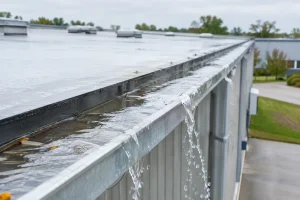
Drainage failures sit near the top of the list. Ponding water is often dismissed as untidy rather than dangerous. That is a mistake. Persistent ponding accelerates membrane ageing, increases structural load, creates slip hazards during access, and usually points to poor falls, blocked outlets or sagging substrate. On large facilities, minor drainage defects can become major lifecycle issues because they affect broad roof areas rather than one isolated detail.
Waterproofing defects around penetrations are another common source of trouble. Mechanical units, pipework, cable trays and retrofit services often create vulnerable junctions. If detailing is poor, movement is not accommodated, or later trades damage the waterproofing, the roof begins leaking at its most complex points. The problem is then blamed on age when the real issue is detailing, sequencing or uncontrolled trade access.
Sheeted metal roofs bring a different defect profile. Fastener failure, lap issues, corrosion, inadequate end-lap sealing and poorly executed flashings can all allow water entry well before the roof is considered old. In coastal or industrial environments, corrosion risk rises sharply, and the defect may be more advanced than surface appearance suggests.
Membrane roofs often fail more quietly. Blisters, open laps, shrinkage, membrane fatigue, loss of adhesion and detail failure at terminations can develop gradually. By the time internal staining appears, the roof assembly may already be holding moisture, insulation may be compromised, and the repair scope may be wider than expected.
Why defects get missed in the first place
The short answer is conflict, access and assumptions.
Many roof assessments are carried out by parties who also sell the repair, replacement or coating system. That creates a built-in incentive to frame the problem in a way that supports a commercial outcome. Sometimes the roof is declared finished when targeted remediation would suffice. In other cases, local patching is recommended because it is easy to sell, even when the defect pattern clearly points to broader system failure.
Access is another issue. Too many inspections are visual, brief and surface-level. They do not properly examine drainage paths, penetrations, transitions, previous repair zones, wet area interfaces or evidence of movement. A roof is not one flat plane. It is a system of details, terminations and risk points. If those points are not checked properly, the report is not worth much.
Then there are assumptions. Internal leaks are often traced to the nearest visible roof feature, but water rarely respects straight lines. It can travel along deck profiles, through insulation, behind walls and across structural elements before presenting inside. A defect diagnosis based on convenience instead of evidence leads to repeated failed repairs and frustrated stakeholders.
What a defensible defect assessment should include
A proper defect assessment should do more than identify symptoms. It should establish condition, likely cause, extent, consequence and action priority.
That means documenting defects with clear photographic evidence, mapping locations accurately, distinguishing active failures from historical issues, and separating cosmetic deterioration from defects that materially affect weatherproofing or safety. It should also identify whether the issue is linked to workmanship, design, maintenance neglect, incompatible materials, roof traffic or later service penetrations.
For commercial decision-makers, the real value is in what comes next. A report should tell you whether the defect calls for immediate make-safe action, planned maintenance, targeted remediation, intrusive investigation or capital replacement planning. If it does not help you sequence expenditure and challenge contractor recommendations, it is descriptive rather than useful.
This is also where independent advice changes the conversation. Roof Inspection Australia operates on that basis for a reason. If the assessor does not profit from the repair scope, the findings are easier to trust and far easier to defend internally.
Handover defects are a category of their own
New or recently completed roofs are not automatically low-risk. In fact, handover periods can be one of the most dangerous times to rely on assumptions.
Commercial roof defects at handover often include incomplete detailing, non-compliant falls, poorly finished penetrations, blocked drainage paths, membrane damage from follow-on trades, inconsistent flashing installation and undocumented changes from the original design intent. These are not minor technicalities. They shape whether the building performs as expected and whether warranty discussions become painful later.
A handover defect that is not recorded early usually becomes the owner’s problem. Once occupancy begins and contractors move off site, it gets harder to prove responsibility. The cost is not only rectification. It is also delay, disruption and a weaker contractual position.
When a defect points to a bigger problem
The most expensive mistake in roof management is treating a pattern issue as a one-off defect.
For example, repeated leaks at multiple penetrations may indicate poor detailing standards across the whole project. Widespread ponding may point to substrate deflection or incorrect falls rather than blocked outlets alone. Recurring lap failure in a membrane roof may suggest installation quality problems, not isolated ageing. Corrosion around fasteners can indicate incompatible materials or environmental exposure that has not been properly accounted for.
This is why context matters. A defect should never be reviewed in isolation from roof age, system type, exposure conditions, maintenance history and building use. A hospital, logistics facility and school may all have roof defects, but the risk profile and response threshold are not the same. It depends on what sits under the roof, how critical continuity is, and what failure would cost the organisation beyond the repair itself.
How to use this commercial roof defects guide in practice
For asset teams, the right response is not to inspect more casually. It is to inspect with purpose.
If you are seeing repeated leak calls, planning major capital works, taking over a new asset, approaching warranty expiry, disputing contractor recommendations or preparing for handover, get an independent technical view before committing budget. Ask for evidence, not reassurance. Ask whether the issue is local or systemic. Ask what can wait and what cannot. Ask what assumptions sit behind the recommended scope.
Most of all, avoid the false choice between doing nothing and replacing everything. Good defect diagnostics create a third option – targeted, evidence-based action that protects cash flow while reducing risk. That is where commercial value sits.
A roof will not reward optimism. It rewards scrutiny, timing and clear-eyed decision-making. If the asset matters, the truth about its condition matters more.