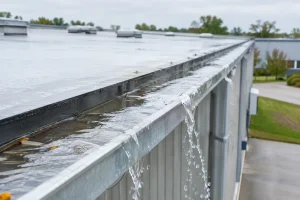




A membrane roof rarely fails without warning. What catches owners out is that the warning signs are often missed, misread or explained away until water ingress, tenant disruption or a capital works surprise forces attention. When clients ask about membrane roof failure causes, the real issue is usually not one defect. It is a chain of design, installation, drainage, movement and maintenance failures that has been allowed to build unchecked.
That matters because commercial roofs do not fail neatly. A leak showing up in one location can be the result of defects metres away. A membrane that looks serviceable from ground level may already be losing adhesion, splitting at stress points or holding water in ways that shorten its life. If you are responsible for a large asset, the cost is not just repair work. It is loss of control, weak contractor accountability and budget decisions made on incomplete information.
The real problem behind membrane roof failure causes
Most membrane failures are blamed on age. Age matters, but it is often used as a lazy explanation. Plenty of membrane roofs underperform well before their expected service life, while others hold up reasonably well because the fundamentals were right from the start.
The stronger question is this: what conditions caused the membrane system to deteriorate faster than it should have? Once you ask that, the pattern becomes clearer. Failures usually come from one or more of five areas – poor design, poor installation, uncontrolled water, substrate or structural movement, and neglected maintenance.
Each one has commercial implications. If the issue is design-related, patch repairs may simply defer a bigger claim. If it is installation-related, there may be grounds to challenge workmanship or handover quality. If drainage is the core problem, replacing sections of membrane without addressing falls is money spent twice.
Design defects that start failure early
A membrane roof is only as good as the detail design supporting it. The field area of the membrane often gets the attention, but most failures begin at transitions, penetrations, parapets, joints and drainage points.
Insufficient falls are one of the most common causes. Water that does not drain properly creates persistent ponding, increases thermal load, accelerates degradation and places stress on laps and terminations. On paper, falls may look compliant. In reality, construction tolerances, structural deflection and poor set-out can produce local low points that hold water long after rainfall.
Detailing around penetrations is another weak point. Plant supports, conduits, balustrade posts and retrofit services often interrupt the waterproofing system in ways that were not resolved properly in the original design. Membranes do not like improvised detailing. Once the roof becomes crowded with later additions, leak risk rises sharply.
Material selection also matters. Not every membrane is suited to every substrate, exposure condition or use profile. A system selected on price rather than compatibility can become brittle, lose flexibility or struggle with movement. In high-exposure Australian conditions, UV performance, heat cycling and weather resistance are not minor considerations.
Why design issues are often missed
They are missed because many handovers focus on whether the roof looks finished, not whether the roof is technically sound. A neat surface can still conceal poor drainage logic, unresolved interfaces and details that were never properly built for long-term performance.
Installation failures are still a major driver
Contractors do not need to install every part of a membrane roof badly for the system to fail. A handful of weak details can do the damage.
Poor surface preparation is a common starting point. If the substrate is damp, contaminated, uneven or unstable, adhesion suffers. That does not always fail immediately. It may take months of heat, moisture and movement before blisters, debonding or seam issues show up.
Seam integrity is another major factor. Whether the system is torch-applied, self-adhered, liquid-applied or mechanically fixed, laps need consistent execution. Incomplete bonding, contamination at laps, insufficient welds or uneven application pressure can leave vulnerable pathways for water entry. Once water gets into the system, fault tracing becomes far more difficult.
Termination detailing is where workmanship often tells the truth. Edge terminations, upturns and reglets need to be secure, weather-tight and compatible with movement. A membrane can perform acceptably in open areas yet fail repeatedly at edges because the finishing detail was rushed or value-engineered.
Then there is sequencing. Roof membranes are often installed under programme pressure, with other trades returning afterwards. Foot traffic, service penetrations and ad hoc modifications can damage a new system before practical completion. If no one is inspecting independently, those defects can pass straight into the asset.
Drainage failure is not a maintenance footnote
If water sits on a roof, the roof is underperforming. It is as simple as that.
Blocked outlets, undersized drainage, poor overflow provision and localised sagging all contribute to standing water. On some assets, maintenance teams are told to clear debris more often, as though that resolves the underlying issue. Sometimes it helps. Often it does not. If the roof geometry, outlet placement or surface profile is wrong, cleaning alone will not correct the risk.
Ponding affects more than leakage. It increases dirt build-up, encourages biological growth, places extra load on the structure and makes defects harder to detect. It can also speed up membrane deterioration, especially where water remains for extended periods after rainfall.
Membrane roof failure causes linked to drainage
When drainage is the root cause, you often see repeated patching around outlets, seams opening in low points, softened insulation, stained soffits and unexplained moisture spread across wider roof zones. These are not isolated maintenance items. They are signs that the roof is not shedding water as intended.
For asset managers, that distinction matters. Treating a drainage failure as a minor leak issue can lead to years of reactive spend with no real improvement in roof performance.
Movement, substrate issues and hidden stress
Roofs move. They expand, contract, deflect and settle. A membrane system has to accommodate that movement, not pretend it does not exist.
Thermal cycling is a major stressor in Australian conditions. Repeated heating and cooling can fatigue seams, flashings and junctions, particularly where the membrane was not designed or installed to handle differential movement between materials.
Structural movement also plays a part. Long-span roofs, lightweight decks and older assets with settlement history can create ongoing stress at critical points. If cracks, ridging or splitting appear repeatedly in similar locations, the roof may be expressing structural or substrate movement rather than an isolated waterproofing defect.
Substrate deterioration is another hidden cause. Corroded metal decks, degraded sheeting, moisture-damaged insulation and unstable screeds all compromise the membrane above. In these cases, replacing the visible waterproofing layer without understanding what sits beneath is a risky shortcut.
Neglected maintenance turns defects into failures
Membrane roofs are not maintenance-free. They are lower maintenance than some systems, but that is not the same thing.
Small issues become expensive when inspections are infrequent or superficial. Debris accumulates around outlets. Protective coatings wear thin. Flashings loosen. Unauthorised penetrations appear. Trades drag equipment across the roof without protection. None of this is dramatic on day one. Over time, it builds a failure pathway.
This is where independent inspection becomes commercially useful. A contractor asked to quote repairs is incentivised to find repair work. An independent consultant is incentivised to find the truth. That difference matters when you are deciding whether a roof needs local remediation, broader rectification or a staged replacement strategy.
How to assess membrane roof failure causes properly
The first mistake is chasing the leak point only. Water can travel. Internal symptoms rarely identify the true defect location.
A proper assessment should review the membrane condition, drainage behaviour, detailing quality, substrate condition, movement indicators and evidence of previous repairs. Moisture detection may be needed. So may destructive investigation in selected areas. It depends on the roof type, age, risk profile and consequence of failure.
What matters is that the diagnosis separates symptom from cause. If the report only says the roof is leaking and recommends patch repairs, that is not enough for a high-value asset. You need evidence, defect mapping, prioritisation and a clear view of whether the problem is local, systemic or design-led.
Membrane roof failure causes and contractor accountability
This is where many owners lose leverage. If the root cause is not defined clearly, responsibility stays vague. Designers blame installers. Installers blame maintenance. Maintenance teams blame age. Meanwhile the asset owner funds the uncertainty.
Clear defect diagnostics change that. They give you a basis to challenge incomplete scopes, reject cosmetic fixes and make capital decisions with more confidence. That is exactly why independent roof consultancy has value. Roof Inspection Australia does not sell rectification work, so the advice is not shaped by what someone hopes to quote next.
The practical outcome is better control. You can stage works properly, defend budgets internally and reduce the chance of paying for the same failure twice.
A membrane roof does not need perfection to perform well, but it does need the basics to be right – design, drainage, detailing, workmanship and oversight. If one of those is weak, failure may only be a matter of timing. The sooner the real cause is identified, the more options you keep on the table.