

A blocked outlet is rarely just a maintenance issue. On a commercial asset, it can be the first visible sign that water is moving across the roof in ways the design never intended. That is why a proper roof drainage assessment matters. It is not about ticking off gutters and downpipes. It is about understanding whether the roof can shed water reliably under real conditions, and what that means for risk, compliance, asset life and budget control.
For owners and managers of large properties, drainage failures have a habit of appearing as something else first. A ceiling stain gets reported. Plant equipment is surrounded by ponded water. A membrane starts failing early. A façade marks up. A tenant complains after heavy rain. By the time the issue is obvious, water has usually been misbehaving for a while.
What a roof drainage assessment actually looks at
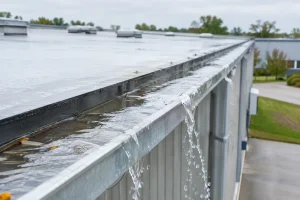
A serious roof drainage assessment examines the full path of water across and off the roof. That includes falls, localised low points, sumps, box gutters, rainwater heads, overflow provisions, downpipe capacity, discharge points and the condition of the waterproofing around those areas. It also considers whether rooftop services, later modifications or poor workmanship have interrupted drainage paths.
This is where many inspections fall short. Someone walks the roof, photographs debris in a gutter and recommends cleaning. Sometimes that is warranted. Often it is not the whole story. Debris can be the symptom, not the cause. If the roof is holding water because falls are wrong, outlets are set too high, the overflow arrangement is inadequate, or plant supports have created obstructions, cleaning alone will not fix the risk.
On commercial and industrial roofs, drainage problems are rarely isolated. They interact with structural deflection, membrane detailing, movement, service penetrations and maintenance history. A drainage review worth paying for needs to connect those dots.
Why drainage failures cost more than most teams expect
Water does not need a dramatic entry point to create major cost. Persistent ponding accelerates membrane degradation, stresses laps and seams, increases dirt build-up and encourages corrosion around fixings, trays and metalwork. On metal roofs, poor drainage can shorten coating life and contribute to fastener issues. On membrane roofs, it can expose weak detailing much earlier than the nominal design life would suggest.
Then there is the operational side. A drainage fault that causes internal leaks in a warehouse, school, hospital or retail asset is not just a roofing problem. It becomes a business interruption problem. You are dealing with tenant complaints, safety controls, possible stock or equipment exposure, reputational pressure and urgent contractor attendance – usually in bad weather, when the least useful decisions get made.
That is why commercial clients need clarity early. Not guesses. Not repair-led advice. They need evidence that shows where water is going, where it cannot get out, and which defects are likely to keep driving cost if they are left alone.
The common issues found in a roof drainage assessment
Some defects are obvious, but many are hidden in plain sight. We regularly see roofs where nominal falls on paper do not match the as-built condition. Settlement, deflection or poor installation can create low points that trap water long after rain has cleared elsewhere.
Box gutters are another recurring problem area. Capacity can be inadequate, outlets may be poorly located, and overflow arrangements are often missing, undersized or compromised by later works. In a high-intensity rainfall event, that is not a minor defect. It is a pathway to internal water entry and serious building damage.
On larger assets, plant and service installations are frequently part of the problem. Cable trays, conduit runs, plinths and access systems are added over time, often without much thought to drainage. Water gets redirected, trapped or slowed. The result is prolonged wetting around penetrations and details that were never designed to act like dams.
Discharge points also deserve more attention than they usually get. Downpipes can be undersized, blocked, damaged or discharging where water simply returns to the building envelope. We also see situations where stormwater connections downstream are the constraint, which means the roof drainage system may be functioning only until a larger weather event exposes the bottleneck.
Why independent assessment changes the outcome
If the party inspecting the roof also wants to sell the fix, the advice can be shaped by scope preference rather than technical truth. That is not cynicism. It is a commercial reality.
An independent assessor approaches a roof drainage assessment differently. The objective is not to find work. It is to establish the defect mechanism, the extent of risk and the most commercially sensible response. Sometimes that means targeted maintenance. Sometimes it means isolated remedial works. Sometimes it means the drainage issue is telling you the roof system is nearing the end of practical service life. Those are very different decisions, and they should not be blurred together.
For asset managers and procurement teams, this independence creates leverage. When a contractor proposes major works, you have a technical basis to challenge scope, sequencing and cost. When a builder says the roof is compliant, you have evidence to test that claim. When capital planning is under scrutiny, you can explain why action is needed now, later or not at all.
Roof drainage assessment in existing assets versus new projects
The context matters. On an existing building, the assessment is usually about failure risk, maintenance planning and whether recurring leak patterns are linked to drainage design, deterioration or poor modifications. The question is practical – what is going wrong, how urgent is it, and what action will actually reduce exposure?
On new projects, handovers and recent builds, the focus shifts. You are looking for design shortfalls, workmanship defects, non-compliant overflows, poor set-out, unfinished stormwater details and buildability problems that should never be inherited by the owner. These are the moments where independent reporting is especially valuable, because drainage defects become expensive arguments once the builder has left site and the warranty clock is running.
In both cases, photographs alone are not enough. Decision-makers need defect logic. They need to know whether a low point is cosmetic or consequential, whether ponding is tolerable or a precursor to failure, and whether overflow provisions will perform under realistic rainfall conditions.
What good reporting should give you
A useful drainage report should do more than describe symptoms. It should identify defect locations clearly, explain the likely causes, distinguish urgent risks from longer-term issues and set out actions in an order that makes budget sense.
That may include immediate maintenance items such as clearing outlets and rectifying local blockages. It may also include more involved recommendations such as regrading sections, modifying sumps, redesigning overflow details, adjusting service supports, repairing membrane terminations or reviewing stormwater discharge capacity. The value is in the prioritisation.
This matters because not every defect deserves the same response. Some issues can be monitored with routine inspection if the risk is low and the roof is otherwise performing. Others justify immediate intervention because the exposure to internal damage, safety events or asset deterioration is too high. A commercially sharp assessment makes that distinction plainly.
For organisations managing multiple sites, consistency is equally important. If one consultant calls every ponded area a critical defect and another shrugs off obvious drainage failures, portfolio planning becomes guesswork. Consistent, evidence-based reporting supports better forecasting and cleaner stakeholder decisions.
When to commission a roof drainage assessment
If a roof only gets attention after a leak, you are already behind. The better trigger is risk exposure. Recurrent wet weather complaints, visible ponding after rainfall, unexplained membrane deterioration, rusting at drainage points, overflowing box gutters, water marking at façades and disputed contractor advice are all valid reasons to inspect.
There are also lifecycle and governance triggers. Before end-of-warranty periods, before major capital planning, after significant rooftop service installations, during due diligence, and after severe rainfall events, a drainage review can save a great deal of false economy. The same applies where a building has a history of patch repairs with no clear diagnosis. Repeating reactive fixes without addressing drainage logic is how maintenance budgets get wasted.
For large portfolios, timing should be strategic rather than ad hoc. High-consequence assets such as hospitals, data-related facilities, education buildings, logistics centres and government property deserve a lower tolerance for uncertainty. The cost of being wrong is simply too high.
A roof does not need to be leaking today to be a drainage problem. It only needs one heavy event, one blocked outlet or one overlooked design flaw to turn a manageable defect into a budget issue. The point of a roof drainage assessment is simple – find the truth while you still have options. That is how you protect the asset, control the spend and avoid taking a contractor’s opinion on faith.