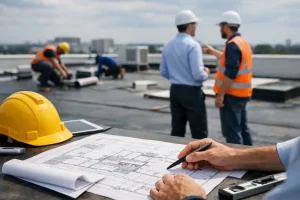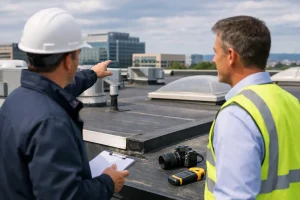


A roof starts costing money long before it fails. By the time water is inside a tenancy, plant room or corridor, the real damage is usually already done – not just to the building fabric, but to budgets, programmes, warranties and stakeholder confidence. That is why a commercial roof condition report matters. It gives decision-makers something more useful than opinions: evidence, priority and a defensible path forward.
For owners and managers of commercial, industrial, education, health and government assets, roofing decisions are rarely simple. You are balancing capital planning, maintenance budgets, contractor advice, tenant expectations, compliance obligations and operational continuity. The problem is that roof issues are often hidden, progressive and easy for others to oversimplify. A leak gets treated as an isolated defect. A ponding area gets called normal. A membrane fault gets patched again. Months later, the same asset is back on the table with a larger claim, a bigger scope and less room to negotiate.
What a commercial roof condition report actually does
A proper commercial roof condition report is not a quote in disguise and it is not a maintenance checklist dressed up as strategy. It is an independent technical assessment of the roof asset, its current condition, its likely failure points and the commercial implications of doing nothing, patching selectively or planning broader remediation.
At its best, the report answers the questions that matter to asset managers and facility teams. What is failing? What is likely to fail next? How urgent is it? Is the issue localised, systemic or design-related? What can be maintained, what should be repaired and what is approaching end of serviceable life? Those answers are what turn roof spend from reactive guesswork into planned risk control.
This is also where independence matters. If the party inspecting the roof also wants to sell the repair, replacement or coating system, the advice is never fully clean. Scope expands. Urgency gets exaggerated. Remaining service life gets written down. The client loses leverage before procurement has even started.
What should be in a commercial roof condition report
A report worth relying on needs to go beyond surface comments and photos of obvious defects. It should identify roof type, construction, access constraints, drainage layout, waterproofing details, penetrations, previous repair history where known, and visible signs of deterioration. More importantly, it should explain the significance of those findings.
Defect identification with context
Not every defect carries the same risk. Open laps at a lap joint, membrane blistering, failed sealants, blocked drainage, corrosion at fixings, cracked flashings and damage around services can all appear on the same roof, but they do not all require the same response. A useful report separates symptoms from causes and minor defects from failure indicators.
That distinction matters commercially. If the report treats every issue as equally urgent, it becomes noise. If it explains which defects threaten watertightness, which affect durability and which can be monitored, the client can make decisions with control rather than panic.
Condition rating and remaining life
A condition rating without reasoning is not enough. The report should state the current condition of the roof system or roof zones and provide an evidence-based view on remaining serviceable life. That does not mean pretending to predict an exact expiry date. Roofing performance depends on exposure, installation quality, drainage design, maintenance history and traffic loads. But experienced assessment can still narrow the decision window.
For portfolio owners, this is one of the most valuable outputs. It helps avoid the two most expensive mistakes in roofing: replacing too early and replacing too late.
Risk prioritisation
The strongest reports do not stop at defect description. They prioritise issues based on consequence and urgency. A high-risk drainage failure over critical operations is not in the same category as cosmetic surface ageing over a low-consequence area. Likewise, active leaks near electrical services or clinical spaces deserve a different response from isolated defects in a warehouse canopy.
This prioritisation supports budget allocation, procurement timing and stakeholder communication. It also helps internal teams justify why one asset needs immediate intervention while another can be managed through planned maintenance.
Scope guidance, not sales language
A commercial roof condition report should outline practical response pathways. In some cases, that means targeted repairs with quality control oversight. In others, the honest answer is that patching has reached the end of its usefulness and broader replacement planning is needed. Sometimes the issue is not the membrane itself but falls, detailing, drainage capacity or poor workmanship from earlier works.
The point is clarity. Clients do not need vague wording like monitor and maintain unless the report explains what to monitor, why it matters and when the trigger for further action occurs.
Why contractor-led inspections often miss the mark
Contractors have a role. Good ones can deliver quality work and practical site knowledge. But inspection advice tied to downstream sales is a different proposition from independent reporting. The conflict is structural, not personal.
If a contractor profits from larger scopes, there is an incentive to frame defects as replacement drivers. If they want quick approval for works, there is an incentive to simplify root causes. And if they completed previous works on the asset, there may be little appetite to document workmanship failures too clearly.
This is where an independent consultant changes the commercial position. The client gets evidence that can be used to challenge overblown scopes, question recurring repair recommendations, assess warranty issues and test whether proposed works actually address the cause of failure. Roof Inspection Australia is built around that model. It does not sell roofing. It just tells clients what is there, what it means and what should happen next.
When to commission a report
The obvious trigger is active leakage, but that is usually too late if the goal is control. A commercial roof condition report is most useful before major procurement, before lease commitments, before asset acquisition, before end-of-warranty periods and before capital budgets are locked in.
It is also valuable after repeated repairs that have failed to solve the problem. Recurring leaks often point to a larger issue – poor detailing, drainage design defects, incompatible repair methods or movement that was never properly addressed. Continuing to patch without diagnosis is not maintenance. It is budget drift.
For portfolios, periodic condition reporting creates consistency across assets. Instead of each roof being judged by whoever last climbed the ladder, the owner gets comparable condition data, clearer risk ranking and a more defensible basis for maintenance and capex planning.
What good reporting changes for commercial owners
The immediate benefit is technical clarity, but the bigger value is leverage. A strong report improves how owners deal with contractors, insurers, internal stakeholders and procurement teams. It gives facility managers a basis for urgent works requests. It gives asset managers a clearer picture of timing and exposure. It gives developers and builders a firmer footing when defects or handover issues need to be challenged.
It also reduces the chance of spending money in the wrong sequence. There is little value replacing one roof zone if the main failure driver is unresolved drainage design. There is equally little value commissioning broad replacement where strategic repairs and maintenance could safely extend service life for several years. It depends on the asset, the roof system, the consequence of failure and the owner’s holding strategy. That is exactly why the report needs to be analytical rather than sales-led.
The standard to expect
If you are commissioning a commercial roof condition report, expect more than photos and general comments. Expect a document that identifies defects clearly, explains root causes where they can be determined, ranks risk, comments on remaining serviceable life, and provides practical next-step guidance tied to business consequences.
You should also expect plain language. Commercial decision-makers do not need technical theatre. They need reporting that stands up in meetings, supports procurement, helps defend budgets and holds up when someone asks, why are we spending this money now?
That is the real purpose of the report. It is not paperwork. It is a control document for a high-risk building element that too often gets attention only after failure. When the roof is tied to operations, compliance, tenant satisfaction and capital planning, guesswork is expensive. Independent evidence is cheaper.
The smartest time to get clarity on a roof is before the next storm, before the next budget round and before someone with a repair target tells you what they think you need.