
A structured approach to roof inspections is one of the most practical tools a commercial property owner has. Without it, assessments become inconsistent, defects get missed, and the cost of reactive repairs replaces the far lower cost of planned maintenance. A commercial roof inspection checklist provides the framework, but a checklist is only as useful as the expertise behind it.
Roof Inspection Australia provides independent commercial roof inspections across Australia, producing detailed Asset Shield Reports™ that go well beyond a checklist walkthrough. This guide covers what a thorough inspection should assess, how often it should happen, and why the independence of your inspector shapes the quality of what you receive.
What Should a Commercial Roof Inspection Checklist Include?
A complete roof inspection checklist for commercial properties needs to cover every element of the roofing system surface, drainage, structure, and penetrations. The following 15-point checklist reflects the scope a professional commercial roof inspection should address:
- Roof surface condition — inspect the field of your roof for cracks, blistering, splits, and surface wear across membrane, metal, or tile systems.
- Coating integrity — examine surface coatings on metal roofing for corrosion, chipping, or UV degradation that exposes base material.
- Lap joints and seams — check that all joins between roof panels or membrane sections are properly sealed with no visible gap or separation.
- Flashing condition — assess all flash details at ridges, walls, parapets, and penetration points for cracking, lifting, or failed sealant.
- Penetration seals — examine every penetration, pipes, conduits, and mechanical equipment for sealant failure or movement damage.
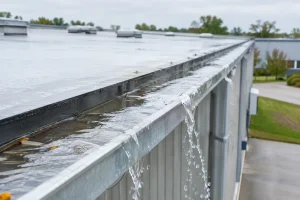
- Gutter and downpipe condition — inspect gutters for debris accumulation, corrosion, sagging, and damage that restricts drainage capacity.
- Drainage outlet condition — check that all drain points are clear of debris and functioning under normal loading conditions.
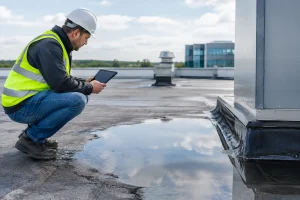
- Signs of water pooling — identify areas of the roof surface where water pools or tracks in ways that indicate drainage deficiencies.
- Structural component condition — assess visible structural elements, including purlins, fascias, and edge details, for deformation, corrosion, or movement.
- Fastener condition — examine roof fasteners for pull-out, corrosion, missing caps, or loosening that compromises panel fixing.
- Parapet wall condition — inspect parapet walls and coping for crack formation, movement, or water pathways that lead onto the roof.
- Ceiling and internal staining — note any ceiling stains, mould, or water damage inside the building that indicates active or historic leak pathways.
- Roof access condition — check that roof access hatches, ladders, and edge protection systems are in safe working order.
- Storm damage assessment — inspect for damage that may be harder to notice without close access, including lifted panels, damaged gutters, and impact markings.
- Asbestos and hazardous materials — identify any components that may contain hazardous materials requiring specialist handling before roofing work proceeds.
This scope defines what a thorough inspection should cover. In practice, a roofing contractor running through a checklist and a dedicated independent roof inspector working through the same list will produce very different findings because what gets recorded, how it is graded, and whether there is a commercial interest in the outcome shapes the result.
Protect your commercial roof with a planned inspection programme.
Why Inspections Are Essential for Commercial Roofing Maintenance
Preventative maintenance on a commercial roof is consistently less expensive than reactive repair. Regular roof inspections identify minor defects, like a loose fastener, a blocked gutter, or a small crack in flashing, before they develop into leak events, structural damage, or premature roof replacement. The pattern on commercial buildings that skip planned inspections is predictable: small problems compound quietly until water appears at ceiling level, by which point the damage extends well beyond the roof surface itself.
Extending roof life through documented maintenance is one of the clearest financial arguments for regular inspections. A commercial or industrial roof that is thoroughly inspected and maintained consistently will perform significantly longer than an equivalent roof that is only assessed when something goes wrong. That extended service life defers the cost of replacement and protects the capital value of the building. It’s important to treat the roof as the asset it is, not an afterthought addressed only in a crisis.
Compliance and insurance obligations add another dimension. Many commercial property insurance policies require evidence of regular maintenance as a condition of cover, and workplace health and safety requirements create obligations around roof access systems and hazard identification. Regular roof inspections produce the documented evidence that supports both. They also create a timestamped record of the roof’s condition history that is invaluable when a claim or dispute arises.
Key Areas Inspectors Assess During a Roof Inspection
Membrane condition is one of the most critical assessment areas on commercial flat roofs. Membranes need to be assessed for blistering, splitting, lap separation, and UV degradation that compromises waterproofing integrity. Even where the surface looks intact from a distance, thermal imaging can identify moisture trapped beneath the membrane, a condition that accelerates deterioration from the inside and is invisible to a standard visual inspection.
Water pooling on flat commercial roofs is both a symptom and a cause of damage. Pooling indicates drainage deficiencies that concentrate water load on specific roof areas, accelerating membrane wear and increasing the risk of structural impact over time. Identifying the locations and extent of ponding along with the drainage failures that cause it is a key output of any professional commercial roof inspection. Heavy rain events reveal pooling patterns that dry conditions conceal.
Roof penetrations are among the most vulnerable components on any commercial roofing system. Every pipe, conduit, mechanical equipment base, skylight, and HVAC unit that penetrates the roof surface creates a potential water ingress point if seals fail or movement occurs. These are the areas that a roofer looking for obvious damage most commonly overlooks because the failure is typically in the seal detail rather than the roof surface itself, and it requires close inspection to assess properly.
Broader signs of damage, including panel deformation, corrosion on metal components, and crack formation at wall junctions and parapet tops, complete the picture that a thorough inspection builds. Damage that may be harder to notice without close access and specialist knowledge is precisely what separates a professional inspection from a property owner’s own visual check from the ground. The detail matters, and it only comes from someone who knows what to look for and where to look for it.
Book a detailed commercial roof inspection with a qualified inspector
What Roofing Contractors Miss vs Independent Inspectors
A roofing contractor inspecting a commercial roof operates within an inherent conflict of interest. Their business depends on finding repair or replacement work, not on delivering an objective assessment of the roof’s actual condition. That does not make every contractor assessment unreliable, but it does mean the incentive structure consistently pushes towards recommendation rather than accuracy. Bias towards repair scope is well-documented in the commercial roofing sector, particularly following storm events and pre-sale inspections.
Early-stage defects are what independent inspectors catch and contractors routinely miss. A minor crack in flashing that is three years from becoming a leak does not generate a repair job today, so a roofing company assessing for revenue is unlikely to flag it with the same urgency as an independent inspector whose only job is to document the roof’s condition accurately. That gap in detection is where long-term maintenance costs accumulate. What a roofing contractor misses today typically becomes a costly repair in a future inspection cycle.
The quality of reporting produced by an independent inspector versus a contractor reflects these different incentives. A contractor’s assessment is typically a quote with justification. An independent inspection report is a classified, graded, documented assessment of every finding with photographic evidence and specific recommendations produced without any commercial interest in what comes next. For asset managers, property owners, and legal proceedings that require expert evidence, only the latter holds up under scrutiny. A third-party roof inspection from an independent specialist is the mechanism through which property owners get findings they can actually trust.
How Often Should Commercial Roofs Be Inspected?
Annual inspection is the standard for most commercial roofing systems, and it is the minimum frequency that supports effective preventative maintenance. Once per year gives inspectors a consistent basis for comparing conditions between assessments, identifying deterioration trends, tracking developing defects, and timing maintenance interventions before they become urgent. Bi-annual inspections are appropriate for older roofs, high-value assets, or buildings in aggressive environments where degradation occurs more rapidly.
After severe weather events, particularly storm damage involving high winds, hail, or sustained heavy rain, an inspection should be conducted regardless of the annual schedule. Weather events expose weaknesses that had not yet manifested, and the window for attributing damage to a specific event for insurance purposes closes quickly. A post-storm inspection conducted promptly creates a documented record that supports the claim process and prevents later disputes about whether damage was pre-existing.
Building type and use also influence inspection frequency. A commercial or industrial roof over sensitive operations, food production, pharmaceutical storage, or data infrastructure warrants more frequent inspection than a standard warehouse because the consequence of a leak extends well beyond the roof repair cost. Seasonal transitions are a useful trigger point: inspecting before winter preparation and after summer’s UV and heat cycling captures the two periods when roofing systems are most likely to show developing issues.
Our Commercial Roof Inspection Process and Reporting
Every commercial roof inspection conducted by Roof Inspection Australia begins with a structured on-site assessment. Our inspectors work through the full scope of the roofing system’s surface, drainage, flashings, penetrations, fasteners, and structural elements in a systematic sequence that ensures nothing is assessed in isolation and nothing is missed. We examine every component that affects roof performance, document every finding, and classify each by urgency before the report is prepared.
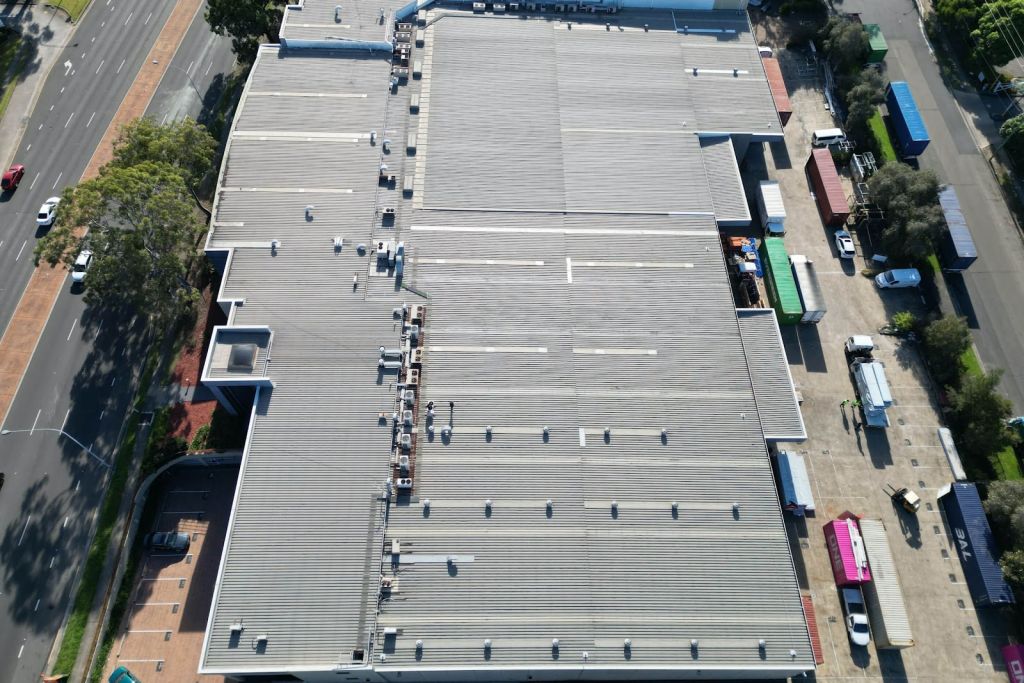
Drone-assisted inspection and thermal imaging are standard tools in our methodology. Drone coverage provides high-resolution aerial imagery of the complete roof area, including sections that cannot be safely accessed on foot and details that are not visible from standard vantage points. Thermal imaging identifies moisture trapped inside the roof assembly, heat loss at compromised insulation zones, and early-stage membrane failures before they produce visible leak events. These tools extend detection capability well beyond what a visual walk-through alone achieves.
The Asset Shield Report™ that follows every inspection is a comprehensive, professionally prepared document structured for decision-makers. Findings are classified by urgency, supported by photographic evidence and drone imagery, and accompanied by specific recommendations that distinguish between repairs requiring immediate attention and conditions suitable for planned monitoring. The report is delivered within 48 hours and is formatted for direct use in insurance submissions, contractor briefings, and capital planning. For those needing commercial property roof inspection services across multiple sites, our reporting standard remains consistent regardless of scale or location.
Request a metal roof inspection in Sydney — fast turnaround guaranteed

Book a roof inspection today
Request a Report Today
Getting a professional commercial roof inspection on the calendar is a straightforward process. Contact Roof Inspection Australia to request an inspection, receive upfront pricing, or speak with one of our inspectors about your specific property. We operate across Sydney and Brisbane and nationally, so whether you need a roof inspection near me in Sydney or a roof inspection in Brisbane for a Queensland asset, the same standard of independent reporting applies.
Understanding the cost before committing is straightforward. Our commercial roof inspection cost is transparent and provided upfront based on your roof type, size, and access requirements. For developers requiring inspections at project handover or practical completion, our roof inspection for developers service is specifically structured for that context. Request your inspection today and get a report that gives you something to act on.
Conclusion
A commercial roof inspection checklist is a useful framework, but it is only as valuable as the expertise, equipment, and independence behind it. A property owner working through a checklist from the ground will identify obvious issues; they will miss the developing defects, concealed moisture damage, and compliance gaps that only become visible with specialist knowledge, thermal imaging, and close physical access. DIY inspection reduces nothing except the likelihood of finding what actually matters.
Incomplete assessments carry real risk. A roofing professional who produces a report biased towards repair scope, or a building owner who assumes no visible damage means no problem, is in the same position: making decisions without accurate information. Commercial roofing decisions, maintenance spend, replacement timing, and insurance claims need to be based on independent, professionally prepared inspection data. A checklist starts the conversation; a qualified independent inspector with the right tools and no commercial agenda finishes it.
A professional commercial roof inspection covers roof surface condition, membrane integrity, flashings, penetrations, drainage systems, gutters, fasteners, structural components, and signs of water damage. The Asset Shield Report™ documents every finding with photographic evidence and urgency grading.
A basic visual check from the ground has value, but it will not identify the defects that matter most: concealed moisture, flashing failures, fastener deterioration, and early-stage membrane damage. These require specialist knowledge, thermal imaging, and close physical or drone-assisted access.
Annual inspections are the standard minimum for most commercial roofing systems. Older roofs, post-storm assessments, and high-value or sensitive-use buildings warrant more frequent inspection.
A commercial roof inspection checklist provides a structured framework for ensuring every element of a roofing system is assessed consistently. It reduces the risk of missing key components and forms the basis of a professional inspection report.
Yes. Drone-assisted inspection is standard in our methodology, providing high-resolution aerial coverage of roof surfaces that are difficult to access on foot. Combined with thermal imaging, drones significantly extend what an inspection can detect.
You receive the Asset Shield Report™ within 48 hours – a detailed document classifying all findings by urgency, supported by photographic evidence, and providing specific maintenance recommendations. The report is ready for use in insurance submissions, contractor briefings, or capital planning.
Yes. Regular roof inspections identify minor defects before they escalate into costly repair events or premature roof replacement. The cost of a planned inspection is consistently less than the cost of the reactive repairs that an uninspected roof produces.
An independent inspector has no financial interest in what is repaired, when it is repaired, or who does the work. That independence is what makes the findings credible — for insurers, asset managers, legal proceedings, and property owners making significant capital decisions. Roofing consultants with a commercial stake in the outcome cannot provide the same standard of objectivity.