
Metal roofing is one of the most durable systems available, but durability is not the same as maintenance-free. Corrosion, fastener fatigue, flashing failure, and coating degradation are common across Sydney’s commercial building stock, and most of it develops gradually, well before anything visible appears from the ground. A well-maintained roof does not happen by accident; it happens because someone is actually looking.
Roof Inspection Australia is based in Sydney and focused entirely on independent commercial roof inspections. We don’t sell repairs, manage contractors, or offer roofing services, which means every report we produce reflects what we found, not what generates the next job.
What Is Included in a Professional Metal Roof Inspection?
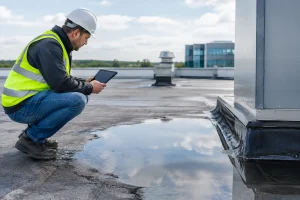
A professional metal roof inspection starts with the structural condition of the roof system. Our inspectors assess the framing, purlins, and cladding fixings for signs of fatigue, deformation, or movement that affect how load is distributed across the roof. Problems with the roof at a structural level are rarely visible until they become serious, which is precisely why a thorough inspection conducted on a planned basis is more valuable than a reactive one after something fails.
Coating and corrosion checks are central to any assessment of a metal roof. Colorbond and similar painted metal systems rely on their coating layer for corrosion protection; once that layer is compromised, the degradation timeline accelerates significantly. Our inspectors examine every panel surface, lap joint, and penetration for coating failure, bare metal exposure, and active rust formation. Early corrosion caught at this stage is addressed with minor repairs; left uninspected, it becomes a full roof replacement decision.
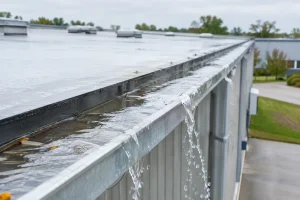
Drainage and flashing receive dedicated attention during every inspection. Blocked or damaged gutters force water back against roof sheeting and into penetration points. Flashing failures at ridges, valleys, skylights, and mechanical penetrations are among the most common sources of water ingress on commercial metal roofs, and they are frequently missed in general building assessments because they require close access to inspect properly. We examine every transition point and drainage pathway to assess the condition of your roof comprehensively.
The full roof assessment report that follows every inspection classifies each finding by urgency, documents it with high-resolution photography, and provides specific recommendations for necessary repairs, monitoring, or further investigation. Detailed reports at this standard give property owners and asset managers a factual baseline for maintenance planning, insurance purposes, and contractor briefings without any commercial agenda attached to the findings.
Book a comprehensive metal roof inspection in Sydney today.
Why Regular Roof Inspections Are Essential for Metal Roofing Systems
Preventative maintenance on a metal roof is straightforward in concept but rarely practised consistently. Regular roof inspections conducted on a defined schedule, typically annually or after significant weather events, allow minor issues to be identified and addressed before they develop into costly repairs or premature roof replacement. A fastener that has worked loose, a lap seal that has failed, or a gutter that is pulling away from the fascia: none of these is a major repair at discovery, but each can become one if left unaddressed.
The financial case for inspection is clear. A new roof on a commercial building represents a significant capital investment. Extending the condition and performance of that asset through planned maintenance guided by accurate inspection data is measurably less expensive than allowing deterioration to compound unchecked until replacement is the only option. Roof assessments conducted regularly give asset managers the data they need to forecast capital expenditure accurately rather than reactively.
Compliance and safety are also relevant on many commercial roofs. Roof access systems, penetration seals, and edge protection all have maintenance obligations under Australian workplace health and safety requirements. A routine inspection identifies compliance issues before they become enforcement matters or, more seriously, safety incidents. Ensuring your roof meets current standards is part of what a thorough inspection delivers, not just a condition report.
Common Issues Found During Metal Roof Inspection
Rust and corrosion are the most prevalent findings on metal roofs in Sydney’s coastal and urban environment. Salt air, industrial pollutants, and moisture cycling create aggressive conditions for exposed metal, particularly where the protective coating has been damaged by impact, abrasion, or fastener movement. Colourbond roofing is highly resistant when intact, but any break in the coating surface initiates a corrosion process that expands progressively. Identifying and treating these areas early is the difference between a repair and a replacement.
Loose or failed fasteners are a common finding on older metal roofs, particularly those exposed to sustained wind loading or thermal cycling. As metal expands and contracts with temperature, fasteners work through their fixing points over time, creating gaps that allow water ingress and reduce the roof’s structural fixing capacity. Inspect your roof for fastener pull-out, oversized fixing holes, or missing caps – all indicators that the fixing system needs attention before the next significant weather event.
Water ingress through failed penetrations and lap joints is one of the most damaging issues a commercial building owner can face. Damage can lead to insulation saturation, mould growth inside ceiling cavities, and long-term structural deterioration that far exceeds the cost of the roof repair that would have prevented it. The challenge is that a leak at ceiling level is often the last sign of ingress; by then, water has been tracking through the roof assembly for some time.
Storm damage on metal roofs often manifests as denting, panel displacement, or damage to gutter systems and downpipes. High winds can lift sheeting at fixing points, particularly on aged roofs where fasteners have already degraded. Even where panels remain in place, the fixing load transferred during a storm event can accelerate the loosening that leads to future displacement. A post-storm inspection identifies damaged roof sections before the next event compounds the problem.
Asbestos is a consideration on older commercial roofing stock in Sydney. Some pre-1990 buildings have asbestos roof sheeting or flashing components that require specialist handling and are subject to specific regulatory requirements. Our inspectors identify and flag asbestos-containing materials where present, ensuring property owners understand their obligations before any roofing work is undertaken.
Schedule your annual metal roof inspection today.
Why Choose an Independent Roof Inspector Instead of a Contractor
A roofer who inspects a roof and then quotes to fix it is not operating from a neutral position. Roofing contractors have a commercial interest in the scope and urgency of what they recommend — not because every contractor is dishonest, but because the business model creates that pressure. Roofing companies that offer free or low-cost inspections typically recover that cost through the work that follows. The inspection is the sales tool; the report is the proposal. That is not what an objective roof assessment looks like.
Independent inspectors have no relationship with the repair outcome. Our report is the product, not the precursor, to a sales conversation. For commercial property owners and asset managers, that independence means the findings in our reports can be used as the basis for competitive tenders, insurance claims, or capital planning without the implicit bias of a contractor’s recommendation built in. The roofing industry has a long history of inflated post-inspection scope on commercial buildings, particularly after storm events or when a property is being sold.
Better long-term planning comes from reliable data. When a property owner has an independent inspection history for their roof, they understand its actual condition trajectory, not the version presented by roofing professionals who profit from urgency. That data supports rational decisions about repair or replacement timing, budget allocation, and maintenance prioritisation across a portfolio. It also gives asset managers something to take to their board or insurer that is credible and defensible.
The trusted insights that come from genuinely independent reporting have tangible commercial value. A third-party roof inspection that confirms a roof has several years of serviceable life remaining is worth knowing — particularly when a contractor has recommended immediate replacement. Equally, an independent report that identifies urgent structural defects protects a property owner from a contractor who may have downplayed risk to avoid losing the client. Either way, independence delivers clarity.
Our Metal Roof Inspection Services in Sydney, NSW 2000
Roof Inspection Australia delivers commercial and industrial metal roof inspection services across Sydney and NSW. Our inspection scope covers every element of the roofing system panels, fasteners, flashings, gutters, penetrations, drainage, edge details, and structural components assessed against current Australian standards and documented in the Asset Shield Report™. We work with asset managers, property owners, facility managers, and developers who need accurate, independent assessment of their roofing assets. For anyone needing a commercial property roof inspection in Sydney, our team is equipped to deliver to that standard.
Advanced tools are standard in our inspection methodology. Drone-assisted inspection provides high-resolution aerial coverage of roof surfaces that are difficult or hazardous to access on foot and captures the full extent of a roof area in detail that a walking inspection alone cannot achieve. Thermal imaging extends our detection capability to moisture trapped inside the roof assembly, heat loss through compromised insulation, and early-stage failures at lap joints and penetration seals. These tools are not optional extras; they are part of how we ensure nothing is missed.
Detailed reports with fast turnaround are part of what makes our inspection services practical for commercial operations. The Asset Shield Report™ is delivered within 48 hours of inspection and is structured for dual use: as an operational maintenance tool for facilities teams and as a submission-ready document for insurance or compliance purposes. If you need to understand the commercial roof inspection cost for your specific property upfront, contact us and we’ll provide accurate pricing before we book.
Protect Your Property with a Comprehensive Roof Inspection
Risk mitigation is one of the most tangible returns on roof inspection investment. A comprehensive inspection identifies the conditions that lead to water ingress, structural failure, and compliance breaches before they occur — giving property owners the information they need to act before a problem becomes an emergency. For commercial assets where business continuity and tenant obligations are in play, the cost of an unplanned roof failure vastly exceeds the cost of the inspection that would have prevented it.
Insurance support is another direct benefit. When a claim is lodged for roof damage, whether from storm, impact, or gradual deterioration, the quality of inspection documentation determines how the claim is assessed. A dated, professionally prepared inspection report that establishes the roof’s pre-event condition is among the strongest evidence a property owner can provide to support a claim. Insurers who encounter well-documented inspection histories process claims faster and with less dispute.
Asset management at a portfolio level depends on reliable condition data across all assets. A roof that looks acceptable from ground level may be approaching the end of its serviceable life; a roof that has raised concerns may have years of useful performance remaining with targeted maintenance. Regular roof inspections convert roofing from a reactive cost centre into a managed asset planned, budgeted, and optimised rather than crisis-driven. For portfolio managers, that shift has measurable financial impact.
Why Roof Inspection Australia Is Trusted Across Sydney
Independence is the foundation of what we do. We do not sell repairs, manage roofing contractors, or have commercial relationships with roofing solutions providers. Every inspection we conduct is assessed and reported on its own merits. What we find is what the report says, without any commercial filter applied. That structure is why our reports are used in insurance claims, legal proceedings, and board-level asset reporting. It is also why roofing consultants and building professionals refer their clients to us when they need an independent second opinion.
Our specialisation in commercial roof systems means the depth of assessment we deliver is specific to the asset type. A metal roof on an industrial building has different failure modes, compliance obligations, and maintenance requirements than roof tiles on a residential property. We are not a generalist home inspection service that includes roofs; we are commercial roofing specialists, and every inspection reflects that focus. Our experience in the roofing industry is concentrated where it matters most: complex commercial roof systems that general inspectors are not equipped to assess at the required depth.
Our detailed reporting standard and proven experience across Sydney have built a track record with asset managers, developers, and property owners who need inspection services that hold up under scrutiny. Whether the context is a roof inspection for developers at project handover, a pre-purchase roof inspection before acquisition, or an annual Asset Shield Report™ for ongoing portfolio management, our approach remains consistent: independent, thorough, and built for decision-makers who need to act on what they receive.
Request a metal roof inspection in Sydney — fast turnaround guaranteed
Book a roof inspection today
Book Your Metal Roof Inspection Near You Today
Metal roofing deteriorates gradually, and the damage that compounds quietly between inspections is always more expensive than the inspection that would have caught it early. Whether you manage a single commercial building or a portfolio of assets across Sydney, getting a roof inspection near me from an independent specialist is the most cost-effective investment in your roofing asset you can make. Contact us to request an inspection, get a quote, or speak with one of our inspectors about your specific property.
We provide transparent upfront pricing, fast turnaround on reports, and clear findings that give you something to act on. If your needs extend across multiple locations, including roof inspection in Brisbane and other states, we operate nationally. Book your metal roof inspection in Sydney today and get a report that tells you what is actually happening above your building.
At minimum, annually. Commercial metal roofs should also be inspected after major storm events, before property transactions, and at key lifecycle milestones such as end-of-warranty periods.
Yes. Fastener failures, lap joint separations, and flashing degradation can allow water ingress well before any panel damage is visible. Thermal imaging identifies moisture pathways inside the roof assembly that a visual inspection alone would miss.
We use drone-assisted inspection for aerial coverage, thermal imaging for moisture and heat detection, high-resolution photography for documentation, and direct physical access for close assessment of flashings, fasteners, and penetrations.
A pre-purchase roof inspection is strongly recommended before acquiring any commercial property. Roof repair or replacement costs can be substantial. Identifying issues before settlement protects buyers from inheriting undisclosed problems.
Yes. Close visual inspection and photographic documentation identify early-stage coating failure and surface rust before it penetrates the base metal. Catching corrosion at this stage allows for targeted treatment rather than panel replacement.
It depends on the size and complexity of the roof. Smaller commercial properties may take two to three hours; larger or more complex roofs requiring drone and thermal imaging assessment will take longer. We provide realistic timeframes when quoting.
That depends entirely on the condition of your specific roof, not a contractor’s revenue target. An independent inspection gives you an objective assessment of what is required, separating necessary repairs from unnecessary replacement recommendations. Our reports are designed to give you that clarity without any commercial interest in which direction you go.