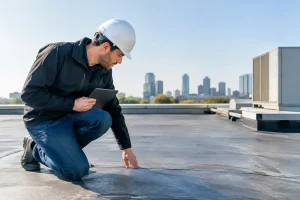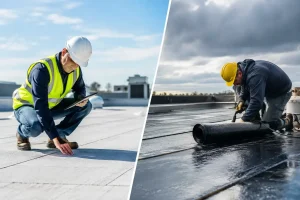

A roof leak is not a diagnosis. Nor is a photograph of ponding water, a split membrane or rust at a penetration. These are symptoms. Roof forensics is the disciplined process of establishing what has failed, why it failed, how far the problem extends and what action is commercially justified.
For owners and managers of commercial property, that distinction matters. The wrong diagnosis can turn a local defect into an unnecessary replacement project. It can also allow a systemic failure to be patched repeatedly while damage, risk and costs accumulate out of sight. Independent forensic investigation replaces assumptions with evidence.
What roof forensics actually investigates
Roof forensics is a technical investigation of roof failure, deterioration or disputed performance. It goes beyond a general condition inspection because its purpose is not simply to describe what is visible. Its purpose is to determine causation, extent, consequence and responsibility.
On a commercial, industrial or institutional asset, the investigation may examine the roof covering, flashings, penetrations, joints, drainage design, falls, overflow provisions, fixings, substrate condition, interfaces with walls and services, and the history of maintenance or prior repairs. The roof is assessed as a system. A membrane can be sound while the drainage arrangement is fundamentally inadequate. A leak may appear at a roof penetration but originate several metres away at a failed transition or blocked outlet.
The outcome should be a defensible technical position, not a vague recommendation to “monitor” the issue or obtain repair quotes. Decision-makers need to know whether the defect is isolated, recurring, progressive, design-related, installation-related, maintenance-related or the result of incompatible works by another trade.
Why visual inspections alone can miss the real problem
A visual inspection is valuable, but it has limits. It identifies observable defects and provides a useful picture of overall condition. Forensic work starts where the visual evidence raises questions that cannot be answered by appearance alone.
Consider a roof where water enters below a plant platform after heavy rain. A contractor may propose resealing the visible joints around the platform. That may be appropriate. It may also be a convenient response that avoids investigating poor falls, concealed flashing laps, overloaded drainage, or water tracking beneath the roof system. If the actual defect lies elsewhere, the resealing work becomes another cost without a reliable outcome.
The same issue arises with premature membrane deterioration. Surface cracking may be caused by age and ultraviolet exposure. It may instead indicate incompatible coatings, chemical exposure, movement in the substrate, incorrect installation detailing or ponding water that has shortened the membrane’s service life. Each cause carries a different remedy, cost profile and potential avenue for contractor accountability.
This is why evidence matters. The most expensive roofing advice is often the advice that sounds certain before anyone has established the facts.
The commercial questions a forensic investigation should answer
A useful roof forensic report does more than list defects. It gives asset managers, project teams and owners the information required to make a controlled decision.
Is the issue local or systemic?
A local defect can often be repaired with targeted works and appropriate quality control. A systemic issue may affect broad areas of the roof or reflect a repeated detail failure across the building. Treating systemic defects as isolated maintenance items can waste operational budgets and delay necessary capital planning.
The investigation should distinguish between scattered wear and a pattern. Repeated failures at identical penetrations, laps, outlets or perimeter details are not random. They are evidence of a common mechanism that needs to be addressed at its source.
What is the likely cause of failure?
Causation is central to roof forensics. The question is not simply whether a roof leaks, but why it leaks. Was the design incapable of managing expected rainfall? Were materials incorrectly selected or installed? Was a later service penetration poorly detailed? Has maintenance been inadequate? Has building movement changed the performance of critical interfaces?
In practice, more than one factor may be involved. A roof may have an original design weakness compounded by blocked drains and poorly executed repair work. A credible report recognises that complexity rather than forcing every failure into one convenient explanation.
What is the risk of doing nothing?
Not every defect requires immediate replacement. Equally, not every leak can wait for the next maintenance cycle. The correct response depends on the likelihood of recurrence, consequences of water ingress, safety exposure, internal operations, tenant obligations, asset value and the ability to manage risk temporarily.
For a logistics facility, water entry can disrupt stock and operations. For a healthcare or education site, the consequences may include service interruption, hygiene risks and safety concerns. For a government or commercial office asset, repeat leaks can create compliance, reputational and leasing issues. The roof condition must be assessed in the context of what sits beneath it.
Who needs to respond, and on what basis?
Forensic findings can materially strengthen discussions with builders, roofing contractors, designers, manufacturers and maintenance providers. They provide a factual basis to challenge incomplete scopes, reject superficial repairs, pursue defect rectification or determine whether warranty obligations may be relevant.
That does not mean every defect becomes a dispute. It means the asset owner enters the conversation with evidence rather than relying on the party proposing paid work to define the problem.
A forensic process should be methodical, not theatrical
Good roof forensics is practical. It does not need dramatic language or speculative conclusions. It needs a clear scope, reliable observations and conclusions that can withstand scrutiny.
The process generally begins with document review. Available drawings, specifications, prior reports, maintenance records, leak histories, warranty information and previous repair invoices can reveal whether a problem is new, recurring or linked to earlier work. These records also help identify design intent and gaps between what was specified and what was built.
The site investigation then tests that history against physical evidence. This may involve detailed roof walks, measurement of falls, inspection of drainage components, review of laps and terminations, assessment of penetrations, moisture investigation where suitable, and targeted opening-up works when concealed construction must be verified. The appropriate method depends on the roof type, access constraints, safety requirements and nature of the alleged defect.
There is a trade-off here. Non-invasive assessment limits disruption and cost, but it cannot always confirm hidden conditions. Opening-up can provide decisive evidence, yet it must be targeted, controlled and properly reinstated. The right approach is the least invasive method capable of answering the commercial question.
Independent advice changes the quality of the decision
A contractor can be highly capable and still have a commercial interest in the outcome. If their business sells repairs, replacement systems or coatings, their inspection findings may lead naturally towards the work they provide. That is not an accusation. It is a conflict that owners should recognise and manage.
Independent roof consultants operate differently. Their role is to assess the asset, document the evidence and advise on the appropriate response. They do not need a minor repair to become a major capital project, and they do not need a replacement project to be deferred in favour of repeat patching.
For complex or disputed matters, independence also creates leverage. A clear report can be issued to internal stakeholders, insurers, builders, contractors or legal advisers with confidence that the technical opinion has not been shaped by a repair agenda. Roof Inspection Australia works on this basis: no roofing products, no repair sales, just evidence-led advice for the asset owner.
When to commission roof forensics
Forensic investigation is most valuable when the cost of being wrong is high. Recurring leaks, early-life failures, disputed defects, unexplained internal damage, handover concerns and repeated repair expenditure are obvious triggers. So are drainage failures, widespread ponding, suspected non-compliant work and roofs approaching major capital decisions where the remaining service life is unclear.
It is also useful before committing to a broad replacement scope. A roof that looks tired is not automatically at end of life. Conversely, a roof that looks acceptable from ground level may have failure mechanisms that justify earlier intervention. Forensics helps prevent both overcapitalisation and false economy.
The final report should set out the evidence, observations, likely failure mechanisms, limitations, risk priorities and recommended actions. It should separate urgent risk controls from maintenance tasks, further investigation and capital works. Most importantly, it should make clear what is known, what remains uncertain and what needs to happen next.
A roof is a major building system, not a maintenance afterthought. When it fails, the real cost is rarely limited to the roof surface. Get the cause established before approving the cure.