



A membrane roof can look fine from ground level and still be carrying defects that will turn into water ingress, tenant disruption, warranty disputes and avoidable capital spend. That is the problem with superficial checks. If you want to know how to inspect membrane roofing properly, you need a method that looks past surface appearance and deals in evidence, risk and consequence.
For commercial assets, membrane roof inspection is not just a maintenance task. It is a control measure. A failed seam over a plantroom, a blocked outlet on a distribution centre, or an unsealed penetration above a healthcare facility can create costs far beyond the roof itself. The inspection has to tell you what is happening now, what is likely to fail next, and what action is commercially justified.
How to inspect membrane roofing with a risk-first approach
The first mistake is treating every membrane roof the same. They are not. A single-ply system on a logistics facility behaves differently from a torch-on membrane over a podium, or a liquid-applied system on a complex roof with dense services. Before anyone steps onto the roof, the inspection should start with context.
That means reviewing the roof type, age, known leak history, traffic patterns, previous repairs, drainage design and any available warranty or handover records. If those records are missing, that is already useful intelligence. Poor documentation often travels with poor installation control.
The next step is to define inspection priorities based on consequence. A membrane defect over a vacant storage area is not the same risk as one over a switch room, operating theatre or data space. Serious inspections do not just ask, “Is the roof damaged?” They ask, “What happens if this fails, and how quickly?”
What to check during a membrane roof inspection
A proper inspection moves in layers. Start broad, then narrow in. General roof condition matters, but the real failures usually sit at transitions, terminations and drainage points.
Surface condition and membrane integrity
Begin by assessing the membrane field for punctures, splits, blisters, wrinkles, shrinkage, exposed reinforcement, laps under stress, loss of surface finish and signs of embrittlement. Not every blemish is critical, but each one needs interpretation. A small cut in a low-risk area may be a simple maintenance issue. Repeated punctures near service routes suggest a systemic traffic management problem.
You are also looking for signs that the membrane has moved or lost adhesion. On some systems, tenting, ridging or localised distortion can indicate substrate movement, moisture below the membrane or installation defects. These are not cosmetic issues. They affect service life and water tightness.
Seams, laps and welded joints
Seams deserve close attention because they are common failure points, particularly where workmanship was inconsistent or ageing has reduced bond strength. Inspect for open laps, fishmouths, incomplete welds, edge lifting, contamination and patch repairs that do not match the surrounding system.
This is where contractor-led inspections often become too convenient. A quick glance is not enough. Seam failures can be narrow, intermittent and easy to miss unless the inspection is deliberate. On large commercial roofs, one weak seam detail can repeat across the entire installation.
Penetrations, upstands and terminations
Most membrane failures do not occur in the middle of an open roof area. They happen at penetrations, wall interfaces, plinths, parapets, expansion joints and threshold details. Every pipe, conduit, support frame and plant penetration needs to be checked for continuity of waterproofing, movement tolerance and sealant condition.
Look for brittle sealants, failed compression details, membrane separation at corners, poor terminations and signs of makeshift repairs. If additional services have been installed after the original roof completion, inspect those areas hard. Late-stage trades routinely compromise membrane systems, and the repair standard is often well below the original design intent.
Drainage performance
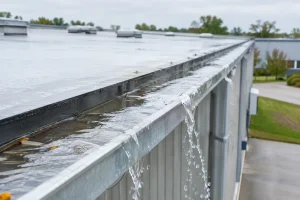
If the roof does not drain properly, the membrane will not perform properly. It is that simple. Check outlets, sumps, gutters, rainheads and downpipe connections for blockage, ponding, silt build-up and evidence of overflow. Membrane roofs fail faster when water sits where it should not.
Some ponding is a design issue. Some is a maintenance issue. Some is structural deflection. The difference matters because the remedy and budget pathway are different. During inspection, record where water is retained, how extensive it is, and whether it aligns with outlet placement, falls, substrate deformation or local blockage.
Previous repairs and patch quality
A roof with many repairs is not necessarily a bad roof, but it is a roof that needs scrutiny. Patch repairs can tell you a lot about both defect history and maintenance quality. Check whether patches are compatible with the existing membrane, properly bonded, correctly terminated and proportionate to the defect.
Poor repairs often create a false sense of security. They may stop a leak briefly while introducing new stress points or moisture traps. If the same area has been repaired multiple times, the issue is probably not the patch itself. It is likely a broader detailing, drainage or movement problem.
Signs the problem is below the membrane
Knowing how to inspect membrane roofing also means knowing when the visible defect is only part of the story. Moisture beneath the membrane, saturated insulation, substrate deterioration and concealed corrosion can all sit below a surface that appears serviceable.
Clues include widespread blistering, soft underfoot areas, recurring leaks after repair, thermal inconsistency, internal staining that does not align with obvious surface defects, and localised depressions. Where risk justifies it, non-destructive testing or targeted invasive investigation may be needed. That decision should be based on consequence and evidence, not guesswork.
This is where independence matters. If the person inspecting the roof also wants to sell the replacement, there is an obvious conflict. The reverse is also true. A maintenance contractor may minimise deeper issues to keep the job within patch-repair territory. Neither position gives an asset owner much control.
Common inspection mistakes that cost owners later
The biggest mistake is inspecting only where the leak appeared internally. Water rarely travels in a straight line. Internal leak location is a clue, not a diagnosis.
The next mistake is relying on photos without defect mapping. Good images help, but decision-makers need location, extent, condition rating and recommended action. Otherwise, the report is just a gallery of problems without commercial value.
Another common failure is ignoring service interfaces. Roof-mounted plant, cable trays, solar supports, balustrades and access systems create concentrated risk. If those details are skipped, the inspection is incomplete.
There is also the issue of timing. Inspecting after a major rain event can reveal active drainage and leak behaviour. Inspecting only in dry conditions may miss that. On the other hand, some surfaces are harder to assess safely when wet. It depends on the roof, the defect history and the inspection objective.
How often membrane roofing should be inspected
For most commercial assets, annual inspection is a minimum baseline, not a best-practice ceiling. High-value or high-consequence buildings often justify more frequent review, especially after severe weather, major service works, tenant fit-outs or defect-prone handover periods.
Newer roofs should not be ignored just because they are under warranty. In fact, early-stage inspections are often where the real value sits. Defects found while warranties, retention or contractor liability still have teeth are far easier to action than defects discovered years later when everyone has moved on.
Older roofs need a different lens. The focus shifts from isolated defect correction to service-life forecasting, repair efficiency and replacement planning. At that point, the inspection should help answer a harder question: is continued patching protecting the budget, or just delaying an inevitable capital event without a plan?
What a useful membrane roof inspection report should deliver
A good inspection report does not bury the client in technical noise. It should identify the membrane type and condition, locate observed defects, explain likely causes, rank risk, comment on drainage performance, note evidence of non-compliant or poor-quality repairs, and set out practical next actions.
Those actions should be prioritised. Some issues need urgent intervention because they threaten operations or internal assets. Others can be programmed into maintenance or capex planning. If every defect is labelled critical, the report has failed. If obvious risks are softened to avoid difficult conversations, it has also failed.
For commercial portfolios, consistency matters as much as detail. Reports need to support budget planning, contractor accountability and stakeholder decisions across multiple sites. That is where an independent consultant earns their keep. Roof Inspection Australia operates on that basis – no repair agenda, no product to push, just evidence that gives clients leverage.
A membrane roof does not need guesswork, and it does not need a sales pitch. It needs a clear-eyed inspection that tells you what is wrong, what matters most, and what can wait. That is how you protect the asset before the roof starts dictating the budget.