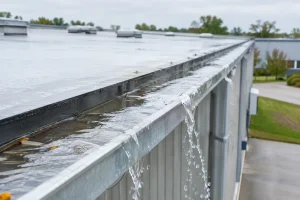




A roof can look finished from the ground and still be carrying defects that will surface after the contractor has left site. That is why the best roof handover questions are not polite administration. They are a control point for warranty, compliance, operational continuity and capital protection.
For commercial property owners, developers and facility teams, handover is the last practical opportunity to demand evidence, test claims and document outstanding risk before final payment and defects liability arrangements reduce your leverage. A handover pack is not proof that the roof is compliant. It is only paperwork until the installation, drainage and details have been independently verified.
Why roof handover needs more than a checklist
Roofing failures are rarely caused by one obvious event. Water enters through poorly formed penetrations, untested interfaces, blocked or under-designed drainage, inadequate laps and details concealed beneath flashings. The resulting ceiling damage, mould, interrupted operations and tenant disputes may not appear for months.
By then, the discussion has shifted from prevention to argument. The builder may point to maintenance. The roofing contractor may blame another trade. The manufacturer may question installation. Your team is left trying to reconstruct what was built and who accepted it.
The right questions create a contemporaneous record. More importantly, they force the project team to show evidence rather than offer assurances. For high-value assets, this is where independent roof inspection has commercial value. A party selling rectification work should not be the only party deciding whether the work is acceptable.
15 best roof handover questions to ask
1. Has the completed roof been inspected against the approved design and specification?
Ask for confirmation of what documents were used for inspection, including the latest approved drawings, roof plans, waterproofing specification and approved variations. A roof cannot be signed off against a superseded detail or a generic manufacturer guide.
Where the installed system differs from the original design, request written design acceptance. Small substitutions in membrane type, insulation thickness, sheet profile or flashing arrangement can alter performance, fire requirements and warranty eligibility.
2. What defects and incomplete items remain open?
Do not accept “nil defects” without a documented inspection basis. Request a current defects register that identifies each item, its location, responsibility, agreed rectification and close-out evidence.
The register should include roof-related work by all relevant trades, not only the roofing contractor. Services penetrations, plant supports, skylights, façade interfaces and electrical works frequently compromise a roof after the principal membrane or sheeting has been installed.
3. Have roof drainage paths been tested in real conditions?
Ask how drainage was tested, when it was tested and what the results showed. Visual observations during dry weather do not establish drainage performance.
For low-slope roofs, ponding water deserves particular attention. Some temporary ponding may be tolerated depending on the system and design, but persistent water accelerates deterioration, exposes falls problems and increases the consequence of minor membrane defects. Ensure outlets, overflows, sumps, gutters and downpipes are clear and functioning as intended.
4. Are overflows installed at the correct level and do they discharge safely?
Overflows are a critical safety feature, not a decorative extra. Ask for evidence that they are correctly sized, positioned and lower than the point at which water could enter the building.
Also ask where overflow water will go. An overflow that discharges across an entry, loading area, electrical equipment or public footpath simply transfers risk from the roof to the site below.
5. Have all penetrations been identified and sealed correctly?
Request a penetration schedule and confirm it matches the roof as built. Every pipe, duct, conduit, support, curb, cable tray and plant connection needs an appropriate detail.
The question is not merely whether sealant has been applied. Ask whether the penetration detail allows for movement, drainage, maintenance access and the particular roof system. A bead of sealant around an unsuitable detail is not a durable solution.
6. Who approved penetrations added after the original roofing work?
Late trade access is one of the most common causes of handover defects. Mechanical, electrical, communications and security contractors often make changes after the roof has been completed.
Ask for written approval, photographs before and after works, and confirmation that each late penetration has been inspected by a suitably qualified roofing representative. Without this record, responsibility becomes difficult to establish when leaks develop.
7. Are flashings, terminations and interfaces complete?
Most leaks occur at transitions, not in the middle of a roof field. Ask specifically about parapets, walls, box gutters, expansion joints, skylights, roof hatches, plant plinths, façade junctions and changes between roofing materials.
These locations must accommodate movement while maintaining weatherproofing. They also need to be accessible enough for future inspection and repair. A detail that works only while it is untouched is not a defensible handover outcome.
8. Has the roof been checked for damage from follow-on trades?
Completed membranes and coated metal roofs are vulnerable to dropped tools, foot traffic, temporary protection failures and plant installation works. Ask whether a final inspection occurred after all trades had finished, not before.
Request photographs of repaired damage and confirmation that repairs follow the system manufacturer’s requirements. Improvised patches may look acceptable but can affect warranty coverage or fail prematurely under ultraviolet exposure and thermal movement.
9. What warranty applies, and what conditions could void it?
A warranty document is only useful if its conditions are achievable. Clarify whether the warranty is product-only, workmanship-only or a combined system warranty, and identify the term, exclusions and claim process.
Ask who holds responsibility if the roofing contractor ceases trading. Also establish whether routine inspection, cleaning or maintenance by approved parties is required. A warranty with vague maintenance obligations can become an argument rather than protection.
10. Have manufacturer inspections and approvals been completed?
If the project relies on a manufacturer-backed warranty, ask for the manufacturer’s final inspection report or written approval. Do not assume that product delivery or contractor accreditation equals project-specific acceptance.
Where no manufacturer inspection has occurred, record that fact. It may be reasonable on some projects, but it should be a conscious risk decision rather than an overlooked requirement.
11. Do we have complete as-built drawings and roof plans?
The handover set should show drainage points, penetrations, plant locations, access routes, roof zones, membrane or sheet types, and significant details. Generic drawings are not enough if the construction changed.
Accurate as-builts save time and reduce damage during future maintenance. They allow facility teams to identify where they can and cannot fasten equipment, how water should move, and which details need specialist attention.
12. What maintenance is required in the first 12 months?
New roofs need maintenance from day one. Construction debris can block outlets, seasonal leaf fall can overwhelm gutters and trades may return to install signage or services.
Ask for a site-specific maintenance schedule covering inspection frequency, gutter and outlet cleaning, vegetation management, access controls and the procedure for reporting leaks. This should distinguish normal maintenance from defects that remain the contractor’s responsibility.
13. Is safe roof access compliant and practical?
A roof that cannot be safely accessed will not be properly maintained. Confirm the location and condition of ladders, hatches, walkways, guardrails, anchor points, warning lines and plant access routes.
Ask whether the access solution is appropriate for the people who will actually use it. A compliance drawing does not help if technicians need to cross fragile roof areas, step over services or carry equipment through unsafe routes.
14. Are fire, insulation and condensation requirements documented?
Roof performance is broader than keeping rain out. Request documentation for fire compliance, insulation installation, vapour control layers and any condensation management measures required by the design.
This matters especially where roof systems incorporate combustible components, concealed cavities or conditioned internal environments. A poorly understood roof build-up can create moisture and compliance issues that are expensive to investigate once the building is occupied.
15. Has an independent party verified the handover condition?
The final question is the one that tests the whole process: who, with no financial interest in repair or replacement work, has inspected the roof and reported on its condition?
Contractor quality checks are necessary, but they are not independent assurance. An independent inspection can identify incomplete details, drainage concerns, workmanship defects and documentation gaps while the project team still has leverage to secure rectification. For complex commercial assets, Roof Inspection Australia provides that evidence-led separation between the work performed and the advice you receive.
What a defensible roof handover record should contain
A strong handover record brings the answers together in a form that can be used months or years later. It should include dated inspection findings, location-marked photographs, the defects register, close-out evidence, approved variations, as-built roof plans, test records, warranties, maintenance requirements and access information.
It should also clearly state any unresolved matters. Silence is not risk management. If an item cannot be completed before handover, document the consequence, responsible party, completion date and the mechanism that preserves your right to require rectification.
Treat handover as a decision, not a ceremony
There are projects where a staged handover is appropriate, particularly where tenancy works, specialist plant or weather delays prevent complete finalisation. That can be managed, provided the limitations are explicit and the remaining risks are controlled. What should never occur is a blanket acceptance based on a tidy folder and verbal reassurance.
Ask the hard questions while responsibility is clear, records are current and money is still on the table. A roof handover should leave your organisation with evidence, control and a practical path to protect the asset – not a future dispute waiting for the next heavy rain.