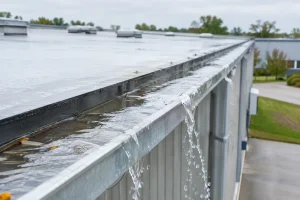



Most commercial roof failures are not sudden events. They are the predictable outcome of deferred maintenance: small defects left unattended until they become expensive ones. The difference between a $2,000 flashing repair and a $150,000 roof replacement is often nothing more than time and attention.
Roof maintenance planning is how facilities and asset managers get ahead of that curve. It turns reactive repair spending into a predictable, budget-managed programme, and it starts with understanding what you have, what condition it is in, and what it needs. Done properly, roof maintenance planning is not a maintenance line item at all; it is strategic roof asset management applied to the one building element that is out of sight until it fails.
Proactive vs Reactive: Why the Distinction Decides the Budget
Reactive roof maintenance is the default for most commercial buildings. Something leaks, it gets fixed. A section of membrane lifts, it gets patched. The problem is not that repairs get done. It is that they get done at the worst possible time, under the most pressure, with the least leverage over cost and scope.
Emergency repairs cost more than planned ones, because contractors hold the leverage when the ceiling is staining and the tenant is calling. Unplanned capital expenditure disrupts budgets. And reactive repairs address symptoms rather than causes, so the same area often leaks again twelve months later because the underlying issue was never identified.
Proactive roof maintenance planning changes the dynamic entirely. Defects are found early, while they are still minor. Repairs are scheduled on the owner’s terms, not under duress. Costs become predictable. And the roof system’s service life is extended, which delays the far larger capital cost of full replacement. This is where roof performance and risk advisory earns its place: the value is not the inspection, it is the decision the data makes possible. Treating the roof as an asset to be managed rather than a problem to be patched is the whole point of strategic roof asset management, and it rests on independent roof asset intelligence that answers to the owner rather than the repairer.
Book a roof inspection with independent roof consultants today.
How to Build a Commercial Roof Maintenance Planning Strategy
A sound roof maintenance planning strategy begins with a baseline condition assessment, then turns that data into a schedule and a budget.
Step 1: Get an independent condition report. Before you can plan maintenance, you need to know what you are dealing with. An independent roof condition report gives you a defect register with urgency grading, compliance status and estimated service life. Everything else is built on it, which is why independent roof asset intelligence is the foundation of the whole programme.
Step 2: Categorise findings by priority. Use the defect grading to separate urgent works (address immediately), short-term works (plan within 12 months) and monitoring items (review at next assessment). This converts the report into an action list.
Step 3: Assign budget to each category. Use the cost indicators in the condition report to build a maintenance budget. Urgent works go into the current financial year, short-term works into the next budget cycle, monitoring items into contingency.
Step 4: Build the assessment schedule. Annual assessments at minimum, more often for older roofs, high-traffic industrial facilities, or buildings in storm-prone regions. Schedule the next assessment before you finish acting on the current one. A regular schedule is what turns one-off checks into ongoing roof performance and risk advisory, and across an estate it underpins portfolio roof condition and risk assessments that can be compared year on year.
Step 5: Establish a trigger-based review process. Storm events, rooftop trades work, tenant complaints of water ingress and end-of-warranty milestones should all trigger a review automatically, rather than wait for the annual cycle.
Step 6: Document everything. Maintenance records, assessment reports, repair invoices and photographic evidence form the paper trail that protects you in warranty disputes, insurance claims and property transactions.
Built this way, roof maintenance planning stops being guesswork and becomes long-term roof asset planning and advisory with a defensible data trail behind every decision. It is also where the right roof inspection services Australia offers stop being a cost and start being roof performance and risk advisory the business can plan around.
Key Steps in an Effective Roof Maintenance Planning Programme
The practical mechanics of an effective programme for a commercial building:
- Baseline condition assessment by an independent inspector
- Defect register with urgency grading and cost indicators
- Annual assessment cycle with trigger-based supplements
- Scheduled remedial works tied to the financial planning cycle
- Post-works assessment to verify repair quality before invoices are paid
- Updated condition report after any significant repair or replacement
- Centralised documentation of all reports, works orders and repair records
The temptation is to treat roof maintenance as a single “maintenance budget” line. The more useful approach is to run it as a sub-programme with its own schedule, condition data and capital forecast, which is exactly how roof asset audits and lifecycle planning are meant to function.
A Seasonal Roof Maintenance Checklist
Roofs fail against the calendar, so a maintenance programme should work with the seasons rather than against them. Use this as a year-round checklist for an Australian commercial roof.
Autumn (pre-winter)
- Clear gutters, downpipes, sumps and overflow outlets of leaf litter before the wet season
- Check and reseal flashings around penetrations, skylights and plant
- Confirm drainage falls are clear so water cannot pond during heavy rain
Winter
- Monitor for active leaks and damp patches during and after prolonged rain
- Inspect internal ceilings for staining that signals concealed ingress
- Log any water entry immediately as a trigger-based review
Spring (post-storm)
- Assess for hail, wind and debris impact after storm season
- Check fixings, fasteners and lifted sheets or membrane laps
- Photograph any storm damage while warranty and insurance windows are open
Summer
- Inspect for thermal movement, membrane blistering and UV degradation
- Check rooftop plant and solar mountings for fixing fatigue
- Schedule the next full assessment before the cycle restarts
Building this rhythm into roof asset audits and lifecycle planning is far cheaper than reacting to a failure, and it is the discipline national roof inspections across a managed portfolio should follow.
Talk to an expert commercial roof consultant today
Roof-Type-Specific Maintenance
Different roof systems age differently, and a maintenance programme that treats them the same will miss the failure patterns that matter. National roof inspections across a mixed estate have to account for each material on its own terms.
Metal and sheet roofs
Watch corrosion at fasteners and laps, capillary action under sheets, and fatigue at fixing points. Maintenance centres on refixing, resealing laps and treating early corrosion before it spreads. Assessed against AS/NZS 1562.
Membrane and flat roofs
Blistering, delamination, ponding water and failed terminations at upstands are the recurring issues. Maintenance focuses on drainage, re-terminating details and repairing the membrane before water tracks beneath it. Assessed against AS 4654.
Tile roofs
Cracked or slipped tiles, perished pointing and bedding failure dominate, along with the condition of sarking beneath. Maintenance is largely repointing, rebedding and tile replacement.
Matching the programme to the material is a core part of portfolio roof condition and risk assessments, and it is why commercial property roof inspection work cannot be reduced to a single generic checklist. Across a portfolio, consistent commercial property roof inspection to one methodology is what makes roof asset advisory and risk management comparable from asset to asset.
How to Build a Budget for Annual Roof Maintenance Planning
The most reliable way to build a maintenance budget is to start from condition data, not historical spend.
Historical spend tells you what was spent on reactive repairs in previous years. It does not tell you what the roof actually needs, or what it will need as it ages. A roof that was in excellent condition three years ago, with low spend to match, may now be approaching the end of its service life and require substantially more. Independent roof inspection consultants build the budget from what the roof is, not from what it happened to cost last year.
A condition report with cost indicators gives you the actual budget requirement based on current defects. That number may be higher or lower than historical spend, but it is accurate, which is what a budget needs to be. For capital planning purposes, the report’s service-life estimate is the single most important data point: if the roof has seven years of estimated life remaining, that replacement cost belongs in the capital plan at year seven, not as a surprise in year six. This is the essence of capital planning support for roofing assets.
On the cost of the assessments themselves, Roof Inspection Australia does not publish a fixed price list. We confirm a single fixed fee once the scope of your asset or portfolio is understood, shaped by roof size and complexity, access, location, and the depth of reporting required. Once the scope is clear, the fee is fixed before any work begins, and you can request a quote to know the full cost up front. For a deeper breakdown of what drives a quote, see our roof inspection cost guide.
Repair or Replace? Making the Call from Condition Data
The hardest maintenance decision is when to stop repairing and commit to replacement. Patching a roof that is past economic repair wastes money; replacing a roof with years of life left wastes capital. The decision should come from data, not from whoever is holding the quote.
Lean toward repair and continued maintenance when defects are localised, the membrane or sheeting is largely sound, and the estimated service life still justifies the spend. Lean toward planned replacement when defects are widespread, repairs are recurring in the same areas, the system is past the midpoint of its expected life, or the cumulative repair cost is approaching a meaningful share of replacement.
An independent assessment gives you the service-life estimate and defect pattern to make that call objectively, which is precisely what roof asset advisory and risk management is for. Feeding that decision into long-term roof asset planning and advisory means replacement is scheduled and funded rather than forced, and it keeps capital planning support for roofing assets grounded in the roof’s real condition rather than a contractor’s quote.
Warranty and Compliance: Why Documentation Protects You
A roof warranty is only as good as the maintenance records behind it. Manufacturers and installers routinely decline claims where the owner cannot show the roof was inspected and maintained to the required schedule. A documented roof maintenance planning programme, with dated assessment reports and photographic evidence, is what keeps a warranty enforceable.
The same records support compliance and transactions. Reports referenced to the relevant Australian Standards and National Construction Code performance requirements, and rooftop works carried out under Safe Work Australia working-at-heights rules, give an owner a defensible position when an insurer, a buyer or an auditor asks for evidence. Choosing roof inspection services Australia can rely on for that documentation is part of protecting the asset’s value, and it is a reason owners increasingly prefer roof inspection services Australia offers on a genuinely independent basis.
How to Transition from Reactive to Proactive Roof Maintenance
The transition does not happen in one budget cycle. It typically takes two to three years to move from a reactive state to a genuinely proactive programme.
Year 1: Commission independent condition assessments across all assets in the portfolio. Use the findings to address urgent defects and build a baseline understanding of where each roof sits in its lifecycle.
Year 2: Implement the annual assessment schedule. Use condition data to build forward maintenance budgets for each asset, and begin scheduling planned repairs rather than waiting for failures.
Year 3 onwards: The programme is running. Assessments are scheduled, budgets are based on data, repairs are planned, and reactive spend drops significantly as defects are caught early.
The investment in getting there, primarily the cost of independent assessments, is recovered many times over in reduced emergency repair costs and extended roof service life. For portfolio owners, this is the point at which portfolio roof condition and risk assessments stop being a cost and start being a control, and the annual data begins to drive genuine capital planning support for roofing assets rather than a reactive top-up each year. National roof inspections delivered to one standard are what make that comparison possible across states.
Tools and Software for Roof Maintenance Planning
Facilities management platforms including Yardi, MRI Facilities Management and Archibus include asset maintenance modules suitable for roof condition tracking and assessment scheduling. For smaller portfolios, a structured spreadsheet is sufficient.
The quality of the outputs depends entirely on the quality of the inputs, so the programme should be fed by independent condition reports from qualified roof inspection consultants, not by contractor estimates written by the party hoping to win the repair.
Whatever the platform, the data behind it should come from independent roof asset intelligence, and the annual cycle should feed roof asset audits and lifecycle planning rather than sit in a spreadsheet nobody revisits.
Start your roof inspection process today.


Book a roof inspection today
Book the Independent Assessments Behind Your Maintenance Plan
Roof Inspection Australia provides the independent condition assessments that make proactive roof maintenance planning possible. No repairs, no conflict of interest, just the data your maintenance programme needs. As independent roof inspection consultants, we deliver the baseline and the annual data that a credible programme runs on.
Our commercial property roof inspection work feeds directly into strategic roof asset management and long-term roof asset planning and advisory, so the maintenance plan and the capital plan tell the same story. This is roof asset advisory and risk management delivered by assessors with no stake in the repairs.
Book a consultation or request a quote today, and receive a documented condition report your maintenance programme, your board and your insurer can all rely on.
FREQUENTLY ASKED QUESTIONS
Start with an independent condition assessment to establish a baseline. Categorise findings by priority, assign budget to each category, build an assessment schedule, establish trigger-based review protocols, and document everything. The strategy is only as good as the condition data it is built on.
Baseline condition assessment, a defect register with urgency grading, an annual assessment cycle, scheduled remedial works tied to the financial planning cycle, post-works assessment, updated condition reporting after significant works, and centralised documentation of all records.
At least annually for most commercial roofs, twice a year for older or high-exposure roofs, and after every major storm. Assessments should also be triggered by rooftop trades work, tenant reports of water ingress, and end-of-warranty milestones.
Base the budget on current condition data from an independent assessment, not historical reactive spend. Use the defect register and cost indicators to quantify current-year requirements, and use the service-life estimate to place replacement cost in the capital plan at the right year.
Facilities management platforms such as Yardi, MRI Facilities Management and Archibus include asset maintenance modules suitable for roof condition tracking. For smaller portfolios a structured spreadsheet works. Whichever you use, feed it independent condition reports rather than contractor estimates, because the planning is only as good as the data behind it.