
A warehouse roof inspection is not a scaled-up version of a commercial office inspection. Industrial and logistics facilities present a distinct set of physical, safety, and technical challenges that require both the right expertise and the right methodology.
Large open-span roof structures, complex drainage systems across thousands of square metres, heavy machinery vibration, chemical exposure, and limited safe access points — these are the realities of industrial roofing inspections. Getting the assessment right protects both the facility and the people inside it.
What Are the Unique Challenges of a Warehouse Roof Inspection?
Several factors make warehouse and industrial roof inspections more demanding than standard commercial assessments.
Scale. A distribution centre or manufacturing facility can have a roof spanning 10,000 to 100,000 square metres. Traditional walk-over inspections at that scale are time-consuming, physically demanding, and risk missing sections without a structured methodology. Drone-assisted inspection is often deployed alongside physical access for large-format roofs.
Roof system complexity. Industrial roofs typically use metal sheet or standing seam systems with long fastener runs, penetrations for ventilation and extraction systems, and drainage layouts designed for high-volume rainfall discharge. Each element has its own failure modes.
Vibration and load effects. Machinery vibration, forklift traffic, and heavy racking systems can transfer loads to the roof structure that accelerate fastener fatigue and joint movement. These effects are often invisible from the surface until a failure occurs.
Chemical exposure. Facilities processing or storing chemicals, fertilisers, or aggressive compounds may experience accelerated corrosion of metal roof components. Standard inspection criteria may need to be supplemented for these environments.
Access constraints. Many industrial roofs have limited safe access points, no fixed walkways, and surfaces that cannot safely be walked without fall protection equipment. Compliant access planning is a prerequisite, not an afterthought.
Book a roof inspection with independent roof consultants today.
Safety Requirements for an Industrial Roof Inspection
Any industrial roof inspection must comply with the Work Health and Safety Act 2011 (Cth) and relevant state-based WHS regulations for working at heights.
The key requirements include:
- A site-specific safe work method statement (SWMS) for working at heights before any roof access
- Fall protection — fixed anchor points, static lines, or temporary edge protection depending on the roof configuration
- Appropriate personal protective equipment including harnesses, helmets, and non-slip footwear
- A permit-to-work system in facilities that require it (common in chemical, food processing, and hazardous materials environments)
- Consideration of roof surface load capacity — particularly on older corrugated iron or asbestos-containing roofs where surface integrity cannot be assumed
Before booking an industrial roof inspection, confirm that your provider has demonstrated working-at-heights competency, carries appropriate insurance, and will submit a SWMS prior to any site access.
At Roof Inspection Australia, safety compliance is built into every inspection scope — not added as an afterthought.
How Is an Industrial Roof Inspection Different from a Standard Commercial One?
The core methodology is the same — systematic assessment, photographic documentation, defect grading, compliance review. But the application differs in several important ways.
Industrial inspections typically involve larger roof areas requiring structured grid-based assessment methodology rather than a simple walkover. Fastener condition and pull-out risk are more critical on industrial metal roofs than on membrane systems common in office buildings. Drainage volumes are higher and drainage failure consequences are more immediate — a blocked scupper on a 30,000m² flat roof can result in catastrophic ponding load during heavy rainfall.
Skylight condition is also a significant consideration in industrial facilities. Polycarbonate and fibreglass skylights degrade over time and can become brittle — creating both a water ingress risk and a fall-through hazard for anyone on the roof.
Talk to an expert commercial roof consultant today
How to Use Drones for a Large Warehouse Roof Inspection
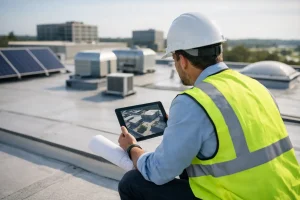
Drone-assisted inspection is increasingly standard for large warehouse and logistics roofs. A drone can survey the entire roof surface in a fraction of the time required for a physical walkover, capturing high-resolution imagery of surface condition, ponding water, drainage layouts, and visible defect patterns.
The practical workflow for a drone-assisted warehouse inspection:
- CASA-compliant operator conducts a full aerial survey capturing orthomosaic imagery and targeted defect photographs
- Images are reviewed to identify areas requiring physical closer inspection
- Qualified inspector accesses specific areas of concern identified from the aerial survey
- Report integrates both aerial imagery and hands-on findings
This hybrid approach is both more efficient and more thorough than either method alone. The drone captures the big picture; the inspector assesses the detail.
How Often Should a Warehouse Roof Inspection Be Scheduled?
For industrial and logistics facilities, biannual inspections are the recommended baseline — not annual. The combination of larger roof areas, more complex drainage systems, vibration effects, and higher consequence of failure justifies the additional frequency.
Beyond the biannual cycle, trigger-based inspections should be scheduled after:
- Major storm or hail events
- Any roof penetration work or installation of equipment
- Discovery of internal water ingress or staining
- End-of-warranty periods on roofing systems
- Before and after property acquisition or disposition
For facilities with ageing roof systems — particularly those with corrugated iron or earlier-generation membrane systems — quarterly drainage checks (which can be conducted by facilities staff) are a useful supplement to the formal biannual inspection.
Warehouse and Industrial Roof Inspection Checklist
A comprehensive industrial roof inspection should cover:
- Roof type, age, and material system identification
- Full surface condition — corrosion, delamination, impact damage, or surface wear
- All fasteners — type, condition, spacing, and signs of pull-out or backing-out
- Lap joint integrity along all sheet overlaps
- Gutters, downpipes, sumps, and overflow outlets — individually assessed
- Ridge and hip capping condition
- All penetrations — extraction fans, ventilation units, service pipes, and conduits
- Skylight condition — frame integrity, glazing condition, and seal performance
- Parapet and coping condition where applicable
- Evidence of ponding or drainage failure zones
- Roof access points — condition and compliance
- Evidence of any previous repairs — quality and remaining service life assessed
- Defect register with urgency grading
- Compliance references
- Recommendations with cost indicators
Start your roof inspection process today.

Book a roof inspection today
Contact Roof Inspection Australia Today
Roof Inspection Australia provides independent warehouse and industrial roof inspections across Australia. Qualified inspectors, CASA-compliant drone capability, and reports built for facilities managers and asset teams. Book your industrial roof inspection today.
Scale, system complexity, vibration and load effects, chemical exposure in some facilities, and access constraints. Large industrial roofs often require drone-assisted assessment alongside physical inspection to ensure full coverage. Safety compliance — including a site-specific SWMS and fall protection — is mandatory before any roof access.
Biannual is the recommended baseline for industrial and logistics facilities, with additional trigger-based inspections after storm events, rooftop trades work, water ingress discovery, or warranty expiry. Facilities with older roof systems benefit from quarterly drainage checks between formal inspections.
Engage a CASA-compliant drone operator to conduct a full aerial survey, then follow up with targeted physical inspection of areas identified from the imagery. This hybrid approach delivers both full-coverage efficiency and the technical detail that physical assessment provides. All RIAx drone operations are conducted by licensed operators under a Remote Operator Certificate.
Roof Inspection Australia operates nationally across all states and territories. Our inspectors are experienced with industrial and logistics facilities across warehousing, manufacturing, food processing, and distribution. Enquire here.
A site-specific SWMS, compliant fall protection (harness, anchors, or edge protection), appropriate PPE, and where required, a permit-to-work. Providers must demonstrate working-at-heights competency and carry appropriate insurance. These are non-negotiable requirements, not optional additions.
Larger scale requiring structured grid-based methodology, greater focus on fastener condition and pull-out risk, higher drainage volume demands, skylight fall-through risk assessment, and more complex access and safety planning. Industrial inspections often incorporate drone-assisted surveys alongside physical assessment.
Roof Inspection Australia is a specialist independent inspection firm with demonstrated experience across industrial, warehouse, and logistics assets nationwide. No repairs, no conflict of interest — just qualified assessment and reporting. Contact us here.