
A roof usually does not fail because of one dramatic event. It fails because small defects are ignored, poor decisions compound them, and nobody independent steps in early enough to call the problem for what it is. For owners and managers of commercial property, understanding roof failure causes is not a technical exercise. It is a risk control issue tied directly to capital planning, compliance, tenant impact and contractor accountability.
The uncomfortable truth is that many serious roof problems begin long before the first internal leak. Water ingress is often the last visible symptom, not the first sign of trouble. By the time stained ceilings, damaged stock or disrupted operations appear, the asset has usually been carrying hidden defects for months or years.
The real pattern behind roof failure causes
On commercial assets, roof failure causes tend to fall into a predictable pattern. Design shortcomings create vulnerability, installation defects lock in weak points, drainage issues accelerate deterioration, and poor maintenance allows everything to worsen unchecked. Age matters, but age alone is rarely the full explanation.
That distinction matters commercially. If a roof is written off as simply old, decision-makers can be pushed into premature replacement or vague repair scopes that do not address the actual failure mechanism. A thirty-year-old roof may still be serviceable if its details are sound and drainage works properly. A five-year-old roof can be in serious trouble if it was badly designed, poorly installed or never inspected properly at handover.
This is where independent assessment has real value. Contractors often view the roof through the lens of what they can sell. A consultant looking only at evidence can separate cosmetic ageing from structural or waterproofing risk.
Design and specification errors
Some roofs are built with failure built in. That sounds blunt because it is. If falls are inadequate, drainage points are poorly located, overflow paths are missing, or membrane systems are specified without regard to actual site conditions, the roof starts its life exposed.
Low-slope roofs are especially vulnerable when design tolerances are tight and real-world construction variability is ignored. A drawing may show compliant falls, but once structural deflection, service penetrations and construction tolerances are added, ponding can become inevitable. Persistent ponding does not just look untidy. It increases membrane stress, attracts debris, accelerates UV degradation at weak points and adds load the structure may not have been expected to carry over time.
Material compatibility is another recurring issue. Different metals, sealants, insulation types and membrane components do not always behave well together. In coastal or industrial environments across Australia, corrosion risk and chemical exposure need to be accounted for early. If they are not, deterioration can begin far sooner than the original budget assumptions allowed.
Poor installation is still one of the biggest roof failure causes
A sound design can still be undone by poor workmanship. In commercial roofing, small installation errors at laps, terminations, penetrations and drainage details create outsized consequences. These are not minor defects if they compromise waterproofing continuity.
The common problem is that many defects remain concealed after completion. Flashings may look neat from ground level while being mechanically insecure or incorrectly sealed. Membranes can be bridged, poorly bonded or terminated without proper pressure bars. Roof sheeting can be misaligned, fixed incorrectly or left vulnerable at side laps and end laps. None of that is always obvious until weather, thermal movement and time expose the weakness.
Handover is often where clients lose leverage. If roofs are not independently inspected before practical completion and during defects liability periods, latent issues can become the owner’s problem far too quickly. That is a commercial failure as much as a technical one.
Penetrations and rooftop services
Every penetration is a risk point. Plant upgrades, comms installations, solar works and mechanical alterations routinely compromise otherwise serviceable roofs. The issue is not just the penetration itself, but the way multiple trades interact with the roofing system.
One contractor cuts the roof. Another seals it. A third returns months later and shifts equipment. Accountability becomes blurred, and the waterproofing detail often ends up as an improvised site solution rather than a properly designed junction. Many leak investigations trace back to service penetrations that were treated as minor works when they should have been controlled as high-risk interfaces.
Drainage failure is often the trigger
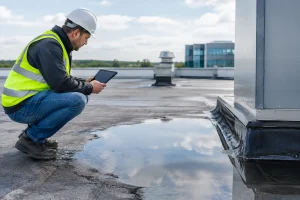
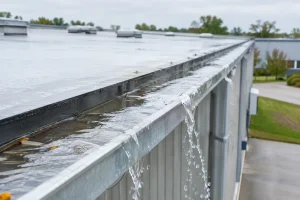
If there is one issue that repeatedly turns manageable defects into serious building problems, it is drainage. Blocked sumps, undersized downpipes, back-falling gutters, ponding areas and missing overflow provisions are among the most common roof failure causes on large assets.
Drainage failures matter because they multiply every other weakness. Water that should leave the roof quickly instead sits against laps, flashings, fixings and membrane joins. Debris builds up. Surface temperatures shift. Corrosion accelerates. During major rain events, the system runs beyond what it can tolerate.
On box gutters and internal drainage systems, the consequences are sharper. These details can fail without much warning, and when they do, internal water entry is often extensive. In occupied commercial, education and healthcare environments, that translates into more than repair cost. It can mean operational disruption, damaged equipment, mould risk, safety concerns and stakeholder scrutiny.
Maintenance neglect versus maintenance reality
Not every drainage issue reflects negligence. Some assets are simply difficult to maintain consistently, especially across large portfolios with mixed building ages and access constraints. But from a risk perspective, the cause still needs to be named accurately. If maintenance access is poor, that is not just an operational inconvenience. It is part of the failure pathway and should be treated as such in planning and budgeting.
Movement, weather and environment
Australian roofs work hard. Heat, UV exposure, thermal cycling, high winds, intense rainfall and coastal conditions all test detailing and materials over time. A roof system that performs adequately in one environment may deteriorate much faster in another.
Thermal movement is routinely underestimated. Metal roofs expand and contract. Membranes move differently from substrates. Joints open, fixings loosen and flashings fatigue. If movement is not properly accommodated, repetitive stress eventually creates points of entry for water.
Severe weather can expose these weaknesses quickly, but storms are often blamed too broadly. Wind-driven rain may reveal the defect, yet the root cause is usually pre-existing – inadequate fixing patterns, failed seals, corroded components or detailing that never had enough tolerance. Calling it storm damage without examining the underlying condition can lead to the wrong scope and the wrong claim position.
Deferred decisions make failure more expensive
One of the least discussed roof failure causes is management delay. Not because owners do not care, but because roofing issues are easy to defer when defects are intermittent, reporting is vague or contractors offer conflicting opinions. That delay has a cost.
A localised leak can indicate widespread wet insulation. Surface corrosion can conceal structural section loss. Repeated patch repairs can mask the fact that the failure mode is systemic. By the time certainty arrives, options have narrowed and the budget impact is higher.
This is why condition reporting needs to move beyond defect lists. Decision-makers need to know what is cosmetic, what is active, what is likely to worsen, and what should be challenged before money is committed. Clear technical evidence gives asset teams leverage. Without it, they are often left choosing between overspend and inaction.
How to assess roof failure causes properly
The aim is not to find a leak and stop there. The aim is to understand the mechanism of failure, its extent, and the commercial implications of leaving it unresolved. That means looking at the roof as a system – waterproofing, drainage, structure, penetrations, maintenance access, service interfaces and historical repairs.
Good assessment also requires context. Is the roof near end of life, or simply suffering from isolated defects? Is replacement actually justified, or has poor maintenance distorted the picture? Are contractor recommendations aligned with the evidence, or with their pipeline? Those questions matter because roofing decisions on high-value assets are rarely cheap and never isolated from broader portfolio strategy.
For many owners, the strongest position comes from separating diagnosis from delivery. Roof Inspection Australia operates on that principle for a reason. We do not sell roofing work, which means our findings are not shaped by a repair target, product preference or replacement agenda.
What commercial owners should do before failure takes control
If a roof has active leaks, visible ponding, repeated patch repairs, corrosion at critical details or disputed contractor advice, the time for assumptions has passed. The practical move is an evidence-based inspection that identifies the actual failure causes, ranks risk, and distinguishes urgent remediation from medium-term capital planning.
That approach protects more than the roof. It protects budgets, procurement decisions, warranties, stakeholder confidence and business continuity. It also gives property teams something they often lack in roofing discussions – control.
The smart question is not whether a roof can be patched one more time. It is whether you understand exactly why it is failing, who is accountable, and what the most defensible next step looks like.