
A roof contractor says the defects are minor, the variation is justified, and the job is on track. Then the leaks return, the handover is vague, and no one wants to own the problem. That is exactly why clients ask how to audit roof contractors before cost blowouts harden into capital mistakes.
For commercial assets, a contractor audit is not a paperwork exercise. It is a control measure. You are testing whether the contractor’s claims, workmanship, documentation and pricing stand up to scrutiny. If they do, good. If they do not, you want evidence early, while you still have leverage.
What an audit is really trying to prove
When you audit a roof contractor, you are not just asking whether the crew turned up and installed materials. You are asking whether the work matches the contract, whether the roof system is fit for purpose, whether compliance obligations are being met, and whether future failure has been built into the asset.
That distinction matters. A roof can look acceptable from the ground and still be carrying drainage faults, membrane detailing errors, unfinished terminations, unsafe access issues, or non-compliant penetrations. A contractor may also provide a neat report that says very little. Presentation is not proof.
Commercial clients need a tighter lens. The audit should test five things at once: scope compliance, workmanship quality, material suitability, documentation integrity, and commercial accountability. If one of those fails, the risk usually spreads into the others.
How to audit roof contractors without relying on their version of events
The first rule is simple. Do not let the contractor define the audit criteria.
If the same party quoting the work, completing the work and reporting on the work is also the one telling you whether the outcome is acceptable, you have a conflict. That does not automatically mean misconduct. It does mean your oversight is weak.
Start with the contract set, not the site walk. Review the specification, drawings, approved materials, scope inclusions, exclusions, warranties, programme commitments and any variation approvals. Many disputes start because clients are auditing performance against assumptions rather than against the actual contracted obligation.
From there, move to physical verification. Inspect the roof, the drainage paths, flashings, laps, seams, terminations, penetrations, edge details, plant interfaces and any high-risk transitions between materials. On commercial assets, these are the areas where hidden defects often sit. The broad field of the roof may not be the problem. The details usually are.
You should also test whether the installed solution suits the building’s operating conditions. A technically neat installation can still be wrong if the material choice ignores ponding risk, traffic exposure, thermal movement, chemical discharge, or maintenance access patterns. This is where many contractor-led recommendations fall apart. They solve the visible issue, not the asset risk.
The documentation that separates control from guesswork
A credible contractor audit is evidence-led. If key records are missing, that is not an admin issue. It is a risk signal.
At minimum, review inspection and test plans, hold point sign-offs, SWMS alignment to actual activities, material delivery records, product data, warranty terms, variation documentation, site photographs, defect lists and completion records. On larger projects, you should also check whether the as-built condition actually matches what has been certified or claimed.
Watch for vague language. Terms like repaired as required, completed to standard, or defects addressed do not tell you enough. What was repaired, where, with what material, under whose instruction, and to which standard? If that level of detail is absent, the contractor has left room to move later and left you carrying the uncertainty now.
This is also where independent reporting becomes commercially useful. A third-party consultant who does not sell repairs has no reason to soften findings to preserve a workstream. That independence gives clients something contractor reports often do not: evidence they can rely on in procurement discussions, disputes, budget reviews and stakeholder reporting.
Workmanship problems that deserve closer scrutiny
Not every defect justifies escalation, but some categories deserve immediate attention because they have a habit of becoming expensive later.
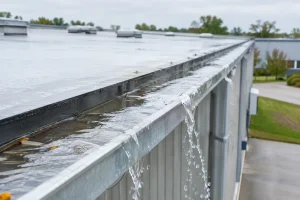
Drainage is one. Falls that do not drain, outlets set too high, blocked sumps, poorly integrated overflows and localised ponding can all shorten system life and trigger internal damage. Waterproofing transitions are another. Upstands, penetrations, joints and perimeter details often fail before the main field does.
There is also the issue of concealment. Once protective layers, cappings or plant are installed over defective work, your visibility drops and your rectification cost rises. If the audit is late, the contractor has more room to argue that the problem is historic, unrelated or caused by another trade. Timing matters.
Then there is substitution. If approved materials have been swapped for alternatives, you need to know whether that change was formally approved, technically equivalent and compatible with adjacent components. A cheaper product that creates a shorter lifecycle or a warranty dispute is not a saving. It is deferred cost dressed up as value.
Commercial red flags during a contractor audit
A proper audit also looks at behaviour, because poor contractor conduct usually leaves technical fingerprints.
Repeated reliance on verbal instructions is one warning sign. So is resistance to providing marked-up records, test evidence or precise defect responses. If every issue is described as cosmetic, maintenance-related or outside scope before it has been independently assessed, caution is warranted.
Another red flag is excessive variation activity around predictable details. Some variation claims are legitimate. Roofing projects can uncover concealed conditions. But if the contractor routinely prices obvious site realities as extras, the issue may be weak scoping, aggressive tendering or deliberate margin recovery.
Programme claims also deserve scrutiny. A contractor may say practical completion was achieved, but if critical defects, incomplete terminations, unresolved drainage faults or missing compliance records remain, completion may be more administrative than real. That matters when warranties, retention, tenancy, or operational risk depend on the status of the works.
Who should perform the audit?
It depends on the asset, the stage of the project and the consequences of getting it wrong.
For low-value minor works, an experienced in-house team may manage a basic review. For live commercial, industrial, government or institutional assets, that is often not enough. The more complex the roof system, the more interfaces involved, and the more money exposed, the stronger the case for an independent specialist.
This is particularly true where there is a dispute, a major defect pattern, a handover concern, or a recommendation for large capital replacement. In those situations, relying solely on contractor input is a poor control position. You need someone who can test the claims, document the evidence and tell you plainly whether the proposed scope is justified.
That is the value of an independent roofing consultant. The role is not to create friction for the sake of it. The role is to give the client technical truth and commercial leverage. Roof Inspection Australia operates in that space for exactly this reason. We do not sell roofing works, which means the advice is not tied to a repair agenda.
How to turn audit findings into contractor accountability
An audit only has value if it changes the decision pathway.
Findings should be categorised by risk and consequence, not buried in technical noise. Separate immediate failure risks from monitor items. Distinguish contract non-compliance from maintenance issues. Identify what requires rectification, what requires redesign, what affects warranty, and what should influence future contractor engagement.
Be specific in your response. If a defect is present, record its location, extent, likely cause, evidence basis and required action. If documentation is deficient, state what is missing and why it matters. If a contractor recommendation is excessive or unsupported, say so clearly. Ambiguity protects the wrong party.
This is also where many clients miss an opportunity. The audit should not only resolve the current job. It should improve procurement and oversight on the next one. If the same documentation gaps, detailing failures or scope ambiguities keep appearing across sites, the problem is systemic. Fix the instruction framework, not just the defect list.
A practical standard for better audits
If you want a useful internal benchmark, ask four blunt questions.
Did the contractor deliver what was specified? Is the installation technically sound at both field and detail level? Does the documentation prove compliance and support warranty position? And if a dispute arose tomorrow, would the current evidence protect your budget?
If the answer to any of those is no, the audit is not finished.
Roofing failures rarely become expensive because nobody looked. They become expensive because people accepted claims without enough proof, signed off incomplete work, or treated specialist defects like general maintenance. A tighter audit changes that. It gives you facts, not reassurance.
When the roof carries operational risk, compliance exposure and capital consequences, trust should never be the audit method. Evidence should be.