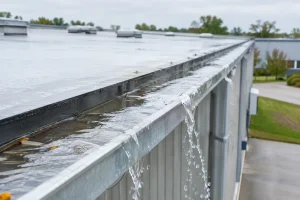




A roof leak rarely starts as a roofing problem on paper. It starts as a ceiling stain over a tenancy, a shutdown risk above critical plant, or an argument between maintenance, builder and contractor about who is responsible. That is where a proper roof leak diagnostics example matters. Not as a generic checklist, but as a clear demonstration of how independent diagnosis turns noise into evidence and evidence into defensible action.
For commercial assets, the cost of getting leak diagnosis wrong is usually much higher than the repair itself. The real damage sits in repeat call-outs, soaked insulation, tenant disruption, warranty disputes, corrosion, mould risk and capital works being pushed forward years earlier than planned. When the diagnosis is weak, the repair is guesswork. When the diagnosis is independent and technically sound, you regain control.
A practical roof leak diagnostics example
Consider a large-format distribution facility in outer Melbourne. The building had a recurring leak above the dispatch zone during wind-driven rain from the south-west. The site team had already engaged a roofing contractor twice. On both occasions, sealant was applied to sheet side laps and around several roof penetrations near the reported leak point. The leak stopped briefly, then returned.
This is a common commercial pattern. Water presents internally at one point, repairs are carried out at the obvious nearby detail, and the actual entry pathway remains untouched. The contractor may not be acting in bad faith, but if they are also selling the repair, there is an obvious incentive to move quickly to a fix rather than slow down and prove the cause.
An independent inspection started with three questions. Where is water entering the building envelope, how is it tracking through the roof build-up, and what defect mechanism explains the timing and weather dependence of the leak? Without answering those three questions, any repair recommendation is just expenditure dressed up as confidence.
Step 1 – Define the leak pattern before inspecting the roof
The first stage was not on the roof. It was inside the building, reviewing incident records, photos from previous events, rainfall timing and wind conditions. Maintenance logs showed the leak occurred only during heavy rain with strong south-westerly winds. It did not occur during light vertical rainfall. That immediately narrowed the field.
If a leak only appears under wind pressure, the likely causes shift. You start looking harder at upstand heights, laps exposed to driven rain, poorly sealed penetrations, apron flashings, dislodged closures and transitions where water can be forced uphill or sideways. You become less interested in broad assumptions such as “the roof is old” and more interested in the exact defect condition that allows pressure-driven water entry.
Step 2 – Inspect the internal evidence properly
Internally, water staining on the sarking and purlin line did not align neatly with the ceiling drip point. Moisture readings were elevated along a track extending upslope from the visible stain. That suggested lateral water migration before discharge, which is standard on commercial metal roofs with insulation blankets, services and framing that redirect flow.
This matters because internal leak points often mislead people into repairing the wrong roof area. In this case, the internal evidence indicated the entry was likely several metres upslope and slightly south of where water was presenting below.
Step 3 – Test the external assumptions, not just the visible symptoms
On the roof, the earlier sealant work was immediately obvious. Fresh sealant had been applied generously around service penetrations and along exposed sheet laps. None of that proved the source had been found. It only proved that someone had tried to stop water somewhere near the complaint.
The inspection identified three relevant conditions. First, a parapet-to-roof transition on the south-west corner had inadequate flashing termination for the exposure conditions. Second, the profile closures beneath a transition flashing were missing in sections, leaving a pathway for driven rain. Third, debris build-up near a box gutter sump was slowing discharge during peak rainfall, causing temporary surcharge and increasing the water load at the transition.
Any one of those defects might not have caused a visible leak in isolation. Together, they formed a credible failure mechanism. Wind-driven rain was entering at the poorly detailed transition, bypassing incomplete closures, then tracking beneath the sheeting and insulation before discharging internally over the dispatch area.
Why this roof leak diagnostics example matters
The lesson is not that every leak comes from a flashing detail. The lesson is that roof leaks are often system failures, not single-point failures. Drainage performance, wind exposure, installation quality, detail design and maintenance condition can combine to produce a leak that no amount of random sealant will fix.
That is where many commercial investigations go wrong. People ask, “Where is the hole?” The better question is, “What combination of conditions allowed water ingress under these specific weather events?” That shift in thinking saves money because it moves the discussion from patching symptoms to correcting causes.
What the diagnosis changed commercially
Once the defect mechanism was established, the recommended actions were precise. The transition flashing required redesign and reinstatement to suit wind-driven rain exposure. Missing closures had to be installed correctly. The sump area needed cleaning and a review of drainage capacity and overflow behaviour. Just as importantly, the earlier sealant repairs were identified as non-diagnostic and non-durable.
That gave the asset team leverage. Instead of approving another vague leak repair, they could issue a scope tied to observed defects and evidence. They could challenge prior workmanship without relying on opinion. They could separate urgent rectification from broader lifecycle planning. That is the commercial value of diagnostics. Clarity before spend.
What a good leak investigation should include
A credible commercial leak investigation should not stop at “found and repaired”. That wording belongs in sales paperwork, not serious asset reporting. For a diagnosis to be useful to owners, facility managers and project teams, it should identify the leak pattern, document probable entry points, explain the water pathway, test alternative causes and set out the level of confidence behind each conclusion.
It should also be honest about uncertainty. Sometimes destructive inspection, moisture mapping, flood testing or staged monitoring is needed before a final repair scope is issued. There is no weakness in that. The weakness is pretending certainty where none exists, then billing the client again when the leak returns.
For high-value assets, the report should also state the consequence of inaction. Is this a local defect with manageable short-term risk, or an indicator of broader installation failure across the roof zone? Does the defect affect compliance, warranty position, tenant operations or latent corrosion risk? Diagnostics should support decision-making, not just defect spotting.
Independent diagnosis changes the outcome
When the same party diagnoses the issue, sells the repair and later assesses whether it worked, the client carries most of the risk. That model is common, but it is not neutral. Independent consultants exist for a reason. We do not sell roofing. We just tell you the truth.
For asset owners and managers, that independence is not a philosophical nice-to-have. It is practical risk control. It improves procurement, sharpens contractor scope, reduces repeat failures and creates a record you can stand behind in internal approvals, disputes or handover discussions.
A strong diagnosis also helps avoid the opposite mistake – overreaction. Not every leak means the roof has reached end of life. In some cases, a targeted rectification is the right move. In others, recurring defects signal that patch repairs are just delaying a larger capital event. The answer depends on evidence, not alarmism.
Reading between the stains
The next time a contractor says, “We think it’s coming from around here,” pause. A leak location is not a diagnosis. A photo of wet plaster is not a failure mechanism. And a tube of sealant is not a strategy.
A proper roof leak diagnostics example shows what good looks like: define the pattern, inspect the internal pathway, verify external defect conditions, explain causation and translate the findings into commercially useful action. That is how you protect budgets, challenge weak advice and stop small roof failures from becoming expensive portfolio problems.
If a roof is leaking, the first job is not to spend. The first job is to know exactly why.