
A roof rarely fails without warning. The problem is that the warning signs are often missed, misunderstood, or buried inside a contractor quote that just happens to recommend expensive works. That is where a commercial roof inspection matters. For owners and managers of high-value property, it is not a maintenance formality. It is a control measure.
When a roof sits over a hospital ward, a logistics facility, a school, or a major retail tenancy, failure is never just a roofing issue. It becomes an operational disruption, a compliance problem, a reputational risk, and usually a budget problem. Water ingress damages more than membranes and metal sheeting. It affects ceilings, services, stock, plant, fitout, and stakeholder confidence. By the time leaks are obvious, the real cost is already moving well beyond the roof.
What a commercial roof inspection is really for
A proper commercial roof inspection is not there to tick a box or confirm that a roof exists. It should answer commercial questions with technical evidence. What is the current condition of the roof asset? What defects are active, concealed, or likely to worsen? Which issues require immediate action, and which can be planned? Are drainage, waterproofing details, penetrations, and terminations performing as intended? Is the advice you are receiving from contractors proportionate to the actual condition on site?
That last question matters more than many portfolios realise. If the same business inspecting the roof is also selling repairs, replacement, coatings, or maintenance packages, the inspection is never fully separated from the sales outcome. Sometimes the recommendations are justified. Sometimes they are not. Either way, the conflict exists.
Independent inspections change the power balance. They give asset managers, facilities teams, developers, and project stakeholders evidence before they commit capital. They also create leverage in conversations with contractors, builders, and warranty providers. If there is a defect, you want proof, not opinion.
Why commercial roof inspection gets pushed too late
Most portfolios do not ignore roofing risk because they are careless. They push inspections back because roofs are out of sight, access can be difficult, and the absence of internal leaks gets mistaken for good condition. That assumption is expensive.
Many roof failures begin with details that seem minor – blocked drainage, poor laps, fatigued sealants, membrane shrinkage, corroding fixings, ponding, cracked flashings, poorly executed penetrations, or damage from other trades. None of these issues stay minor forever. The speed at which they worsen depends on the roof type, building use, weather exposure, maintenance history, and how long water has been tracking through the assembly.
There is also a procurement problem. Roof spend often arrives as a surprise, which means it competes with other capital priorities. Without condition data, decision-makers are left reacting to the loudest failure rather than planning around the most material risk. A commercial roof inspection gives structure to that decision-making. It helps separate urgent defect rectification from works that can be staged, monitored, or challenged.
What decision-makers should expect from a serious inspection
Not all inspections are equal. A contractor doing a quick walkover before issuing a repair proposal is not the same as an evidence-based roof condition assessment.
A serious inspection starts with context. Building age, roof system type, occupancy risk, maintenance records, known leak history, previous rectification works, and current project stage all matter. A handover inspection for a new development is looking for different issues than a lifecycle review for an ageing industrial asset. The methodology should change accordingly.
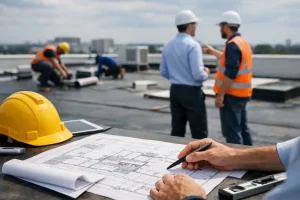
On site, the focus should go well beyond visible holes or obvious corrosion. Roof coverings, laps, joints, penetrations, perimeter details, drainage performance, waterproofing interfaces, plant supports, traffic damage, prior repairs, moisture pathways, and buildability issues all need attention. In many cases, the detail around rooftop services is where risk concentrates. Mechanical upgrades, solar installations, comms equipment, and ad hoc penetrations routinely compromise otherwise serviceable roof systems.
Just as important is the reporting. A useful report does not hide behind jargon or flood the reader with photos that lack meaning. It should identify the defect, explain why it matters, show supporting evidence, define likely consequences, and rank the issue by priority. It should also make clear where further invasive investigation or specialist testing may be required. Clarity is the product.
The financial value is not in the inspection fee
The fee for a commercial roof inspection is usually insignificant compared with the cost of getting the roof wrong. That is the real comparison.
If an inspection prevents a premature roof replacement, it has paid for itself. If it identifies latent defects during a defects liability period, it has paid for itself. If it helps an owner challenge vague remedial pricing, scope creep, or unnecessary coating recommendations, it has paid for itself. If it provides evidence that supports staged capital planning instead of panic spend, it has paid for itself.
There is a common mistake in commercial property – treating roof advice as a low-value input because the roof itself is not a tenant-facing asset. But the roof protects every tenant-facing asset underneath it. It also protects income continuity. Once that is understood, independent assessment stops looking like an overhead and starts looking like risk control.
When a commercial roof inspection is most valuable
Timing affects value. The best inspections are not always the ones ordered after water is coming through the ceiling.
Pre-acquisition inspections can expose deferred maintenance, hidden defects, non-compliant details, and replacement liabilities that change the numbers on a deal. Handover and completion inspections can identify workmanship defects before they become the owner’s problem. Warranty-period inspections matter because many defects only become visible after weather exposure or thermal movement. For existing portfolios, periodic condition assessments support maintenance planning and help justify capital requests with evidence rather than instinct.
There are also moments where scrutiny should increase. After major weather events, rooftop plant works, tenancy modifications, or other contractor activity, roofs deserve another look. A surprising number of leaks begin after someone unrelated to roofing has been on the roof.
Independence matters when the stakes are high
This is the point many clients arrive at after a bad experience. They were told the roof needed full replacement. Or they were told it was fine, right up until internal damage appeared. Or they accepted handover from a builder and inherited a list of avoidable defects. The pattern is not unusual. Roofing advice is often shaped by what the adviser stands to sell.
That is why independent consultancy has real commercial value. When the inspection party is not selling rectification works or products, the incentive changes. The brief becomes simple – identify the truth, document the evidence, and protect the client’s position. Roof Inspection Australia operates on that basis, which is why the reporting is built to support action, not a sales pipeline.
Independence does not mean every roof is a crisis. Sometimes the right advice is that the roof is performing adequately, defects are isolated, and replacement can wait. Sometimes the right advice is the opposite. Credibility comes from being able to say both with equal confidence.
What to challenge in any roof report
Commercial clients should be sceptical of vague language. If a report says a roof is in poor condition, ask why. If major works are recommended, ask what evidence supports that recommendation. If leaks are attributed to age alone, ask whether the actual failure points have been identified. If the suggested solution is a coating system across the entire roof, ask whether the substrate, drainage, detailing, and moisture condition make that technically appropriate.
There is always a trade-off between patch repairs, targeted rectification, refurbishment, and replacement. The right path depends on asset strategy, operational criticality, residual life, access constraints, and budget timing. A sound inspection does not pretend there is one answer for every building. It sets out the options, the risks attached to each, and the likely financial implications over time.
That is what commercial teams need when they are briefing executives, defending budgets, or negotiating with contractors. Not noise. Not scare tactics. Not a quote disguised as an assessment.
A roof will not stay silent forever. If you are responsible for a critical asset, the question is not whether to look closely. It is whether you want the truth while you still have room to act.