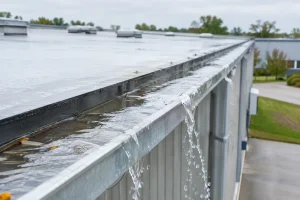



A roof that leaks above a critical plant room, teaching space or warehouse operation does not give an asset team the luxury of a theoretical debate. The decision between roof replacement vs remediation determines capital timing, business disruption, safety exposure and the credibility of the person signing off the spend.
The problem is that the recommendation often comes from a party that stands to deliver the work. A contractor may be technically competent and still have a commercial preference for a larger replacement scope or a short-term repair programme. Neither position is automatically wrong. But neither should be accepted without evidence.
For commercial asset owners, the right answer is not the cheapest immediate option or the most comprehensive-looking proposal. It is the scope that controls risk at a defensible whole-of-life cost.
Roof replacement vs remediation is an evidence decision
Remediation means targeted work intended to restore roof performance without replacing the entire roof system. It may include membrane repairs, seam or lap treatment, replacement of failed flashings, drainage corrections, local substrate repairs, penetration detailing, recoating, or carefully designed overlay works. It is not a synonym for applying a coating over every problem.
Replacement means removing and renewing some or all of the roof assembly. Depending on the system and condition, this can involve the waterproofing membrane only, the cladding, insulation, roof sheeting, flashings, drainage components, substrates and associated safety systems. A replacement is not always a full strip-down to structure, but it should be clearly defined.
The distinction matters because roofs fail in different ways. A membrane can be nearing the end of its useful life while the substrate remains serviceable. Conversely, a roof can look sound from above while concealed moisture, corroded decking, failed fixings or poor falls make a superficial repair programme poor value.
The question is not, “Can this roof be repaired?” Almost any roof can receive another repair. The question is whether remediation will restore reliable performance for a period that justifies the expenditure, risk and repeat access.
When remediation is the commercial choice
Remediation is often the stronger option where deterioration is isolated, the underlying roof build-up remains dry and stable, and recurring defects have a clear, correctable cause. A relatively young roof with failed penetration detailing, damaged laps from trade traffic or localised ponding does not necessarily need replacement.
It can also be appropriate where capital funding is scheduled for later years, provided the interim scope is designed as risk management rather than cosmetic patching. That requires a realistic service-life forecast, clear maintenance requirements and an understanding of what could disrupt operations before replacement occurs.
A well-scoped remediation programme can preserve capital, reduce operational disturbance and address defects before they spread into insulation, ceiling spaces, electrical services or occupied areas. On large facilities, targeted works may also allow staging around production, tenancy, patient care or teaching requirements.
However, remediation only works when the diagnosis is sound. Persistent leaks are frequently blamed on the visible membrane when the cause is blocked drainage, inadequate falls, incompatible materials, failed expansion joints, poorly detailed services penetrations or workmanship defects. Repairing the symptom simply creates a new invoice and delays the actual decision.
When replacement becomes the lower-risk spend
Replacement should be seriously considered when failures are widespread, water ingress is recurring across multiple zones, repairs are becoming routine, or the roof has reached the point where its remaining life cannot be predicted with confidence. The trigger is not age alone. Some roofs outlast expectations through good design and maintenance; others fail early because of detailing, installation quality, environment or access damage.
The case for replacement strengthens when investigations identify trapped moisture, degraded insulation, substrate corrosion, widespread membrane embrittlement, extensive fastener failure or structural and drainage deficiencies that cannot be resolved through isolated works. These conditions can convert a modest roof defect into a broader asset risk.
Replacement may also be the practical path when the building is being repositioned, expanded or upgraded. New rooftop plant, photovoltaic systems, changed occupancy requirements, fire compliance works or altered drainage demands can make a new roof system more rational than trying to preserve an arrangement that no longer suits the asset.
There is a hard commercial truth here: repeatedly funding reactive repairs is not maintenance planning. It is often deferred capital expenditure with growing operational risk attached.
The checks that should happen before either decision
A credible recommendation starts with inspection, not pricing. That means close review of representative roof areas, details, penetrations, drainage points, interfaces and internal signs of water entry. It also means reviewing roof history: previous repair records, leak locations, warranty information, original construction details, planned building works and known access issues.
For higher-value or more complex assets, targeted testing may be needed to establish what cannot be seen at surface level. Moisture investigation, trial openings, thermal assessment and substrate checks can help determine whether a roof is locally defective or broadly compromised. The testing method should suit the roof type and suspected failure mechanism. Generic testing does not create certainty.
The assessment should then separate facts from assumptions. A useful report identifies the defect, probable cause, affected extent, consequence of inaction, recommended scope, expected service-life outcome and the limitations of the assessment. Photographs without interpretation are not a strategy.
Before approving a major works proposal, decision-makers should be able to answer four questions:
- Is the proposed scope treating the root cause rather than the visible symptom?
- What evidence supports the stated extent of deterioration?
- What service life is realistically expected after the work is complete?
- What operational, safety and warranty risks remain if the work is delayed or reduced?
If the answers are vague, the scope is not ready for procurement.
Compare options on lifecycle cost, not tender total
The lowest tender price can be expensive when it produces another disruption event in two years. Equally, a full replacement can be poor capital discipline if the roof has a viable remediation pathway with ten or more years of predictable service ahead.
A proper comparison should account for direct construction cost, consultant and investigation fees, access requirements, temporary protection, internal damage exposure, tenant or operational disruption, maintenance demand, future replacement timing and warranty value. For a logistics facility, water entry can interrupt stock handling and damage inventory. For a hospital, it can affect critical spaces and infection-control arrangements. The roof cost is only one part of the exposure.
Programme is also a material consideration. Replacement may require larger work zones, longer access periods and more weather sensitivity. Remediation can sometimes be staged with less disruption, but it may involve repeated mobilisation and ongoing monitoring. Neither option is automatically easier. The building’s operations should shape the delivery strategy.
Do not let warranties decide the scope
A long warranty is not proof that a proposed solution is suitable. Warranties contain conditions, exclusions and maintenance obligations. They may not respond to pre-existing moisture, drainage defects, third-party damage, unapproved penetrations or interfaces outside the contractor’s scope.
The key question is whether the system design, preparation, detailing and quality assurance are sufficient for the roof’s actual condition and environment. A warranty should support a sound technical decision, not replace one.
This is where independent oversight has real value. Roof Inspection Australia does not sell roof repairs, replacement systems or products. That separation allows the assessment to focus on condition, evidence, risk and scope – not work volume.
Build a decision that holds up under scrutiny
For asset managers, the final recommendation needs to survive more than a site meeting. It may be challenged by finance teams, boards, insurers, tenants, government stakeholders or future buyers. A defensible recommendation explains why remediation is sufficient, why replacement is necessary, or why a staged approach provides the best control of risk.
Sometimes the correct answer is a hybrid: immediate remediation to stabilise active leaks and protect operations, followed by planned replacement in a defined capital cycle. That approach only works if the interim works are clearly limited, the residual risk is understood and the replacement date is treated as a commitment rather than a hopeful forecast.
Do not ask a roof contractor what they would like to install. Ask an independent specialist what the roof is telling you, what can genuinely be retained, and what failure will cost if you get the timing wrong. That is how a roof decision becomes an asset decision.